Bidspirit auction | Felipe Moratilla (1827–1908) – Portrait
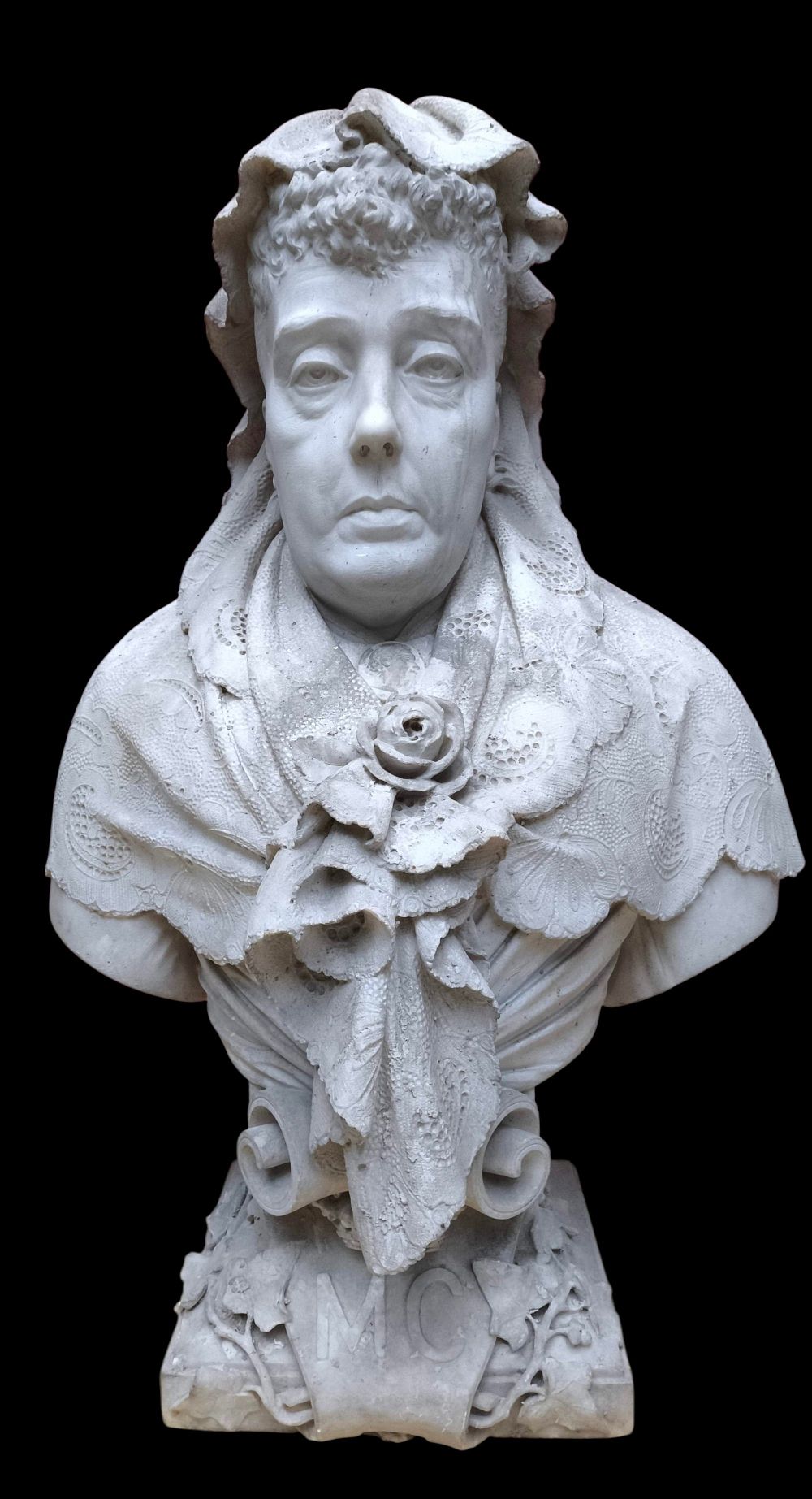
Felipe Moratilla (1827–1908) – Portrait of a Lady - A carved stone sculpture depicting the bust of a distinguished lady of advanced age, wearing a half-mantilla in the Spanish style. On the front of the base, the work bears the letters “M C” beneath a crown, likely the initials of the subject. Signed on the reverse of the plinth in capital letters: “F. MORATILLA”. Dimensions: 77 (height) x 54.5 (width) x 36 (depth) cm. We suggest that the lady in question may be María Cristina of Bourbon-Two Sicilies (Palermo, 27 April 1806 – Sainte-Adresse, 22 August 1878), Queen Consort of Spain following her marriage to King Ferdinand VII. The work is signed by the Spanish sculptor Felipe Moratilla Parreto (Madrid 1827 – Rome 1908), who had direct contact in Rome with this distinguished lady, as the artist received financial support from Queen María Cristina of Bourbon. In fact, in 1858 she acquired the Palazzo Mattei-Albani-Del Drago there, next to San Carlino alle Quattro Fontane, a masterpiece by Francesco Borromini, intended as a residence for her daughter Milagros, wife of Filippo Massimiliano del Drago. Felipe Moratilla was the son of Francisco Moratilla, goldsmith to Queen Isabella II of Spain. Felipe trained at the Royal Academy of Fine Arts of San Fernando in Madrid. He was awarded a scholarship to complete his artistic training in Rome from 1848 onwards, and also received financial support from Queen María Cristina of Bourbon, as we have noted. In 1882, the Spanish press reported on the achievements and career of this sculptor. From 1899 onwards, he played an active role in various World’s Fairs, such as the 1900 Paris Exposition, where he was involved in selecting candidates and works, amongst other events. Among his most notable works are: Nymph at the Fountain (1866, Madrid, Museo Nacional del Prado); The Three Infantes (1866, Rueil Malmaison, Paris), dedicated to the children of Queen María Cristina of Bourbon; Bust of the architect Narciso Pascual y Colomer (1874, Madrid, Real Academia de Bellas Artes de San Fernando); T heological Virtues (1876, Madrid, Prado Museum), a work awarded third prize at the National Fine Arts Exhibition of that year; Virtues (Santiago de Chile, cemetery) on the funerary monument to General Bulnes (1799–1866); The Neapolitan Fisherman (1877, Madrid, Prado Museum), awarded a second-class medal at the 1878 National Exhibition; Pantheon of the Spaniards (1880, Rome, Verano Monumental Cemetery); Callixtus III and Alexander VI (1881, Rome, Church of Santa María de Montserrat de los Españoles); Pan in the form of a Herma with Bacchus (1887, Madrid, Prado Museum); Portrait of Pope Leo XIII (Rome, Spanish Embassy to the Holy See); Sphinxes (1895, façade of the National Archaeological Museum, Madrid), amongst others.