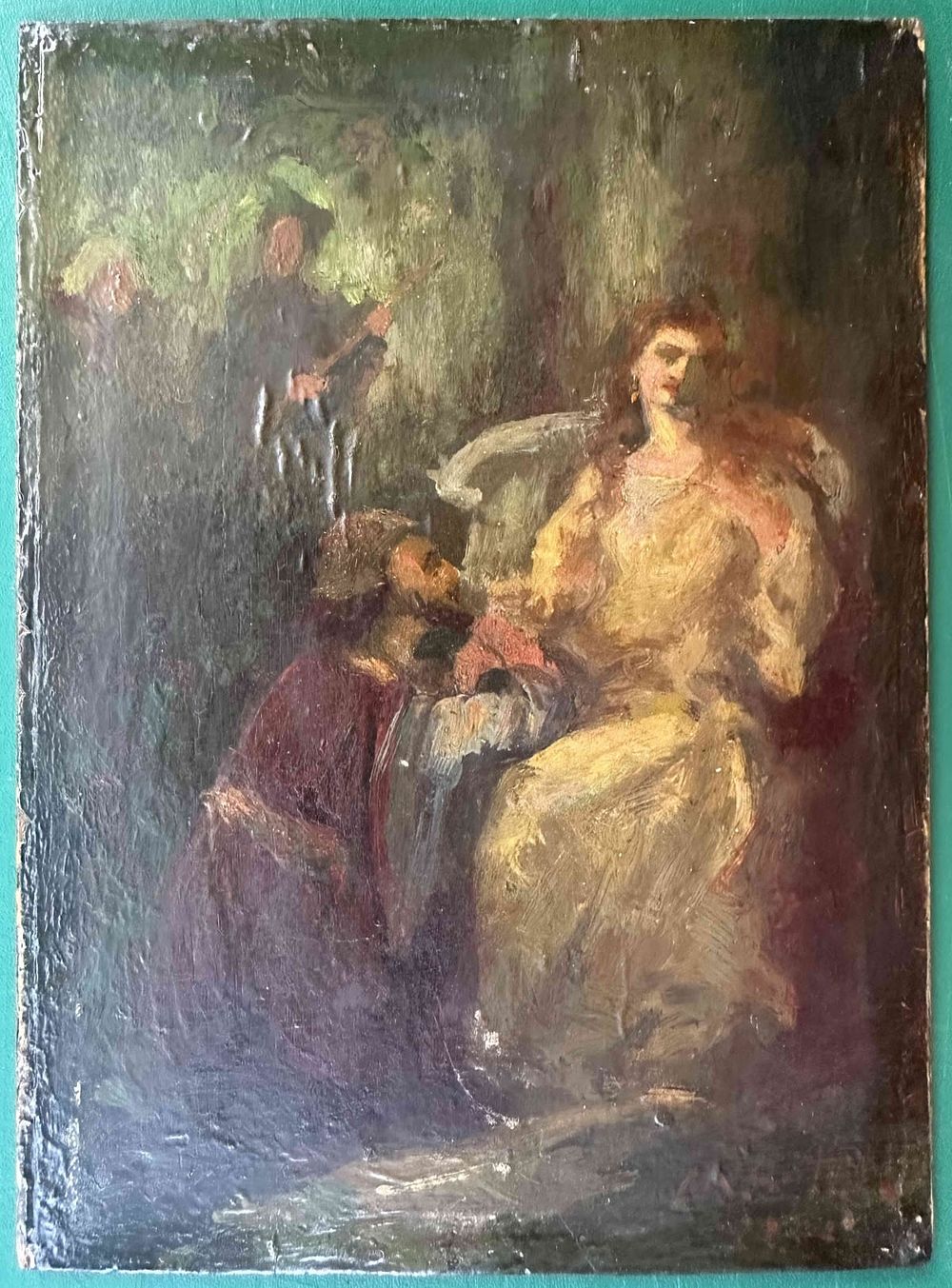
Bidspirit auction | Maurycy Gottlieb (Polish, 1856-1879) Lovers
Maurycy Gottlieb (Polish, 1856-1879) Lovers scene/biblical scene - The lovers (from Adam Mickiewicz's poem 'Chatti [The Ambush]'), or perhaps, Haman begging Esther for his life (from the biblical Scroll of Esther). Oil on panel. 18.5x13.5 cm. Signed and dated lower right m. Gottlieb / 1876. Source: Private collection, Israel. (The painting has been in their family collection since the 1960s, when it was purchased by the current owner's parents in London, UK). Condition: minor scuffs at bottom center and left; Sporadic color loss elsewhere. Note 1: The reverse bears a label with a typewritten research document and statement of authenticity, dated 1957, prepared by Dr. Kazimierz Buczkowski, a Polish art expert active around the mid-20th century. On the label it says (translated from Polish): assessment: Oil painting on board. Dimensions: height 18.5 cm, width 13.5 cm. She shows in the foreground, to the viewer's right, a young woman in a yellow dress sitting on a chair. The woman holds her left hand in her lap, with her right arm resting on the arm of the chair. A man dressed in Polish clothes is kneeling to the left. In the background, on the left, two figures are seen - one of them with a shotgun in his hands. The picture is signed lower right: from Gottlieb and in the corner 1876. assessment: The described drawing submitted to me for inspection by P. Tomeshevsky is, in my opinion, an original work by Morrissey Gottlieb (1879-1856), a sketch for a composition that, as far as I know, was not created, interesting despite some oddities due to some oddities. For her color values, which play such an important role in Morrissey Gottlieb's work. The artist took the subject for this work from Mikiewicz's ballad 'Chatti' (in the foreground a pair of lovers; in the background the betrayed Vived with a shotgun in his hand and a Cossack next to him). In my opinion the signature on the painting is beyond doubt, especially compared to the signatures in Gottlieb's catalog of unknown works, published in 1938. As confirmed by X-ray examination with a Hanau [UV?] lamp, the image shows only minor retouching. Krakow 28 IV 1957 Dr. Kazimierz Buczkowski [hand signed and ink stamp] Note 2: According to Buchakowski this work is a study for a painting that ultimately was not created by Gottlieb (perhaps, due to his death a few years later at a young age). Buczkowski identifies the image as based on a scene from the short ballad Chety: Ballade Ukrainska by Poland's national poet Adam Mickiewicz, considered the greatest poet in all of Polish literature. The ballad, whose title has been variously translated as 'Ambush: A Ukrainian Ballad', 'The Guards' or 'The Watchmen', can be dated to around 1828. It tells the story of a Vivada (military leader or governor) who caught his wife cheating. He takes with him a Cossack servant named Naum whom he orders to shoot the unfaithful woman while he himself shoots her lover. However, the Cossack avoids committing the crime and instead shoots his master. The ballad was translated into Russian by the famous Russian poet Alexander Pushkin. In 1890-91, the Russian composer Piotr Tchaikovsky published a symphonic ballad called 'The Viboda, Op. '78 based on Pushkin's translation. (For more information about Adam Mickiewicz see https://en.wikipedia.org/wiki/Adam_Mickiewicz. For an English translation of the ballad see https://literat-ug-edu-pl.translate.goog/amwiersz/0050. htm?_x_tr_sl= pl&_x_tr_tl=iw&_x_tr_hl=iw&am p;am p;am p;am p;am p;am p;_x_tr_pto=sc.) Note 3: Many contemporary observers of this work have commented that it may actually be ”biblical” in essence, when they present the banquet scene from the Scroll of Esther (7:7-8) in which Haman throws himself at Queen Esther's feet, begging her to save him from the wrath of King Ahasuerus: ”7 And the king got up in his anger from the feast of wine and went to the garden of the palace, and Haman stayed to beg for his life to Esther the queen, because he saw that evil had happened. Against him by the king 8 Then the king returned from the garden of the palace to the place of the wine banquet and Haman fell on the couch where Esther was.