Bidspirit auction | [LONDON; HANDEL, HAYDN; MOZART; BOCHSA;
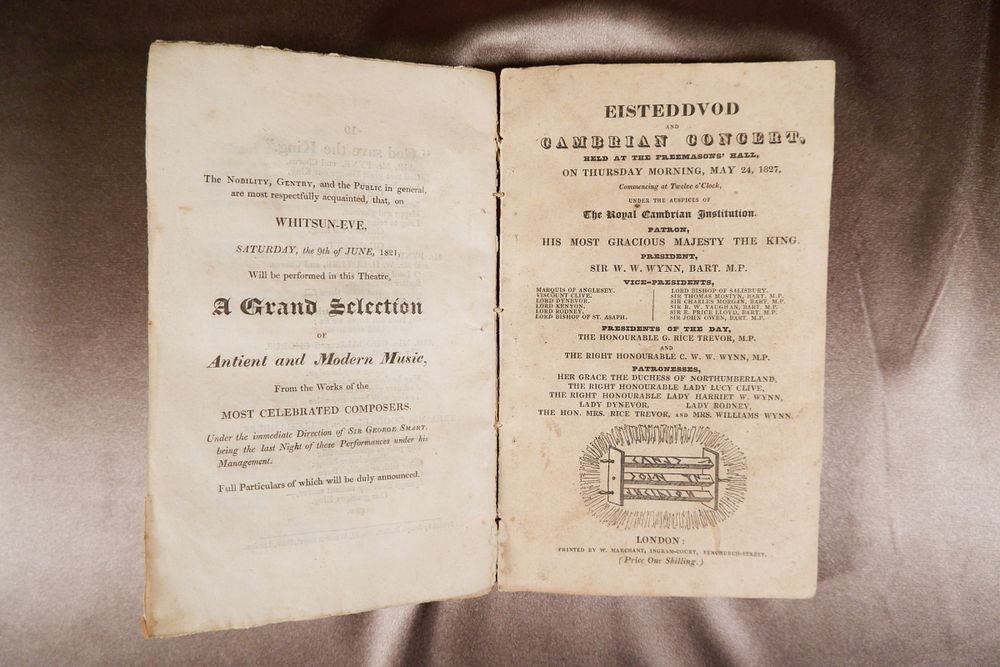
[LONDON; HANDEL, HAYDN; MOZART; BOCHSA; ROSSINI; FREEMASONRY; EISTEDDFOD; WALES] 11 PROGRAMMES FROM THEATRE ROYAL DRURY LANE, COVENT GARDEN, AND 1 FROM FREEMASONS' HALL. London. 1821; 1822; 1827. 19.5 cm x 11.5 cm. B. - A curious volume, apparently homemade, containing 12 programme sheets of musical works, eleven of which were performed at the Theatre Royal Drury Lane in 1821-1822, and one referring to a Welsh festival held at the Freemason's Hall in 1827. These booklets include the programmes for the performance of works by great composers such as Handel, Haydn, Mozart, Bochsa and Rossini, among others. They list the team responsible for the concerts and transcribe the vocal parts of the works in English and Italian. Some of these works were conducted by the great musician Sir George Thomas Smart (1776 - 1867), who was already beginning a career that, decades later, would elevate him to one of the most respected conductors in the UK. Smart became known for having maintained the tradition of regularly presenting the great music of George Frideric Handel, and was one of the main people responsible for keeping it alive over time. He was one of Ludwig van Beethoven's correspondents - whose works he helped make known in England, even conducting some of the great composer's pieces at the Theatre Royal Drury Lane - and a close friend of another great name in Western music: Carl Maria von Weber. These very rare documents that ANNO is now bringing to light testify quite clearly to the permanence of the taste for the music of the late Baroque and classicism until very late in the 19th century in England, and not a certain kind of revivalism. Somewhat different, for instance, from what the great composer and conductor Felix Mendelssohn did a few years later in Germany, in 1829, when he organised a concert of one of the most beautiful and complex compositions created by human genius: Johann Sebastian Bach's oratorio Matthäuspassion ( The St Matthew Passion ), today catalogued as BWV 244. The famous playwright and controversial figure Thomas Killigrew (1612 - 1683) built the first Drury Lane theatre in Covent Garden in 1663, with the permission of King Charles II, husband of Catherine of Braganza. This theatre was small, about the size of the current stage, and only lasted a short time as it burnt down in 1672. Killigrew's second theatre, opened in 1674, was much more successful, running for 117 consecutive years. The British National Anthem was sung for the first time on its stage in 1745, as was the famous patriotic song Rule, Britannia! in 1750. In 1794, the building was renovated to accommodate 3600 spectators, a considerable size for the time. However, just 15 years after the renovations, a new fire destroyed it for the second time. From 1812, in a beautiful project designed by the great architect Benjamin Dean Wyatt (1775-1852), the Theatre Royal Drury Lane took on its actual configuration. Between 2013 and 2021 it underwent extensive restoration work, keeping its heritage values intact. The Theatre Royal Drury is the oldest theatre in the world in continuous use on the same site and is listed as ‘Grade One’ by Historic England. The 1827 programme, bound about halfway through the volume, is a very rare leaflet from a traditional Welsh ‘Eisteddvof’ ( eisteddfod ) - a ritualised festival of Welsh culture with medieval roots and revived in the 18th century. This was under the auspices of The Royal Cambrian Institution, an institution promoting the culture and history of Cymru, which at the time was chaired by Sir Watkin Williams-Wynn (1772 - 1840), 5th Baronet. The institution had been founded in 1751 and was recovering its momentum after a difficult period, not only because the first generation of founders had passed away, but also because the Napoleonic Wars made all aspects of British life difficult. These concerts should be seen as reactivating this important London Welsh association, which would go down in history as The Honourable Society of Cymmrodorion, a name it still bears today. Sir Walter Scott was, for example, at this stage, and despite nearing the end of his life, a very active member of the endeavour of this ‘Second Cymmrodorion’, which was to be reborn. The fact that the concert was organised at Freemason's Hall may have been mere coincidence, but it could also be related to the origins of the institution itself, which arose from the break-up of the Honourable and Loyal Society of Antient Britons, a charitable organisation for Welsh families and children living in London, whose rituals seem to have been Masonic in inspiration. Some of its members, though few, were active freemasons, including the 4th Baronet of Wynn, who even founded a lodge on his estates, but relations between Welsh institutions and freemasonry were apparently ambiguous. These Welsh groups in London would thus remain almost a parallel freemasonry,