Bidspirit auction | [TANGRAM; CHINA] Xun Le Xuan
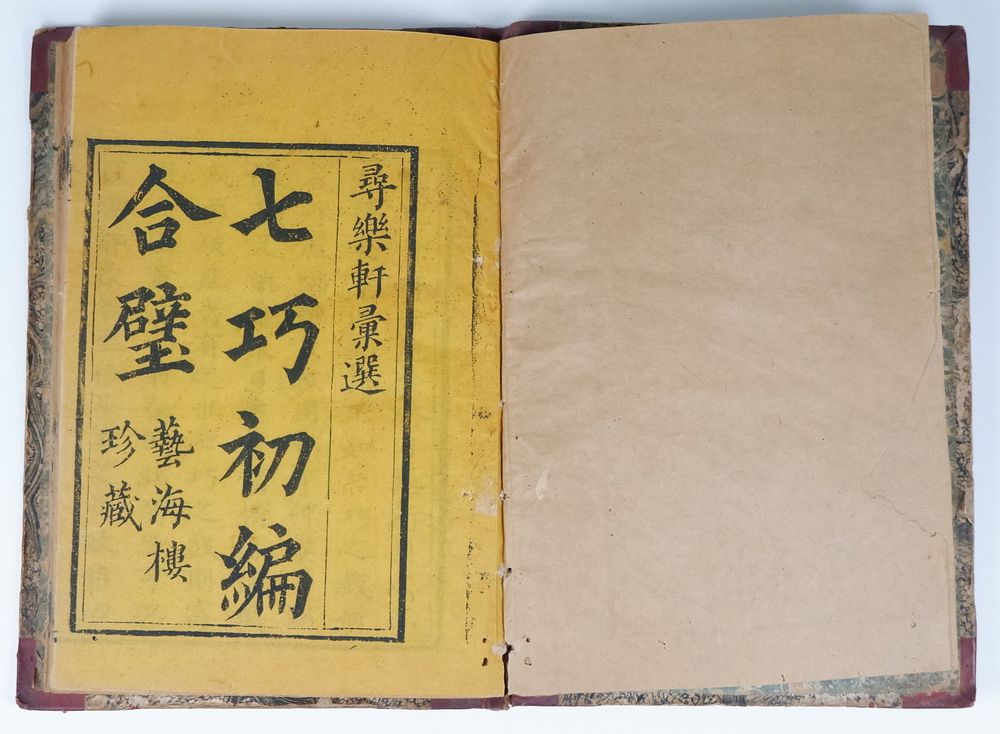
[TANGRAM; CHINA] Xun Le Xuan [尋樂軒] - FIRST EDITION OF THE COMBINED JADES OF QIQIAO. s.l. [China]. Deposited in the bookshop of Yi Hai Lou [藝海樓]. 2nd year of Daoguang [1822]. 80 pp. 19 cm x 11.2 cm. Bd. - A very unusual challenge book devoted to the famous Chinese puzzle tangram [七巧]. It opens with an introduction by a certain Master Puoman [破悶主人] (a pseudonym that is difficult to trace) on the first few pages (reading from the back), which paraphrases, for marketing purposes, the words of Confucius: “Confucius once said that it is healthy to play games.” In fact, in the Analects (Yang Huo [陽貨], 22), the following dialogue is recorded: The Master said: — It is difficult to deal with one who gorges himself with food all day long, without applying his mind to anything good! — And are there not game players and chess players? — Being one of those is still better than doing nothing. The text also traces the origins of the tangram to the Qiqiao Festival — the Festival of the Crafts of Supplication — and praises the superior qualities of the tangram when compared to games of chance, as it “increases one’s wisdom” and “no money is wasted when playing this game.” The second part of the book contains eighty pages of problems to solve, each accompanied by a corresponding caption. Tangram (qiqiao-ban [七巧板] = “seven pieces of skill”) is a game composed of seven fixed pieces that can be combined in various ways to create geometric figures, almost always imbued with some metaphorical or mystical significance. The challenges consist in following only the outer lines of a given silhouette, which the player attempts to reproduce by filling it in with the respective pieces. Although its origins are shrouded in mystery and may date back to the Song dynasty, it appears to have been invented in China towards the end of the 18th century, reaching the Western world shortly afterwards (the first book being printed in Paris in 1817). This particular copy is therefore very rare, as it states that it was written “in the second month of the year Daoguang rengwu, ” corresponding to the second year of Daoguang, or 1822 AD in the Gregorian calendar. The game was immensely popular among intellectuals and artists during the 19th century and, after a brief period of decline, enjoyed renewed popularity — especially among soldiers in the trenches of the Great War — before spreading throughout the world as one of the most challenging puzzles, suitable for a variety of educational, artistic, and leisure purposes, &c. Printed from woodblocks on rice paper; text in seven columns. As a curiosity, this book was later paginated at the top by a Western hand, certainly shortly after printing, in manuscript form and with Arabic numerals — but incorrectly, from front to back. Good general state of preservation. Simple yet careful 19th-century English-style binding with leather spine and rounded corners; some visible signs of handling. Slightly trimmed, affecting the outer margin, but not hindering legibility. The interior is very clean, on delicate rice paper; pages folded into bifolia. Small wormholes in two places and some in the inner margins and at the bottom of the initial pages (on the obverse), without affecting the printing. Puncture marks from the stitching of the original binding. Reading by 劉澤民 (Chak Man [Bernard] Lau) (@bernardlauhere).