Bidspirit auction | Baudelaire, Charles - LES FLEURS
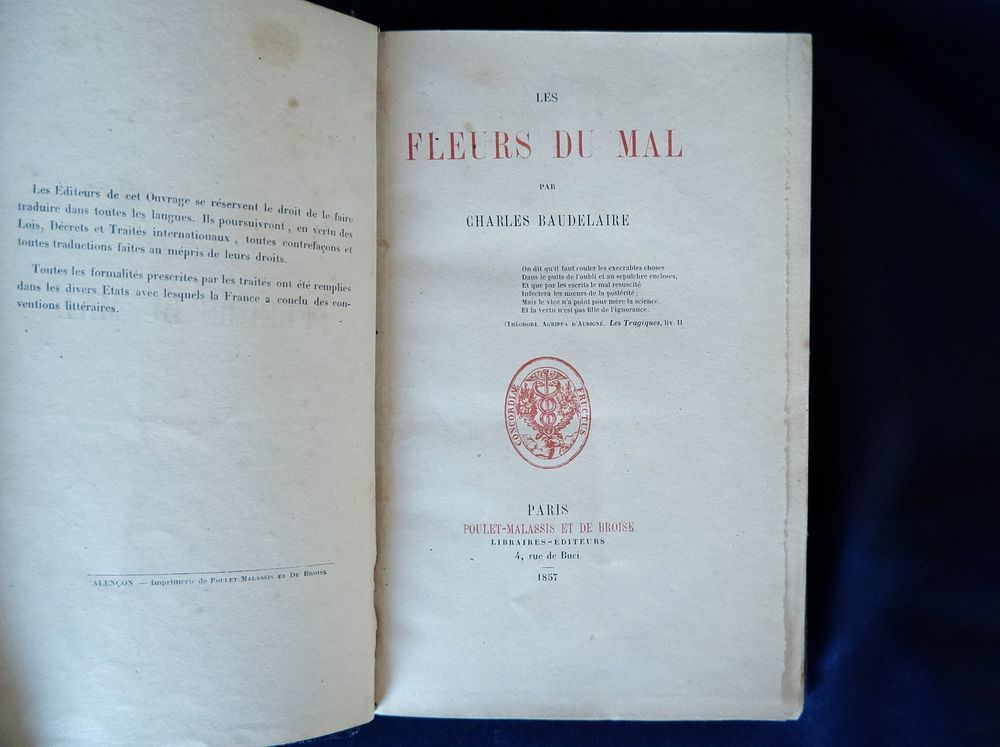
Baudelaire, Charles - LES FLEURS DU MAL. Paris. Poulet-Malassis et de Broise. 1857. 248 (4) pp. 18,7 cm x 12,2 cm. E em cx. - First edition, from a print run limited to only 1,300 copies, of what became one of the most influential poetry books in the Western canon. It includes the six poems later censored: “Les Bijoux, ” “Le Léthé, ” “À celle qui est trop gaie, ” “Lesbos, ” “Femmes damnées, ” and “Les Métamorphoses du vampire.” The censorship of these “scandalous” verses by the Tribunal de la Seine led to the seizure and mutilation of around 230 copies of this edition — this copy escaped the purge. This edition is identifiable by the following peculiarities: “Feurs” appears in the running head of pp. 31 and 108; p. 45 is mistakenly numbered as p. 44; and the last word of the first line on p. 201 is printed as “captieux” instead of “capiteux.” Les Fleurs du mal profoundly marked the history of modern Western poetry. Known until then chiefly as an art critic, Baudelaire aspired to leave a lasting literary legacy. From the 1840s onwards, he began composing poems of a dark and provocative tone, expressing his disenchantment with the banality and moral corruption of modern urban life. This first edition caused scandal and admiration in equal measure. A year later, the French State prosecuted the author and his publisher for “offence against public morality”, demanding the suppression of six poems deemed indecent — all of which this copy contains. Despite the censorship, the Tribunal de la Seine acknowledged the literary value of the work as a whole. The title was suggested to Baudelaire by his friend Hippolyte Babou, and it symbolises precisely that tension between the beautiful and the corrupt, between the purity of art and moral decay. The structure of the work, organised into sections such as “Spleen et Idéal, ” “Fleurs du mal, ” “Révolte, ” “Le Vin, ” and “La Mort, ” reflects the poet’s inner struggle between the desire for transcendence and the weight of melancholy, between sensual attraction and perdition. Poems such as “La Beauté, ” “Le Serpent qui danse, ” and “L’Invitation au voyage” reveal the constant contrast between ideal and abyss. Over time, new editions added further poems and consolidated the work as one of the most influential of the nineteenth century, embodying a poetic revolution that paralleled the artistic upheavals then sweeping through France and much of Europe. Its musical language, urban imagery, and fascination with decadent beauty made Les Fleurs du mal a turning point in Western poetry — a mirror of modernity and its contradictions. Provenance: According to the present owner, this copy belonged to the distinguished Brazilian psychoanalyst, writer, and poet Carlos Fernando Fortes de Almeida (Rio de Janeiro, 11 May 1936 – Rio de Janeiro, 6 October 2016). Better known as Fernando Fortes, he served as President of the Sociedade Brasileira de Psicanálise and was a prolific author of short stories, novels, plays, and poetry, receiving several literary awards. A well-connected figure within the artistic and cultural milieu of Rio de Janeiro, he associated with many of the foremost Brazilian artists and writers of the past century and the early years of this one. After his death, the copy passed into the hands of a reputed pianist and connoisseur of French literature and poetry, who brought it across the Atlantic. Good overall condition. Sound later half-amateur binding in a fitted case, very lightly handled. Top edge gilt. Does not retain the original wrappers. Interior generally clean, with only very occasional and faint foxing, slightly more noticeable on the opening and closing endpapers. Minute paper loss on the outer margin of the final leaf, likely caused during printing.