Bidspirit auction | Caietani, Thome de Vio [Tommaso
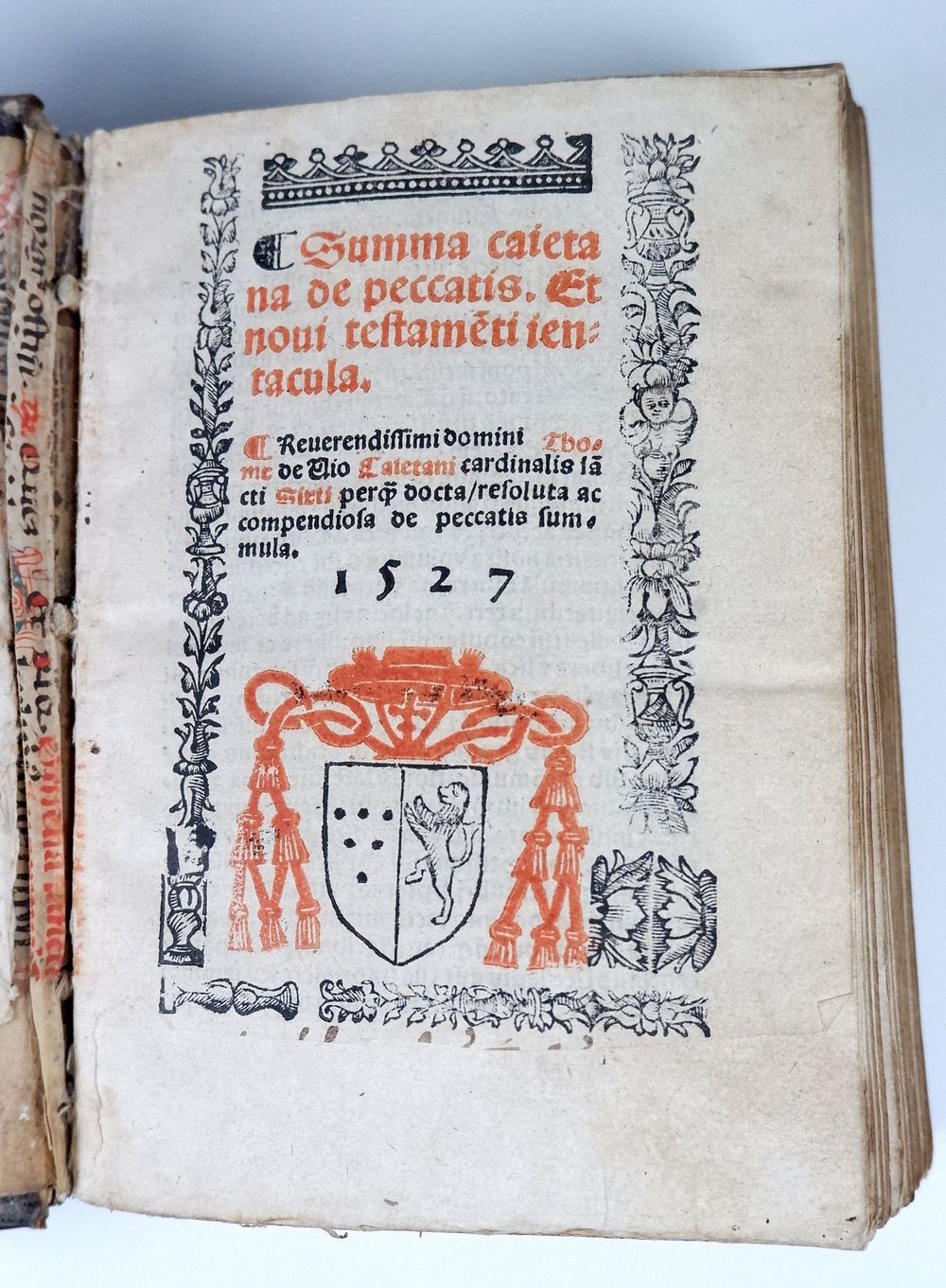
Caietani, Thome de Vio [Tommaso de Vio; Cajetan] – SUMMA CAIETANA DE PECCATIS. ET NOVI TESTAMETI IENTACULA. Lugduni. Antonij du Ry para Jacobi de Giunta. M.cccccxxvij [1527]. [10], ccciiij [1] ff. numbered. 14 × 9.6 cm. E. - Caietani, Thomae de Vio [Tommaso de Vio; Cajetan] – Summa Caietana de Peccatis. et Novi Testamenti Ientacula. Lugduni [Lyon]. Antonij du Ry [Antoine du Ry] for Jacobi de Giunta [Jacopo di Giunta; Jacques Giunta]. M.cccccxxvij [1527]. [10], ccciiij [1] ff. numbered. 14 × 9.6 cm. E. — Bound with: — Idem – Ientacula Novi Testamenti Cardinalis Sancti Sixti. Lugduni [Lyon]. Antonij du Ry [Antoine du Ry] for Jacobi de Giunta [Jacopo di Giunta; Jacques Giunta]. M.D.xxvij [1527]. cxxxi [1] ff. numbered. Celebrated “summula” printed during the lifetime of the cardinal titular of the Roman basilica of San Sisto, the Dominican Tommaso de Vio (1469–1534), known as Cajetan (Gaetano; Caetano; Cajetanus, etc.). He entered history as the scholar carried on the shoulders of the crowd after defeating Pico della Mirandola in debate at Ferrara; as the Dominican Master General; and, above all, as one of the very few clerics of the Roman Church who confronted Martin Luther fearlessly in person at the famous Diet of Augsburg (1518). Among many other events of historical importance, he was later one of the principal drafters of the papal bull Exsurge Domine (1520), which declared Luther a heretic should he not recant his propositions. De Vio also acted as the papal scribe for the renunciation of the annulment of the marriage between Henry VIII of England and Catherine of Aragon, and as one of the leading diplomats responsible for the election of Charles V as Holy Roman Emperor — an honour for which the latter rewarded him. A figure of major influence in the political and ecclesiastical affairs of early modern Europe, he exerted great authority in the Curia as counsellor and diplomat under Popes Julius II, Adrian VI, Leo X, and Clement VII. The two works here presented are treatises of moral theology, necessarily Thomistic, given the author’s standing: the first a compendium of various sins followed by commentary and explanation; the second a more strictly theological analysis, addressing several quaestiones concerning exegetical predicates contained in the New Testament. Both were printed by Antoine du Ry (active 1516–1533) for the distinguished Florentine bookseller Jacques Giunta (Jacopo di Giunta; 1486–1546), who played a central role in the development of Lyon’s book trade in the early sixteenth century. Giunta sponsored the printing of dozens of post-incunabular works and maintained book depots in several major European cities, including Lisbon (Baudrier, 1964, p. 78). Each volume bears his woodcut device after the colophon (ibid., p. 98), featuring the fleur-de-lis motif that highlights his Florentine origin, appearing also on the second title-page of the Summa. Both works indicate that they were revised by Joannes Danielis, otherwise little known beyond his title as Bachelor of Theology and as the reviser of nearly all of Cajetan’s publications — very likely his trusted friend. This Lyonese second edition of 1527 (the first, also issued by Giunta, was printed in Rome in 1525; a further Summa appeared at Cologne by Peter Quentel in 1526, and a Ientacula at Paris by Claude Chevallon the same year) is exceedingly rare, with very few copies held in public libraries worldwide, and not even listed by Baudrier in his catalogue of Giunta (1964, pp. 77–223). Judging by the number of early editions, these texts were well regarded and continued to be studied for centuries thereafter. As a curiosity, one may note a later version printed in Braga by António de Mariz (or de Maris) in 1566, edited by the Dominican friar Diogo do Rosário and published at the command of the celebrated Archbishop of Braga, Friar Bartolomeu dos Mártires — also a Dominican and recently canonised. This copy is enhanced by its inclusion of the Ientacula. The two volumes display high typographical quality, printed in a single column of 31 lines, on fine paper and with carefully composed title-pages bearing Cajetan’s arms and woodcut initials with floral decoration, in places already reflecting the fully developed iconographic grammar of the Renaissance. Condition: Good general state of preservation. Contemporary monastic binding, with intact metal clasps and subtle raised bands; covers decorated in blind on natural leather, with rectangular and diagonal geometric motifs within a phytomorphic border. Some handling wear and minor losses, chiefly at the head of the spine and two of the three bands. Spine slightly cracked at the joint between the two volumes. Endpapers formed of recycled leaves from a Gothic manuscript. Title-page of the Summa trimmed to remove an ownership inscription, nearly reaching the woodcut (which remains intact). Some early underlining and occasional marginalia. Interior exceptionally clean and complete.