Bidspirit auction | Saresberi[en]sis, Johãnis [Salisbury, John of]
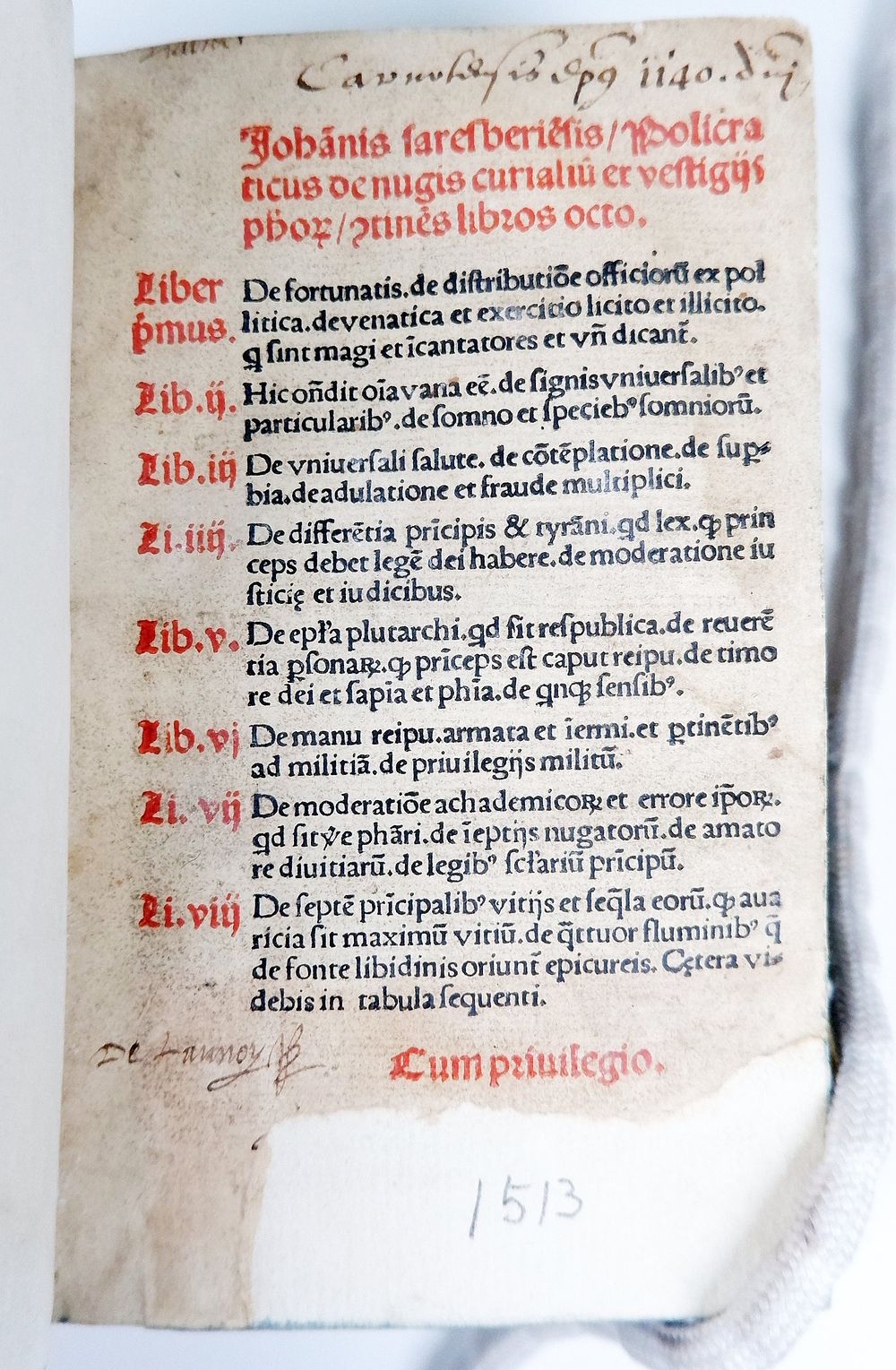
Saresberi[en]sis, Johãnis [Salisbury, John of] - POLICRATICUS DE NUGIS CURIALIU[M] ET VESTIGIJS PH[ILOSOPH]O[RUM], [PER]TINE[NTE]S LIBROS OCTO. [Lyon]. Constantin Fradin. 1513. [12] 375 fls. 15,5 cm x 9,5 cm. BD. - Colophon: Iohannis Saresberiensis Policraticus de nugis curialium & vestigiis philosophorum in octo partitus libros partiales: finitur. Curavit imprimi honestus vir Constantinus Fradin bibliopola Anno Dñi M.cccc.&.xiij. Extrema manus apposita fuit eodem anno xvij Kalendas Maii. Post-incunabular edition of what is considered the first great work of political theory of the Middle Ages, completed circa 1159. The Policraticus offers a pioneering reflection on power, law, and the morality of Christian governance. Divided into eight books, the treatise opens with a biting critique of the frivolities of court life — the nugae curialium — and develops into a philosophical and political construction in which the State is conceived as a living body, each class performing its function under the direction of the prince, the head of the social organism. John of Salisbury (c. 1115–20 – 1180), an English scholar educated in Paris and a witness to the assassination of Thomas Becket, argues in these pages that the true prince governs as a servant of the law and of the common good, distinguishing himself from the tyrant who rules for his own ends. The author goes further still, asserting — in both theological and legal terms — the legitimacy of tyrannicide, a bold and unprecedented notion for the twelfth century. Drawing upon both classical and Christian sources, the Policraticus fuses the legacies of Plato, Cicero, Roman law, and Christian moral doctrine, anticipating ideas that would shape Western political philosophy. It stands as a foundational text of medieval thought and one of the earliest systematic attempts to define the ethical limits of power. For this reason, several scholars trace the intellectual framework inaugurated by Salisbury to the origins of the Magna Carta, hearing its echoes in the arguments of the English barons before King John, or, later, in the pages of Thomas More’s Utopia. In this way — if one continues to follow the thread of the Fates — the Policraticus may ultimately be seen as contributing, by inheritance, to the formation of modern democratic systems. Good general condition. Later vellum binding; lacking ties. Slightly trimmed, with tinted edges and sprinkled fore-edge. Repair to the foot of the title-page due to paper loss. Interior generally very clean, printed on crisp paper, with occasional faint damp-staining. Some early underlining and contemporary marginalia.