Bidspirit auction | Cartari, Vincenzo; Pignoria, Lorenzo; and
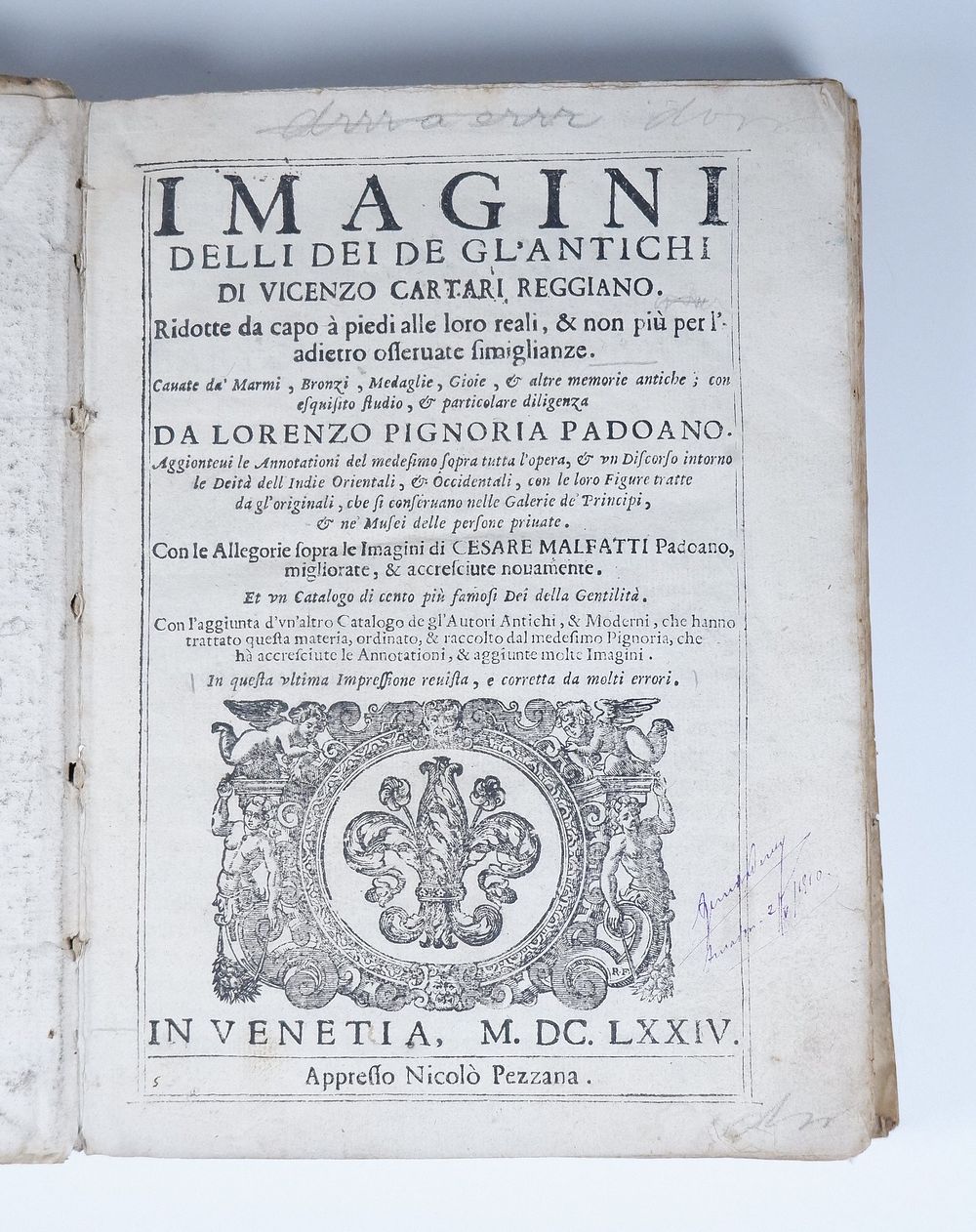
Cartari, Vincenzo; Pignoria, Lorenzo; and Malfatti, Cesare - IMAGINI DELLI DEI DE GL'ANTICHI DI VICENZO CARTARI REGGIANO, &c. Venetia. Nicolo Pezzana. 1674. (20) 368 pp. 22,8 cm x 16,5 cm. Bd. - “In questa vltima impressione reuista, e corretta da molti errori.” “In this latest edition, revised and corrected of many errors.” Important and rare late sixteenth-century edition of this celebrated and exquisitely illustrated Italian work on the deities of the ancient world, first published in 1556 (Venice, Marcolino). The second part includes deities of the Americas, notably from Mexico and other regions. A fine copy of Vincenzo Cartari’s iconographic encyclopaedia, richly illustrated. Revised and corrected in relation to the editions of 1626 and 1647, it includes splendid woodcuts depicting “more than a hundred” gods and goddesses “of the Gentiles”. The plates were engraved by Filippo Ferroverde under the direction of the Paduan scholar Lorenzo Pignoria. Cartari (c. 1531 – after 1571), a native of Reggio Emilia, was a mythographer and diplomat in the service of the Dukes of Este at Ferrara, and the distinguished author of the first modern translation of Ovid’s Fasti. He achieved great renown with these Imagini delli dei de gli Antichi, a handbook widely read and disseminated throughout the late Renaissance, and reissued more than twenty-five times in several languages. The first illustrated edition appeared in 1571; the version here offered, more elaborate, replaces the earlier woodcuts with new representations inspired by archaeological objects — cameos, medals, and reliefs — reflecting the growing interest in the study of materials from Antiquity at the dawn of scientific archaeology and the already advanced and well-cultivated knowledge of classical cultures. The appendices written by Pignoria, published between 1615 and 1624, reveal the collector’s spirit and the learned curiosity characteristic of the seventeenth century. They describe “true and real” images of the gods — sculptures, coins, and exotic objects — observed in various European collections. The most innovative section, Images of the Gods of the Indians, broadens the scope of the work to divinities of the entire world, constituting an early landmark in modern ethnographic studies. Pignoria analyses idols from Mexico and Peru, drawing on artefacts from the New World and illustrations from the Vatican Codex 3738, and also describes gods of India and Japan, such as Ganesha and Amida, based on accounts by Jesuit missionaries. He even establishes curious parallels between the religions of America, India, and Egypt, arguing that the newly discovered peoples modelled their idols on Egyptian images — an idea to which contemporary conspiracy theories still occasionally cling. Cartari’s aim was to offer artists a complete iconographic repertory of the deities, heroes, and allegories of classical Antiquity. The work, of rare erudition not only in content but also in the artistic composition of its vignettes and engravings, opens with an introduction on the origin of religion and the structure of the Universe, represented in a beautiful folding plate, and arranges the gods according to the cosmic forces they personify and the functions they perform, grouping lesser figures around the principal ones. Provenance: Library of Dr João Alberto Pereira de Azevedo Neves (Angra do Heroísmo, 12 May 1877 — Lisbon, 14 April 1955), pioneering forensic physician in Portugal, notable politician and man of letters whose memory remains cherished by all who knew him. In good general condition. Vellum binding in sound state, with an old catalogue number in pencil on the front cover. Lacking the front flyleaf. Catalogue vignette on the verso of the front cover, together with earlier pencil notations. Title-page with a small ownership signature dated 1910 in the lower right-hand corner, and an old pencil note at head. Clean interior on crisp paper, with occasional faint damp-staining at the top margin. Very rare and aesthetically remarkable. References: Brunet I, pp. 1600–1601 (not mentioned). Graesse II, p. 56. Sabin 11104, III, p. 270. USTC 1713536.