Bidspirit auction | [ESPANHA. OBRA PIONEIRA. APOCALIPSE. MILENARISMO.
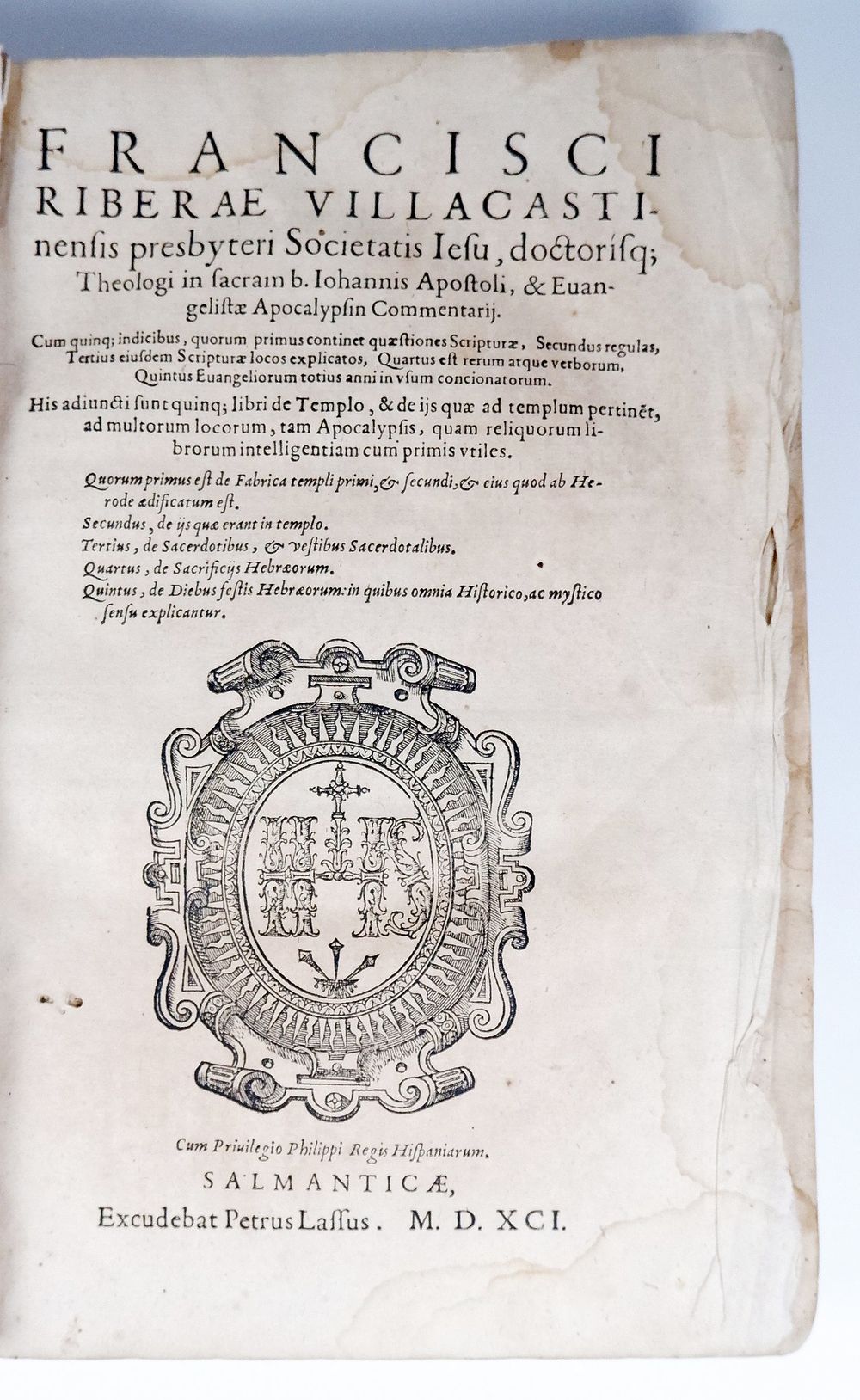
[ESPANHA. OBRA PIONEIRA. APOCALIPSE. MILENARISMO. RELIGIÃO] Riberae, Francisci (Francisco de Ribera) – THEOLOGI IN SACRAM B. JOHANNIS APOSTOLI. Salmaticae. Excudebat Petrus Lassus. 1591. (8) 333 (26) pp. 29 cm x 20,5 cm. Bd. - — Bound with: Riberae, Francisci – Libri di Templo. Salmanticae, Excudebat Petrus Lassus, 1591. [6] – 222 – [17] pp. 29 cm. E. “Cum completi fuerint milli anni renovabitur mundus a Deo et coelum complicabitur et terra mutabitur, transformabit Deus homines in similitudine angelorum. Tunc erit secunda resurrectio, in qua excitabuntur iniusti ad cruciatus sempiternos (…)” (p. 285). (When the thousand years are completed, the world shall be renewed by God; the heavens shall be folded up, and the earth shall be changed; God shall transform men into the likeness of angels. Then shall there be a second resurrection, in which the unjust shall rise to eternal torments…) First edition of this work, regarded by several scholars as a pioneering book of millenarian thought. Ribera’s work would go on to influence numerous later authors — among them Cornelius a Lapide and Father António Vieira — some of whom helped to disseminate this apocalyptic “prophecy” throughout Europe, with far-reaching and unexpected consequences. The following excerpt, from Professor António Vítor Sanches Ferreira Ribeiro’s article “O império de um profeta sereno: ensaio de decifração do pensamento do padre António Vieira”, illustrates the importance and intellectual context of Ribera’s book: “(…) Although it would later bear fruit mainly in the Protestant world, this prophetic typology seems to have originated in the writings of certain Jesuits. The Jesuit Francisco Ribera and his interpretation of the Apocalypse are identified as the starting point of this turn (…). Ribera’s continuator was another Jesuit, the Flemish Cornelius a Lapide. As he himself stated in his Inquisition proceedings, Cornelius was a fundamental source for Vieira regarding the interpretation of the Book of Revelation. Vieira cites him, in particular, on a point that seems to have greatly disturbed the inquisitors: the destruction of Rome, identified with the great harlot of Babylon (…) Parallel to the innovation introduced by Ribera and Cornelius, prophetic exegesis underwent an evolution in England. Around 1600, a circle of Hebraists was formed there to produce an ‘authorised version’ of the Old Testament. Through this process, English scholars gained access to Jewish exegesis of the Scriptures. From then on, the Jews came increasingly to be seen as essential to the fulfilment of prophecy (…)- Thus, English exegetes began to link the destruction of Rome to the conversion of the Hebrews. This prophesied fall of Rome is one of the overlooked aspects of Vieira’s trial, connecting him with an apocalyptic current of thought alien to the Portuguese context.” The second work, Libri di Templo, is a concise treatise on the origin of Solomon’s Temple, its rites, and related subjects. At both the beginning and end of the volume are two manuscript leaves in Latin, written in two inks (likely from the 16th century), bound in with the printed text. Condition: Bound volume comprising two works in one. Contemporary full vellum binding. The first work shows tears to leaves G7 and X5; the second, a tear affecting the text on leaf B3. Some oxidation and browning at the head margin, occasionally causing slight paper weakness (without loss of text). The remainder of the interior handled but in good general condition, with light uniform toning. Rare. Palau 266867.