Bidspirit auction | Vitoria, Fray Balthazar de; Baupitsta
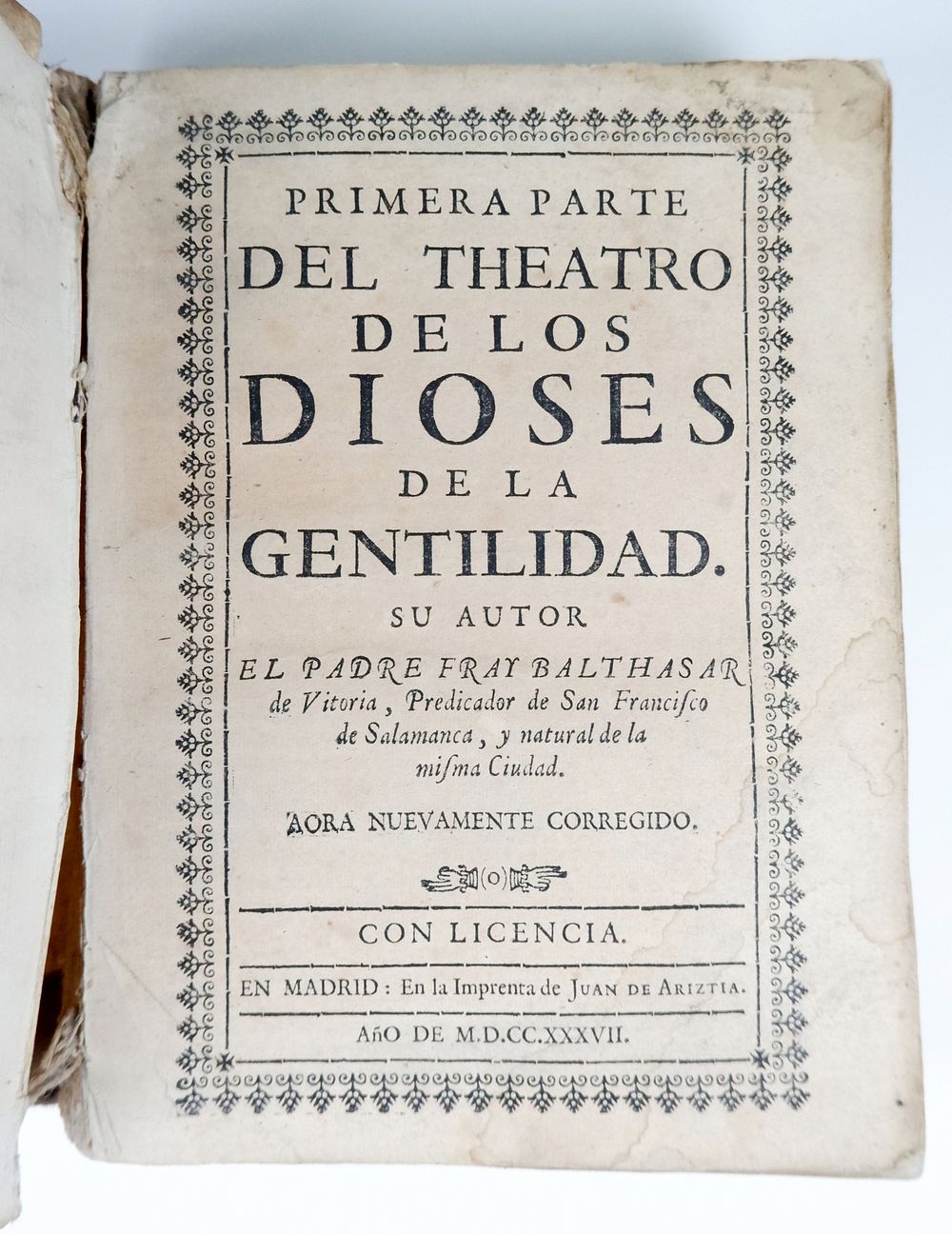
Vitoria, Fray Balthazar de; Baupitsta Aguilar, Juan (P. Fr.) – THEATRO DE LOS DIOSES DE LA GENTILIDAD. 3 vols. Madrid. Imprenta Juan de Ariztia. 1737-1738. (8) – 679 – (10) pp.; (4) – 590 – (6) pp.; (16) – 356 – (36) pp. 20,5 cm x 15,2 cm. Bd. - First, second, and third parts of this curious work by Fray Balthazar de Vitoria, completed by Juan Bautista de Aguilar. Essentially a treatise on the Greek and Roman deities, the work also serves as a literary compendium, containing citations from some of the finest Spanish and Portuguese authors — including Camões and Góngora — on mythological subjects. It further includes intriguing references to the Iberian Peninsula, aiming to connect the classical material with episodes set in Portugal and Spain. In the chapter on Neptune, we read: “El pez más notable que se ha visto en todos los mares es el que pareció en nuestra España, en la costa de Galicia, en el puerto de Carril (…) este año de mil seiscientos y diez y ocho (…). Este pescado disforme entró en la Ría de Arosa una noche (…) era una figura de lagarto y parece ser el que los mareantes llaman Marsopla (…) tenía de largo más de cuarenta varas, y la boca era de siete brazas de grande (…)” (“The most remarkable fish ever seen in all the seas was that which appeared in our Spain, on the coast of Galicia, in the port of Carril (…) in the year 1618 (…). This monstrous fish entered the Ría de Arosa one night (…) it had the form of a lizard and seemed to be that which sailors call the Marsopla (…) it was more than forty varas in length, and its mouth seven brazas wide (…).”) When discussing the location of the Elysian Fields, after considering Brittany and the Canary Islands, the author suggests another possibility: “…aonde el río Tajo (…) se mete en el mar, à la mano derecha, de los quales tomaron el nombre de la ciudad Elisipolis, ó Olisipo, que es Lisboa (…) y la tierra à mano izquierda del río Tajo por estar enfrente de los Campos Elisios, se llamó Anlisia ó Andalucia (…)” (“…where the River Tagus enters the sea, on the right-hand side, from which the city took the name Elisipolis or Olisipo, that is, Lisbon (…) and the land to the left of the River Tagus, being opposite the Elysian Fields, was called Anlisia or Andalusia (…).”) There are also mentions of the River Lima and the myth of the River Lethe, along with other Iberian mythological themes, making this an especially interesting blend of classical erudition and regional imagination. Condition: Bound copies. Contemporary vellum bindings. The interior of the first volume bears an old manuscript note and an ink stain on p. 245 (affecting the text but not rendering it illegible), with small tears to the margins of pp. 193–194 and pp. 563–564, not affecting the reading. Paper shows some oxidation. The volume is slightly loose in its binding (one sewing detached). The second volume has a marginal tear on pp. 573–574, not affecting the text. The third volume is in good overall condition, though with some age-toning to the paper. Uncommon.