Bidspirit auction | Sue, Eugène – LE JUIF
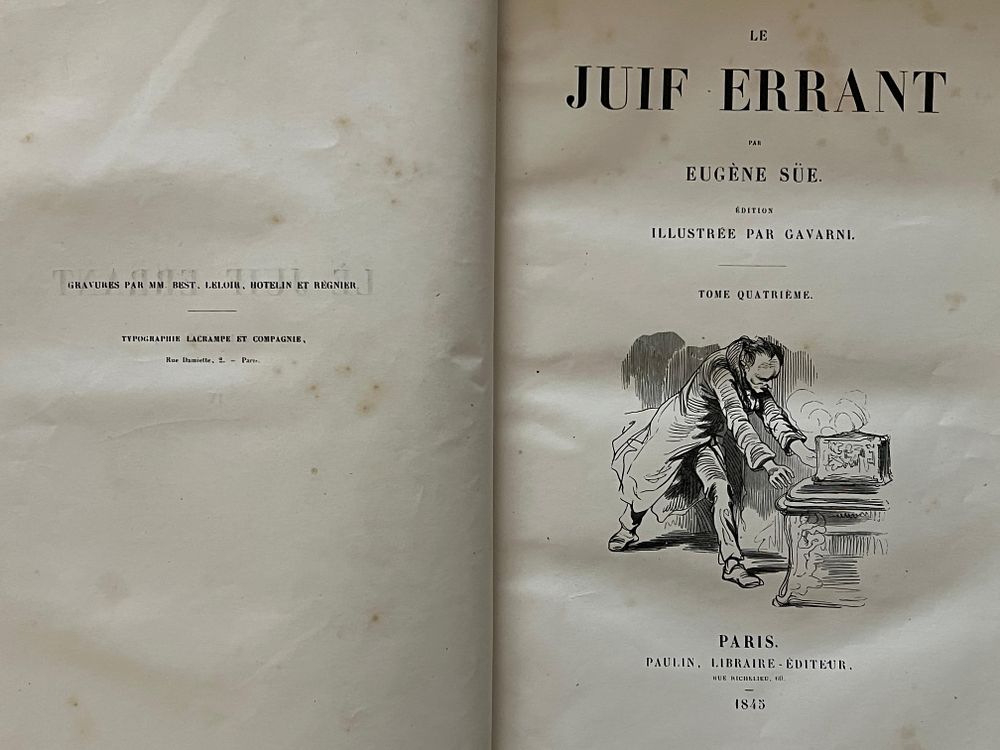
Sue, Eugène – LE JUIF ERRANT. ÉDITION ILLUSTRÉE PAR GAVARNI. Paris. Paulin, Libraire-Éditeur. 1845. 4 volumes. Vol. I: (6) 331 pp.; Vol. II: (6) 332 pp.; Vol. III: (6) 327 pp.; Vol. IV: (6) 352 pp. 27,0 cm x 19,0 cm. Bd. - First edition, illustrated edition, complete and of exceptional rarity, of the most celebrated serial novel by Eugène Sue, ornamented with eighty-three hors-texte plates and approximately six hundred intercalary vignettes engraved in wood by the master of satirical drawing Paul Gavarni, as well as a hand-colored folding map representing the itinerary of cholera morbus. This edition by Paulin, published in the same year in which the serialization of the novel in the newspaper Le Constitutionnel was concluded, represents one of the most ambitious editorial projects of French Romanticism and constitutes, according to bibliographers, one of Gavarni's finest graphic productions. Le Juif Errant was originally published in serial form in the newspaper Le Constitutionnel between June 25, 1844 and August 26, 1845, a period during which it captivated millions of French readers with the story of the Wandering Jew Ahasuerus and his sister Herodias, condemned to wander the Earth until the end of time, and the vicissitudes of a Protestant family whose inheritance, coveted by the Company of Jesus, becomes the object of intricate machinations. The novel constituted a violent libel against the Jesuits, reflecting the anticlerical tensions that agitated the France of Louis Philippe, and achieved unprecedented commercial success, generating pirated editions, translations and theatrical adaptations throughout Europe. Eugène Sue, born Marie-Joseph Sue in 1804, son of a celebrated Parisian surgeon, began his literary career as an author of maritime novels, having served as a physician in the French Navy. It was with Les Mystères de Paris, published in serial form between 1842 and 1843, that Sue achieved fame, popularizing the genre of the social serial novel in France and establishing himself as chronicler of urban miseries and defender of the disinherited. Le Juif Errant consolidated his position as one of the most widely read novelists of the nineteenth century, although literary criticism of his time and afterward was often severe regarding the artistic value of his works, accusing them of being melodramatic and excessively didactic. The present illustrated edition, launched by Paulin in 1845 to capitalize on the extraordinary success of the serial, entrusted Paul Gavarni with the task of giving visual form to Sue's universe. Gavarni, pseudonym of Sulpice Guillaume Chevalier, born in 1804 (the same year as Sue), was already then one of the most reputed French illustrators, celebrated for his satirical lithographs published in magazines such as Le Charivari and for his albums of Parisian customs. The collaboration on Le Juif Errant represented one of the most extensive book illustration projects of his career, producing eighty-three hors-texte compositions and approximately six hundred vignettes, decorated initials, chapter heads and tails that punctuate the text. The engravings, executed in wood by some of the finest xylographers of the period following Gavarni's drawings, capture with notable dramatic efficacy the melodramatic scenes and archetypal characters of the novel: sinister Jesuits, suffering heroines, Machiavellian villains and the Wandering Jew himself in his tragic majesty. A particularly notable element of this edition is the folding map included in the third volume, titled ”Itinéraire du Choléra-Morbus pestilentiel” or ”Marche progressive du Choléra Morbus en Asie et en Europe depuis 1817 jusqu'en 1832,” engraved and hand-colored. This map, which documents the geographical progression of the cholera pandemic that devastated Europe and Asia in the 1820s and 1830s, appears in the novel as a crucial narrative element, for Sue integrated the cholera epidemic into the plot, making it serve the fateful designs that pursue the characters. The presence of this map, frequently missing in surviving copies, attests to the completeness of the present set. Bibliographers are unanimous in affirming that Le Juif Errant in Paulin's illustrated edition is a work rare in good condition. The reasons are multiple: the popularity of the novel led to intensive use of the volumes, which circulated from hand to hand; the paper, although of good quality, was susceptible to foxing and acidification; the bindings, frequently economical, did not resist handling; and many copies were dismembered to extract the engravings, sold separately. Complete sets of the four volumes, with all the plates and the map, are today objects eagerly sought after by collectors of French Romantic literature and nineteenth-century illustration. The present set, complete in its four volumes, presents period binding in half leather over boards covered with decorated paper, probably executed shortly after publication. The spines, smooth,