Bidspirit auction | Morais Sarmento, Inácio Pizarro de
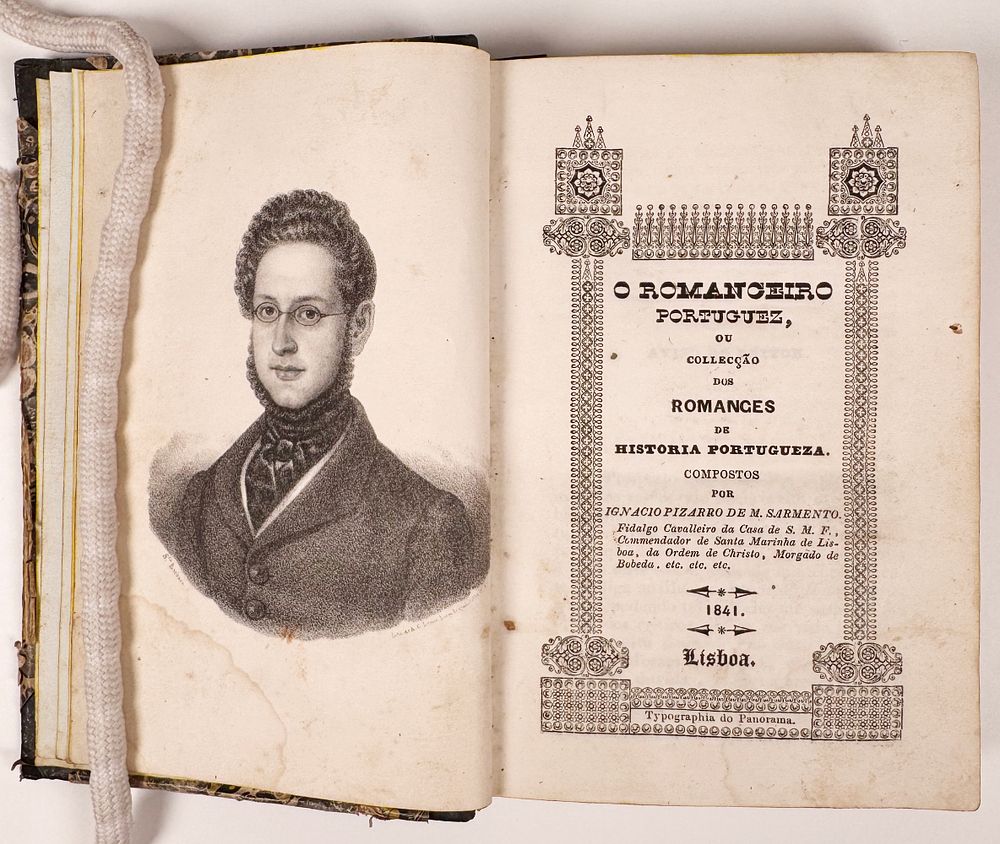
Morais Sarmento, Inácio Pizarro de — O ROMANCEIRO PORTUGUES. OU COLLECÇAÕ DOS ROMANCES DE HISTORIA PORTUGUEZA [First Half and Second Half]. Lisbon / Oporto. Typographia do Panorama / Typographia Commercial. 1841 and 1845. 2 vols.: viii, [ii], 270, [vi]; vi, [ii], 260, [xxiv] pp. 16.0 × 11.0 cm. E. - First complete edition of both volumes of this fundamental work of Portuguese Romanticism. The First Part, Lisbon, 1841, contains seven verse romances on scenes from Portuguese history — among them ”Frei Luís de Sousa” (pp. 217–238), in 38 octaves of heroic decasyllables, which was, according to Camilo Castelo Branco, the direct source of Garrett's celebrated drama of the same name, written in 1843 and first performed in 1844. The Second Part, Oporto, 1845, is even rarer than the first: the BNP and the General Library of the University of Coimbra hold no catalogued copy, and its print run was little more than 700 copies, of which 676 were reserved by subscribers. The author drew on the chronicles of Fernão Lopes and Duarte Nunes de Leão, on the História de S. Domingos by Frei António da Encarnação, on the História Genealógica, and on other sources, transcribing some of them in part or in their entirety, in a synthesis that fuses historical erudition with the Romantic enthusiasm of his generation. Inácio Pizarro de Morais Sarmento (Bóbeda, Chaves, 1807 – Chaves, 1870), Morgado de Bóbeda, was a poet, playwright, and deputy to the Cortes. Innocêncio III, 214–215, X, 56, and XI, 267. Camilo Castelo Branco, ”Esboços de Apreciações Literárias”, 3rd edition, Lisbon, 1908, pp. 241–249. Illustrated hors-texte with a portrait of the author, drawn by Santa Bárbara and printed at the lithography of A. C. Lemos, and with engravings in both volumes — those in the first drawn by Cerqueira and lithographed by A. C. Lemos; those in the second drawn and lithographed by J. A. Correia and printed at the lithography of Manuel Luiz da Costa. Different bindings in each volume, both contemporary, with leather spines and gilt tooling. Edges of the first volume painted yellow and lightly crimson-stained in the second.