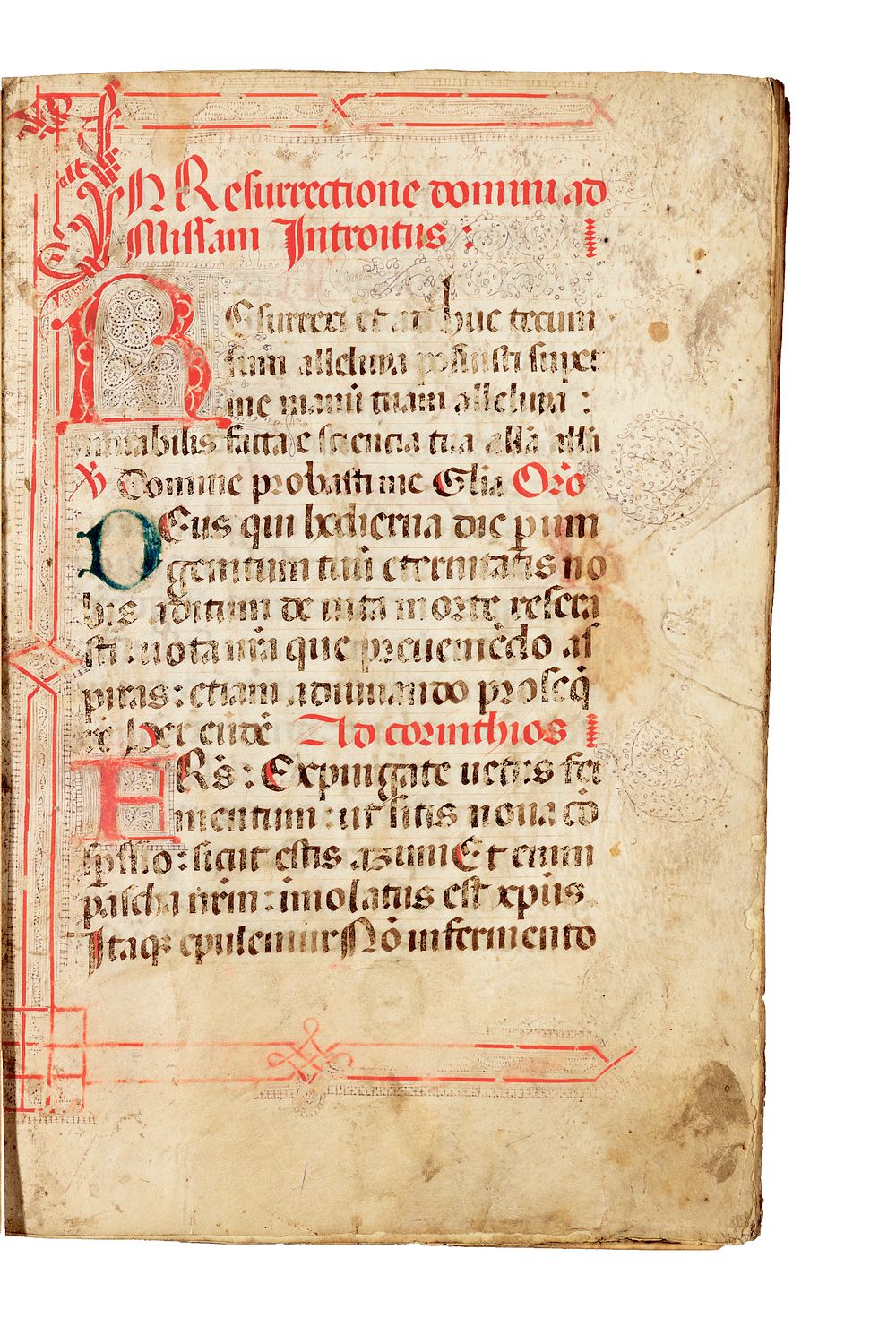
Bidspirit auction | ORDINARY FOR THE DIVINE OFFICE
ORDINARY FOR THE DIVINE OFFICE OF THE ORDER OF AVIS. Manuscript on vellum. Portugal. Dated 1303. 22 leaves, numbered I to XXII. c. 300 mm x 200 mm. E. - THE OLDEST KNOWN DOCUMENT OF ITS KIND RELATING TO THE ORDER OF AVIS, THE OLDEST PORTUGUESE MILITARY ORDER. Produced at the dawn of the fourteenth century, this ”treasure in vellum” — in the words of Professor Saul António Gomes, who devoted a monographic study to it — is the earliest known testimony of the liturgy followed by the priests and knights of Avis, the ”warrior monks” who, under the observance of Cîteaux and the spiritual dependence of Calatrava, played a leading role in the Reconquista and the affirmation of the Kingdom of Portugal. The ordinary set out the order of the Divine Office throughout the liturgical year, allowing us today to reconstruct the ways in which the Order partook of the unity of the Church of Rome in medieval times. Its singularity within the national panorama is unequivocal. Saul António Gomes writes: ”we are faced with a manuscript unique within the history of the Military Religious Orders in Portugal in medieval times. Unique in its content, and unique given its absolute rarity and antiquity. A manuscript, therefore, of exceptional patrimonial and historical importance.” Dr Maria de Belém Roseira, Counsellor of the Ancient Military Orders, sums it up as ”a singular piece of the History of Portugal.” The historical significance of the document extends beyond the liturgical sphere. The Order of Avis is inseparably bound to the nation's destiny: it was its Master, D. João, whom the Cortes of Coimbra acclaimed King of Portugal in 1385, founding the House of Avis — the house of D. Duarte, of Prince Henry the Navigator, and of the princes who opened the age of discovery to the world. This codex, predating that founding moment by eight decades, documents the spiritual life of the institution at its height, at the beginning of the fourteenth century, when the friars of Avis, led by Master Fr. Fernão Rodrigues, were negotiating with the Supreme Pontiff for the renewal of their habits and observances. Furthermore, the codex retains a continuous and documented line of provenance — a rarity among medieval Portuguese manuscripts in private hands. Kept in the library of a house of the Order, it was still being annotated there in the seventeenth and eighteenth centuries, when a seventeenth-century hand drew a knight of Avis on the frontispiece and copied the colophon from the final folio, since lost; it subsequently passed into the possession of Eduardo Augusto Xavier da Cunha, himself a Commander of the Order of Avis, remaining within his descendants until its incorporation into the present-day collection of Dr António da Silva-Araújo. The frontispiece drawing, though faded, merits note: it depicts a mounted knight with sword raised, accompanied, it would seem, by two severed heads — a composition which Dr Marta Alexandre, Director of the Interpretative Centre of the Order of Avis, identified, when presenting the above-mentioned study, as the figure of Giraldo, ”the Fearless”, conqueror of Évora in 1165, a protagonist of that city's coat of arms and a figure regarded by the friars as the founder — albeit not in fact — of the Militia of Évora. The latter is documented only from 1176, three years after Giraldo's death, having settled in Avis after 1211 — so that the drawing stands as a retrospective evocation of the legendary founding hero of the city, whose military exploits were held, after the taste of seventeenth-century historiography, to have given rise to the Militia, rather than as a mere portrait of a friar of Avis. The drawing thus testifies that, by the seventeenth century, the codex was already being kept with reverence, as a repository of the Order's identity and memory, rather than as a working book. Medieval manuscripts of this nature have become exceedingly rare on the international market, progressively absorbed by public and private institutions that remove them permanently from trade. In Portugal, comparable specimens — charters, books of hours, medieval liturgical codices — have all but disappeared from catalogues since the middle of the last century. No other medieval ordinary of a Portuguese military order is known to survive in private hands, and none remains in the Iberian Peninsula of comparable antiquity. Liturgical manuscript on vellum, apparently of sheepskin, c. 300 mm × 200 mm, 22 leaves with Roman numeration (I–XXII) at the centre of the head margin, apparently sixteenth-century numeration, recalling that found in the Manueline charters of the first third of the sixteenth century. Four gatherings survive — a quaternion (fols. I–VIIIv), a ternion (fols. IX–XIVv) and two binions (fols. XV–XVIII and XIX–XXI, the latter incomplete) — with leaves missing between the second and third gatherings. Gothic script in dark brown ink, in a single ruled column; rubrics in red; filigree initials in red and blue;