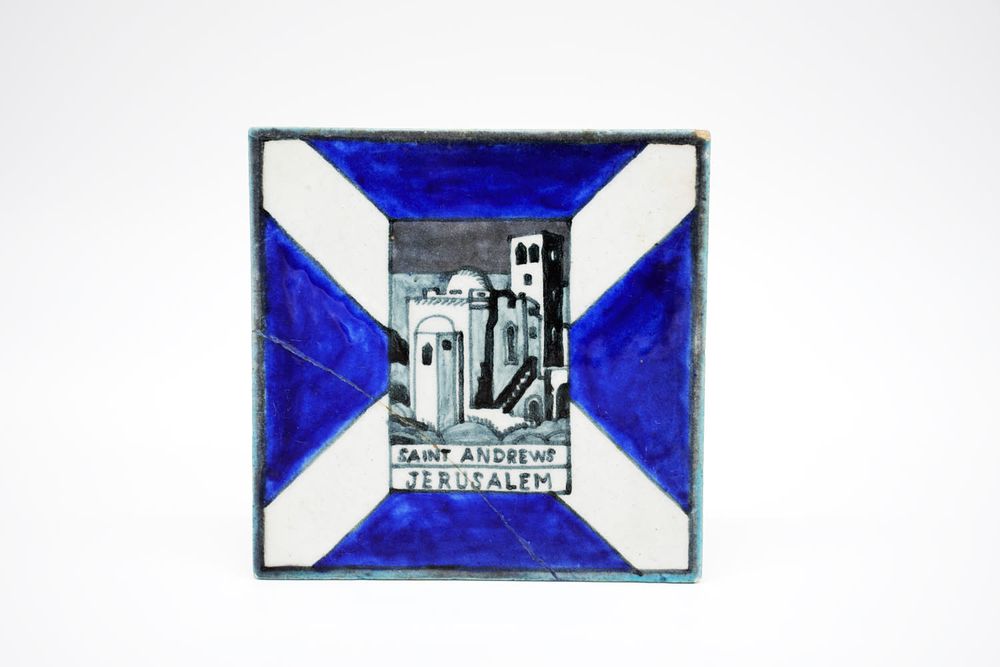
Bidspirit auction | armenian pottery glazed tile, 1920s
armenian pottery glazed tile, 1920s - A highly rare tile from the joint workshop — unsigned, though its material, glaze, and subject matter attest unequivocally to its origin. The tile was brought to England by a British soldier upon his return home after the war, and came to us through members of his family. The tile bears the flag of Scotland, at its centre a depiction of the Scottish church ”St. Andrews” and the inscription ”Saint Andrews, Jerusalem.” Before us stands a piece of genuine historical and artistic rarity. While one section was broken and has been professionally restored, the character and integrity of the tile are fully preserved. The decision to establish the church was taken as early as 1917 by the two principal ecclesiastical bodies then active in Scotland: The United Free Church and The Church of Scotland. The church was designed by Clifford Holliday, one of the most distinguished planners and architects of Jerusalem during the British Mandate period. The architect Zoltán Sámson Harmat, who worked in Holliday's office and later became a noted architect in his own right, also participated in the design. The church was built upon the hill facing Mount Zion, to the west of what is today the Cinematheque, and was constructed between 1927 and 1930. It is named after Scotland's patron saint, Andrew the Apostle — one of the twelve disciples of Jesus and brother of Peter, who was by trade a fisherman. The church is dedicated to the fallen of the 52nd Division, the majority of them Scottish soldiers who lost their lives during the British conquest of the Land of Israel and Jerusalem. The foundation stone was laid by General Edmund Allenby in 1927. The chosen site commanded a relatively elevated position affording a direct line of sight to the Old City, and lay in close proximity to the railway station. The land had belonged, since the Ottoman period, to the Anglican Church.