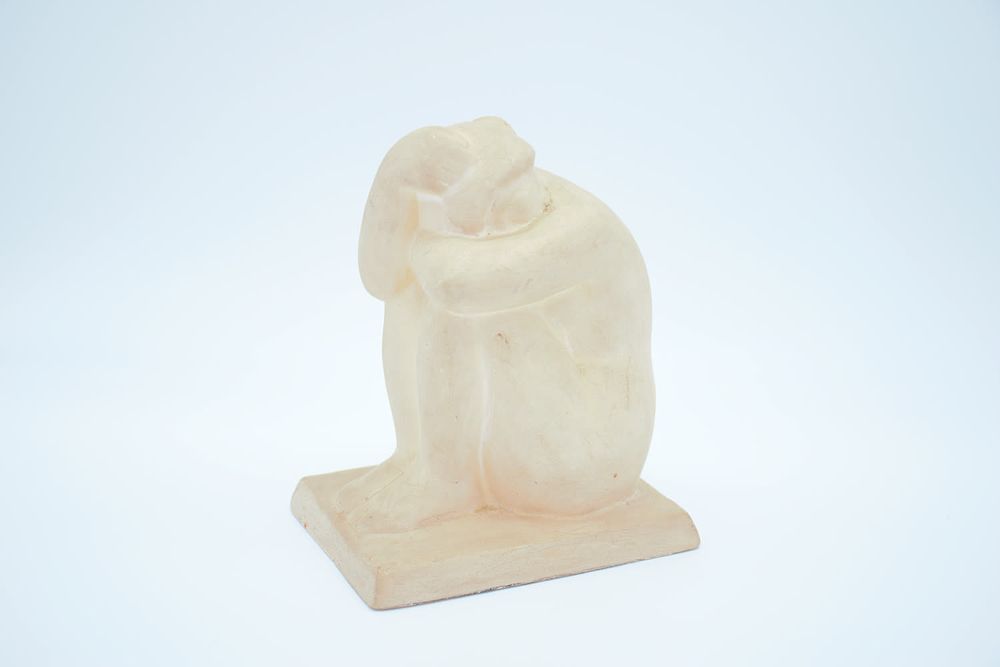
Bidspirit auction | Moshe Ziffer, Seated Woman, ceramic,
Moshe Ziffer, Seated Woman, ceramic, 1930s–1940s - A ceramic sculpture by the artist Moshe Ziffer depicting a seated female nude. Signed in English. Moshe Ziffer (24 April 1902 – 9 April 1989) was an Israeli sculptor, and an honorary citizen of both Tel Aviv and Safed. Ziffer was a pivotal figure in Israeli sculpture, particularly during the 1950s. His work was characterised by a gentle and conservative modernism that dominated Israeli sculpture of the period, leaving its mark on numerous statues and monuments. Ziffer worked in stone, wood, and bronze. Moshe Ziffer was born to Hanna and Menachem Mendel in Przemyśl, Galicia, then under Austro-Hungarian rule (present-day Poland). His father was a builder, as were many in the family, and possessed considerable artistic talent. Ziffer studied at a Polish gymnasium, though at home he was raised in the spirit of Zionism, and began studying Hebrew at the age of six. In his youth he was a member of the Hashomer Hatzair youth movement, and later underwent training through the Hehalutz organisation. In preparation for manual labour in the Land of Israel, he spent three months learning the craft of carpentry. At the age of seventeen he left his family home and moved to Odessa, where he joined an organised voyage aboard the ship ”Ruslan, ” which departed from the port of Odessa and arrived at the port of Jaffa on 19 December 1919 — marking the beginning of the Third Aliyah. In 1924, Ziffer joined members of Hashomer Hatzair who were founding Kibbutz Beit Alfa. One day, the donkey he was riding stumbled and threw him to the ground. During his hospitalisation over several weeks, he occupied himself by reading books on art, which rekindled the artistic instinct that had been dormant within him since his early youth. He began to carve wood, and resolved to travel to Vienna to convalesce, visit his family who had remained in Galicia, and study the art of sculpture. Before his departure he ascended to Jerusalem and visited Boris Schatz at the Bezalel School of Arts and Crafts. He spent a fortnight in the studio of the sculptor Abraham Melnikov, assisting in the casting of the work ”The Woman of the 20th Century.” Ziffer travelled to Europe and joined the class of Professor Eugen Steinhof at the Kunstgewerbeschule in Vienna. In 1925, as part of an international exhibition of decorative arts in Paris, Steinhof exhibited works by his students, among them pieces by Ziffer. In October 1928, Ziffer presented twenty-three of his sculptures at the Holbein Gallery in Vienna. Despite the critical acclaim, the opportunities that presented themselves, and the counsel of his mentor Steinhof, Ziffer resolved to continue his studies at an academy — this time in Berlin — where he joined the studio of the sculptor Edwin Scharff, with the aim of broadening his formal vocabulary through close observation of nature. Ziffer first met Albert Einstein in Berlin in 1929, and Einstein awarded him a scholarship for the duration of his studies there. A bond formed between the two men, and they maintained a correspondence. One of the stone sculptures of a female figure that Ziffer created during his Berlin years was presented as a gift to Einstein and today resides in the home of Einstein's daughter — herself a sculptor — in Princeton, New Jersey. In April 1933, Ziffer was compelled to flee Germany and returned to the Land of Israel, leaving behind at the academy all the works he had produced during his four years of study there, with the exception of the stone figure he had given to Einstein. In the second half of 1937, Ziffer travelled to Paris for a second extended stay, during which he befriended Jewish artists of the School of Paris and gained considerable recognition among artistic circles and critics. Upon his return to the Land of Israel in September 1939, he resumed teaching — first in Jerusalem and subsequently in Tel Aviv.