Bidspirit auction | Tehillim with Commentary Chazeh Tzion
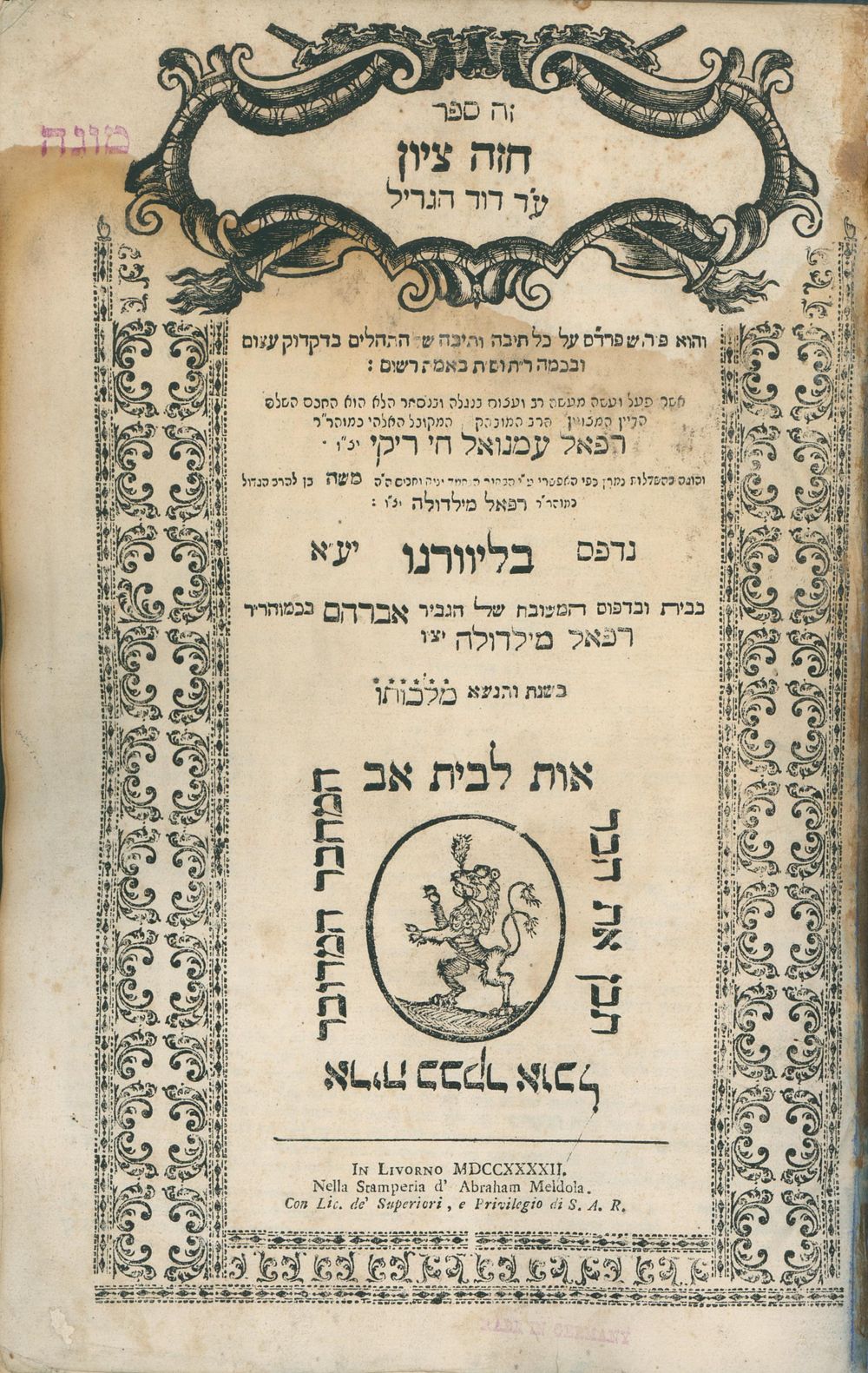
Tehillim with Commentary Chazeh Tzion by the Author of Mishnat Chassidim. First Edition, Livorno 1742–1743. Family Emblem of the Author, Martyred for the Sanctification of God's Name During Printing. - The commentary Chazeh Tzion on Tehillim, written according to the PaRDeS methodology (literal, allegorical, homiletic, and mystical interpretation), by the great kabbalist and saintly sage, Rabbi Emanuel Chai Ricchi, the author of Mishnat Chassidim and other works. The Tehillim text is vowelized, printed in the center of the page, surrounded by the commentary. The printing is elegant and meticulous. First Edition. Livorno, 1742. Printed by Abraham Meldola. During the printing of this sefer, the author was murdered for the sanctification of God’s name (kiddush Hashem). Although the title page still mentions him with a blessing for his life (”may he be remembered and preserved, ” יצ”ו), the end of the sefer contains an account by his son detailing the tragic events of his death. Additionally, a eulogy, Kinah al HaRav HaMechaber Zatzukal (”Lamentation for the Holy and Righteous Author”), was written by Rabbi Shlomo Yosef ben Nathan Karfi. The title page prominently displays the family emblem of the author: an image of a lion holding a stalk of wheat in its mouth, alongside the verse: ”The lion shall eat straw like the ox, the sign of the house of the distinguished author.” At the conclusion of the sefer, the author’s son provides a detailed account of the tragic martyrdom of his saintly father. In summary, in 1741, Rabbi Emanuel Chai Ricchi traveled to Italy to establish permanent financial support for his yeshiva and to print his monumental commentary on Psalms, Chazeh Tzion. On his return journey from Modena to Bologna, he was attacked by wicked thieves who brutally killed him after he refused to defile himself by eating pork. After his passing, a dream written in his own hand was found among his belongings, in which he recounted his spiritual connection to Rabbi Yehuda ben Bava, one of the Ten Martyrs of the Roman persecutions, and his foreknowledge of his own martyrdom. Rabbi Emanuel Chai Ricchi (1648–1743) was one of the great kabbalists of Italy, renowned for his works Mishnat Chassidim and others. He traveled extensively, including to the Land of Israel, where he established a yeshiva in Jerusalem. Among its attendees was the holy Or HaChaim Rabbi Chaim ben Attar. In 1742, Rabbi Ricchi traveled across the Jewish communities of Italy to raise funds for his yeshiva. During this time, he began printing his commentary Chazeh Tzion in Livorno. On Rosh Chodesh Adar 1743, while traveling from Modena to Bologna, he was ambushed by foreign soldiers. They attempted to force him to eat pork, and when he refused, they strangled him to death with the straps of his tefillin and robbed the charity funds he had collected. His cousin, Rabbi Emanuel ben Yitzchak ben Tzion Ricchi, lamented: ”His blood was shed because he refused to defile his soul with impurity.” Rabbi Yaakov of London, in the introduction to his sefer Shivah Einayim (Livorno, 1745), also mentioned the tragic event: ”He was martyred for the sanctification of God's name. On that very day, three soldiers captured him, spilled his blood, and robbed him of a great sum of money he had collected, all for his refusal to defile himself by eating forbidden food... ” The beginning of Chazeh Tzion contains a lengthy autobiographical introduction by Rabbi Ricchi, in which he recounts his life journey, writings, travels, and the challenges he endured. At the end of the sefer, the author’s son, Rabbi Avraham Shmuel Ricchi, elaborates on the circumstances of his father’s martyrdom: ”Upon leaving Modena, on his way to Bologna, wicked thieves fell upon him... they drew their swords girded upon their thighs... robbed him of his wealth and attacked this zealous man... ” He describes how the Jews of Modena honored his father’s death: ”I cannot fail to express my gratitude to the people of Modena, for they honored him even in death. Immediately upon hearing the grievous news, the leaders of the city set out... They removed him from the place of burial by the riverbank and brought him to a Jewish cemetery in the city of Gintu... ” The son also transcribed a chilling entry found in Rabbi Ricchi’s personal prayer book, written in his own handwriting. It recounts a dream he had in Jerusalem in 1740, in which he was told that he possessed the soul of Rabbi Yehuda ben Bava and that he too would die for the sanctification of God's name. He prefaced the dream with the following words: ”I now record the dream exactly as written in his prayer book...” The text of the dream reads: ”In Jerusalem, the holy city, in the year 1740, I dreamt one night that I and another were being killed for the sanctification of God’s name. Later that same year, on the eve of Shabbat, I dreamed again, and they said to me: 'Your soul is from one of the sages...' When I inquired further,