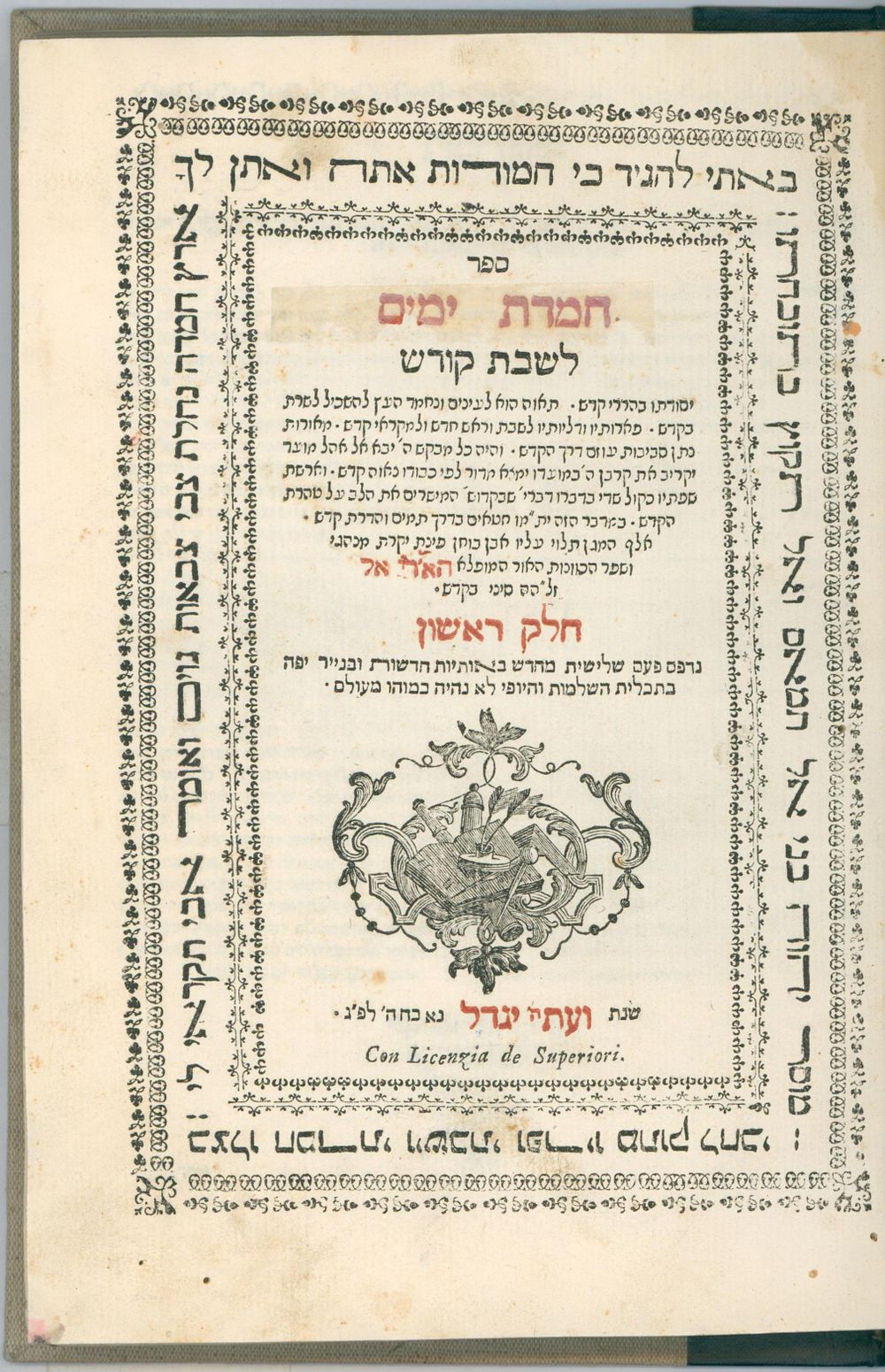
Bidspirit auction | Sefer Chemdat Yamim, containing practices,
Sefer Chemdat Yamim, containing practices, prayers, & mystical rectifications in the way of Kabbalah. The famous & enigmatic Kabbalistic work, whose authorship remains unknown. Venice 1763. Complete set. - Sefer Chemdat Yamim, containing practices, prayers, and mystical rectifications in the way of Kabbalah. The famous and enigmatic Kabbalistic work, whose authorship remains unknown. Venice, 1763. Complete set. Since its first printing and to this very day, spanning centuries, the identity of its author has not been definitively established. Some attributed it to Nathan of Gaza (the prominent disciple of the false messiah Shabtai Tzvi), and therefore dismissed it. On the other hand, others discovered lofty teachings within it and treated it as a most sacred text. The scholar and bibliographer Avraham Yaari wrote an entire book in an attempt to reveal the author’s identity (Ta’alumat Sefer, Jerusalem, 1954), and since then, many articles have been written on the subject. Around fifteen years ago, a large work titled Otzer Chemdat Yamim was compiled, collecting all research regarding this mystery. The controversy surrounding Chemdat Yamim stems from its focus on Kabbalah, particularly Lurianic Kabbalah. It was first published by the Rishon LeTzion Rabbi Yisrael Yaakov Algazi, father of Rabbi Yom Tov Algazi, based on writings he found in a cave in Safed. The identity and character of the author—whether early or late, Sabbatean or faithful to tradition—remains in dispute, and consequently, so does the attitude toward the customs presented in the book. The book was published 54 years after the death of Shabtai Tzvi and includes poems bearing the acrostic “Natan Azati, ” as well as essays known for their Sabbatean allusions. The Yaavetz (Rabbi Yaakov Emden) harshly criticized it: “I glanced into it briefly and recoiled. Then I understood its nature and the trace of Sabbatean heresy embedded in it through countless abominable hints.” In Shivchei HaBesht, it is told that the Baal Shem Tov once remarked on a Motza’ei Shabbat that a book had emerged from the camp of Shabtai Tzvi, which, through the smoothness of its language, would mislead many Jews, referring to Chemdat Yamim. Similarly, Rabbi Yehuda Fatiyah of Baghdad recounted that he rectified the soul of the book’s author after great spiritual efforts (recorded in his work Ruchot Mesaprot). Conversely, Rabbi Chaim of Volozhin, disciple of the Vilna Gaon, spoke positively of the book, stating that even if it was written by Nathan of Gaza, the content is free of defect and likely authored before his turn to Sabbateanism. Likewise, the saintly Kabbalist the Leshem referred to the author as “one of the most exalted of the holy ones” (Leshem Shevo VeAchlama, Derush Olam HaTohu, Part II, Derush 4, Branch 24, Sec. 8). Volume 1: 109 Leaves. Volume 2: 128, [1] Leaves. Volume 3: 96 Leaves. Volume 4: 103 Leaves. 25 cm.