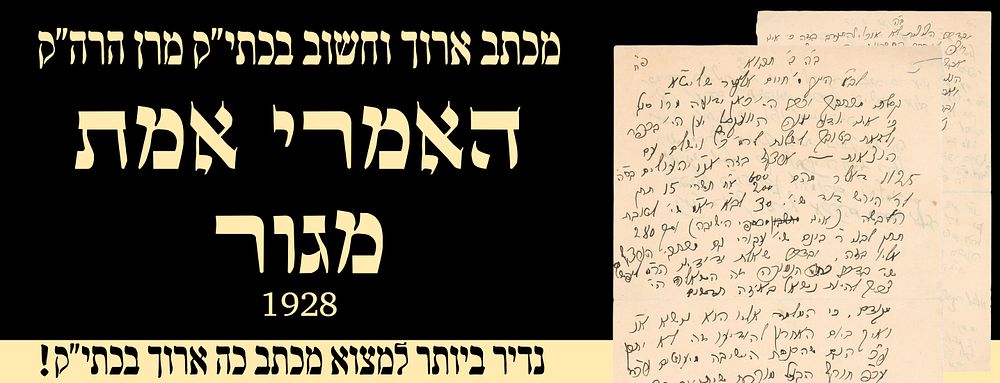
Bidspirit auction | Long and Important Autograph Letter
Long and Important Autograph Letter from the Holy Rebbe the Imrei Emes of Gur – 190 words! 1928. - As is well known, the Imrei Emes’s holy practice was to write with utmost brevity. It is therefore exceedingly rare to find such a long letter in his sacred handwriting. 1 . A long and carefully reasoned letter was sent by the administration of Yeshivat Sfas Emes in Jerusalem to their Rebbe, the Imrei Emes of Gur, regarding a kol koreh printed by his nephew, Rabbi Chaim Elazar Alter, following the instruction of his father, the holy Rabbi Menachem Mendel Alter of Pabianice. The kol koreh concerned the proper way of making tzitzis, but the committee of the yeshiva feared that involvement in the matter could cause harm to the yeshiva, particularly since the kol koreh was published without their prior approval. Jerusalem, Adar 1929. 2. In response, the Imrei Emes wrote a long, two-sided letter addressing the finances and general affairs of the yeshiva. In the course of the letter, he mentions his son, the Lev Simcha of Gur: “And the sum of 280 you shall give to my son, Reb Bunim shlit”a, on my behalf, also the letter enclosed herein to him.” He continues by offering guidance about the sudden dismissal of a teacher: “Regarding the question of our friend Rabbi Lipshitz about the lower class – this question ought to have been asked several months in advance, for the teacher relies on it for his livelihood, and how can one inform him on the very last day? This cannot be. Therefore, although the yeshiva’s income is limited, nevertheless the lower class must continue for the coming winter term, and we trust in the salvation of Hashem that the yeshiva’s income will increase.” On the matter of etrogim: “Concerning the etrogim promised last year, it is necessary to fulfill the promise.” On the subject of the length of study after marriage: “Inform us if it is true what has been rumored, that some members of the committee say our intention is to change from the decision that a young man, after his wedding, should study for a year and a half, at most two years. I have spoken with my brothers and brothers-in-law shlit”a, and there is no change on our part in this matter.” Finally, he addresses the issue of the tzitzis kol koreh: “Regarding the tzitzis, I cannot involve myself in this, as I do not wish to mix financial matters of the yeshiva into it. However, your father and brother shlit”a can assist in this.” He concludes with a New Year’s blessing: “I bless you and your household with a good year, and I ask that you convey the same to the members of the committee in general, and in particular with blessings for a good year to the teachers and the students.” Parshas Ki Savo, 1928. It should be noted that his son, the Rebbe the Lev Simcha of Gur, resided in Eretz Yisrael during in 1927–1929, and again from 1934–1938. Maran Rebbi Avraham Mordechai Alter (1866–1948), the third Rebbe of Gur, universally known as the Imrei Emes after his sefer, was one of the foremost leaders of world Jewry. Under his leadership, Gerrer Chassidus reached its peak, with estimates of over 100,000 followers before the Holocaust. Though the vast majority of his followers and descendants perished in the Shoah, the Rebbe himself survived and rebuilt Gerrer Chassidus in Jerusalem. His three surviving sons in turn each served as Rebbe: the Beis Yisroel, the Lev Simcha, and the Pnei Menachem.