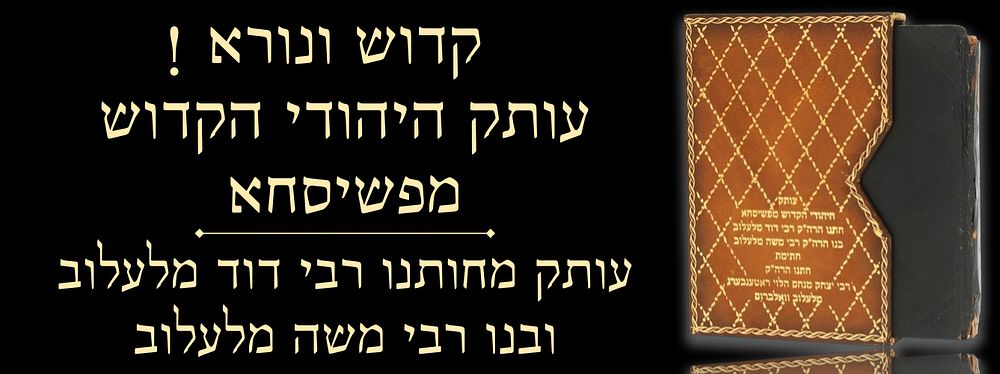
Bidspirit auction | Holy and awe-inspiring! Copy of
Holy and awe-inspiring! Copy of the holy Jew of Peshischa, His Mechutan Rebbi David of Lelov; his son, Rebbi Moshe of Lelov; Signature of their grandson, Rebbi Yitzchak Menachem HaLevi Rottenberg of Lelov, Wolbrom. Sefer Mishnat Chassidim. - Signature of the Holy Rebbe Yitzchak Menachem ha-Levi Rotenberg of Lelov, Wolbrom. Sefer Mishnat Chasidim. Mishnat Chassidim by Rabbi Immanuel Chai Ricchi. Amsterdam, 1740 Second Edition in the authors lifetime. Incomplete copy. On the first leaf appears a genealogical inscription recording the lineage of this sacred and distinguished copy, written in the handwriting of their grandson, the Admor Rebbi Menachem Binyamin Bentzion Halberstam–Rottenberg of Sanz–Wodzisław. It details the chain of ownership from generation to generation: “ With the help of Heaven, this holy sefer belonged to my revered ancestor, our holy master—awesome is his name—the Holy Jew, may his merit protect us, of Przysucha. He gave it as a gift to my revered ancestor, our holy master Rebbi Reb Dudel, may his merit protect us, of Lelov, and it passed by inheritance to his son, the holy Rebbi Reb Moshe, may his merit protect us. Thereafter to his son-in-law—my revered ancestor, the righteous Rebbi Yitzchak Menachem, may his merit protect us—and after him to his son, the righteous Rabbi Alter… the father of my mother.” Thus writes their grandson, Menachem Binyamin Bentzion Rottenberg Halberstam.” “The signature of my grandfather, the righteous Rebbi Yitzchak Menachem … appears at the beginning of the Order of Moed in this holy sefer.” And indeed on leaf 34b appears an ownership inscription in the handwriting of the Holy Rebbi Yitzchak Menachem Rottenberg of Lelov : “Belongs to Rabbi Yitzchak Menachem HaLevi of Lelov. ” On leaf 13 appears his signature: “Yitzchak Menachem HaLevi.” His Holy handwriting is not known from any other source, but seemingly both inscriptions are in his own Holy hand, especially since on leaf 13 it is written simply “Yitzchak Menachem ha-Levi, ” and it is unlikely that anyone else would have written it in this manner. And so attests his grandson in his inscription mentioned above. Extremely rare — no other sefer or letter by him is known! The holy and awe-inspiring Rabbi Yaakov Yitzchak Rabinowitz—known as the Holy Jew of Peshischa . was born in the town of Przedbórz. In his youth he was a great scholar and even headed the yeshiva in Opatów. He drew close to Chassidut under the influence of Rebbe Moshe Leib of Sasov. Rebbe David of Lelov brought him into the circle of disciples of the Chozeh of Lublin . According to one tradition, he was called “the Jew” (HaYehudi) because the disciples of the Seer avoided calling him by his given name—identical to their master’s—and instead referred to him simply as “the holy Jew.” Rebbe Yehuda Aryeh Leib Alter of Gur explained that this title reflected his constant spiritual ascent—“as one who rises each day from being ‘not yet a Jew’ to truly being a Jew.” He passed away on 19 Tishrei 1813and was buried in an ohel in Przysucha. He was succeeded as leader by his disciple, Rebbe Simcha Bunim of Peshischa. His Mechutan the holy Rebbi David (the first) Biderman of Lelov , was born in 1746 to Rabbi Shlomo Tzvi Biderman of Lelov. He was a disciple of Rebbe Elimelech of Lizhensk and of the Chozeh of Lublin. Among his most prominent disciples was the Holy Rebbe Chaim David of Piotrków, whom he brought to repentance and guided on his spiritual path, and who later became a wonder-working Rebbe. He also drew Rebbe Simcha Bunim of Peshischa closer to Chassidut. Other noted disciples include Rebbe Yitzchak of Warka, Rebbe Yeshaya of Przedbórz, and Rabbi Chanoch of Warsaw. His son the Holy Rabbi Moshe Biderman of Lelov , was born in 1777. He married the daughter of the Holy Jew of Peshischa . In 1813 he began to lead his father’s court, attracting followers from across Poland. Among his famous disciples was Rebbe Shlomo Hakohen Rabinowicz- the Tifret Shlomo of Radomsk. The holy Rebbe of Koznitz said of him: “Whoever wishes to see the form of Moses our teacher should look upon him.” In 1851 he ascended to the Land of Israel, saying that if he merited reaching the Western Wall, he would hasten the redemption. His disciple, the Tiferet Shlomo, explained that he longed to ascend because he was “the husband of the Matronita, ” like Joseph the Righteous. (Indeed, he passed away during the Torah portion Vayechi, which recounts Joseph’s death.) Rebbe Yisrael Friedman of Ruzhin encouraged his journey, saying: “Poland is not worthy of the light of such a candle.” When he arrived in the Land of Israel, he fell ill. As his condition worsened, he instructed that he be carried on his bed to the Western Wall. However, as they approached, local Arabs attacked them with stones, forcing them to turn back. On that very day, 13 Tevet 1851, he passed away and was buried near the tomb of Zechariah.