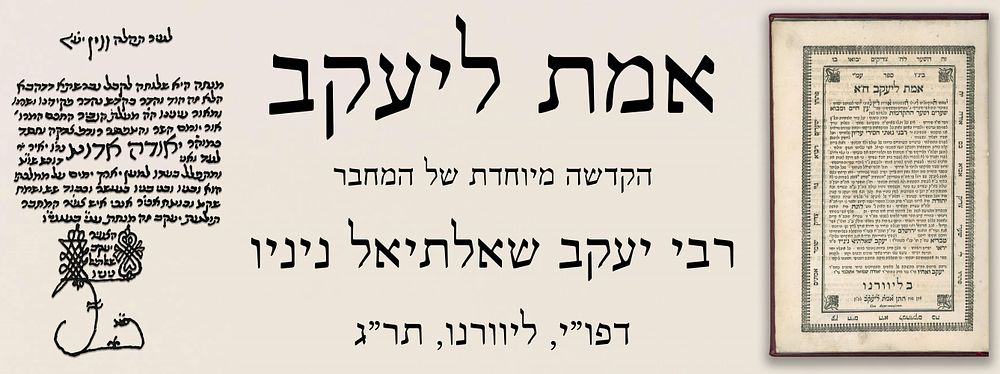
Bidspirit auction | Emet LeYaakov - Special dedication
Emet LeYaakov - Special dedication by the author, the kabbalist Rabbi Yaakov Shealtiel Ninio, to the noble Judah Leon Adutt of Vienna. First Edition, Livorno, 1843. - Sefer Emet Le'Ya'akov – commentary and Derushim on Etz Chaim and Mavo She'arim by Rabbi Chaim Vital. By the kabbalist Rabbi Ya'akov Shalti'el Ninio. Mafteachot u-Netivot — indexes and pathways to the three major works of Rabbi Chaim Vital: Etz Chaim, Mevo She’arim, and Sha’ar HaHakdamot, arranged alphabetically. The sefer includes, for the first time, kabbalistic novellae drawn from manuscripts of great authorities: Kavanot of Rabbi Shalom Sharabi, not known from any other source. Responsa of Rabbi Yom Tov Algazi regarding kabbalistic intentions during the Shemittah year. Responsa and introductions concerning the intentions of prayer from a manuscript of Rabbi Avigdor Azaryel. Novellae from Rabbi Raphael Abraham Shalom Mizrahi Sharabi. Novellae from Rabbi David Magar. Novellae from Rabbi David Pardo, and others. Livorno, 1843–1844. Only edition. Printed by the Ashkenazi Brothers Press. On the verso of the title page appears an elaborate handwritten dedication, in the author’s own hand and with his ornate signature, addressed to the notable Sir Judah Leon Adutt, head of the Sephardic community of Vienna. There is a beautiful literary wordplay here: “Anochi ish tza‘i”r ha-mechaber, tola‘at Ya‘akov, zeh minchat an”i be-onyi”v.” The phrase subtly forms the author’s name Ninio (ניניו) through the initial letters and wording: ענ”י (ani) hints to ניני בעוניי”ו (be-onyav) hints to ניניו. The Gaon & Mekubal Rabbi Yaakov Shealtiel Ninio was born in Jerusalem c. 1800 and grew up in the shadow of the great Beit-El kabalists. He was sent by the Tiberias community on a fundraising mission, and made a great impression wherever he went. Rabbi Girundi met with him and wrote about the meeting in his Toldot Gedolei Yisrael (p. 359), mentioning Rabbi Shaltiel's righteousness. He died at a young age c. 1849. He was particularly known for this work, ”Emet L'Yaakov” and Rabbi Chaim Palagi mentiones him many times with great respect. The famous nobleman Judah Leon Adutt was born in 1774 in Constantinople. He served as the head of the Sephardic community in Vienna, was extremely wealthy, and well connected with the royal authorities. He devoted great effort to assisting the Jewish community of Jerusalem and its emissaries, and the officials of the Pakidim ve-Amarcalim organization also benefited from his support. He likewise helped many authors finance the printing of their works. It is related that the gaon Rabbi Chaim Palaggi once wrote to him requesting that he approach Baron Rothschild to seek financial support for the establishment of the Jewish hospital in Izmir. He passed away at the age of 95 in 1869. He is mentioned in a letter from Rabbi Abraham Eliezer HaLevi, Av Beit Din of Trieste, addressed to Maran the Chsam Sofer, written on 7 Nissan 1821, which was later printed in Igrot Soferim, the correspondence of the Chatam Sofer (letter 59). He is also mentioned on the title page of the sefer Kin’at Tzion, printed in Amsterdam, 1846, where he is praised with exalted titles, describing him as a distinguished and God-fearing benefactor who supported the printing of the work so that “its wellsprings might spread outward.” Likewise, he is mentioned in the introduction written by Rabbi Reuven Baruch to the second edition of Birkei Yosef, printed in Vienna in 1860 , where he is described with the honorifics: “A man of valor, abundant in good deeds, righteous and wholehearted - Signor Leon Yehudah Adutt.” Stamps of the Rebbe of Drohobych, Rabbi Mordechai David Teitelbaum (approx. 1846 – Kislev 1919), son of Rebbi Nachum Tzvi Teitelbaum of Drohobych (brother of the Yetev Lev and grandson of the Yismach Moshe), and son-in-law of the gaon and tzaddik Rabbi Chanina Horowitz, Av Beit Din of Olinov. He served as Av Beit Din of Stutchin and later as Av Beit Din of Drohobych. He was a cousin of the Rebbe of Munkacs, author of Minchat Elazar, and of the Rebbe of Sighet, author of Kedushat Yom Tov. In 1902 he immigrated to the Land of Israel, where he was considered among the leading figures of the community, and his name appears first on a public proclamation from that period. As a kabbalist and expert in the teachings of the mystical tradition, he was especially fond of the developing settlement in Meron, and at a certain stage moved to live near the tomb of the divine Tanna Rabbi Shimon bar Yochai. He also lived in Safed, where he was known as the Rebbe of Drohobych. His son was the Husiakov Rebbe, Rabbi Yitzchak Teitelbaum (martyred in the Holocaust), father of Rabbi Mordechai David Teitelbaum, the Rebbe of Husiakov–Be’er Sheva. [5], 145, [1] Leaves. 30.5 Cm.