Bidspirit auction | Signature of the holy Rebbe,
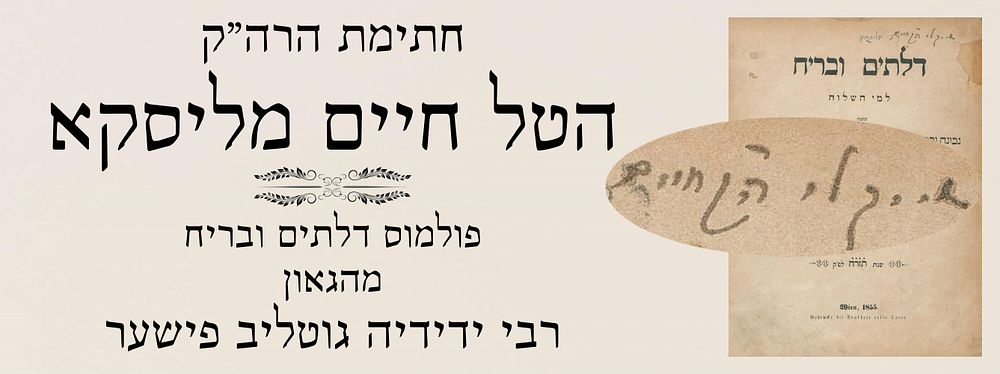
Signature of the holy Rebbe, the “Tal Chaim” of Liska. Deletim u’Veriach – a polemical work on the laws of divorce by Rabbi Yedidiah Gottlieb Fischer. - Deletim u’Veriach, a halachic polemic concerning a bill of divorce (get), by the gaon Rabbi Yedidiah Gottlieb ben Gabriel Fischer. First Edition, Vienna, 1855. On the title page appears his holy signature: “Belongs to me, the humble Chaim , ” and in another hand, “the rabbi of Liska.” The Rebbe, the holy Rabbi Chaim Friedlander of Liska (known by the title of his work Tal Chaim), was born in 1836 to his father, the holy Rabbi Moshe Friedlander, dayan of Kleinwardein. In 1860 he married Rebbetzin Sarah, daughter of the holy Rebbi Tzvi Hirsch of Liska, author of Ach Pri Tevuah. His illustrious father-in-law cherished him dearly and bestowed upon him of his sacred spirit. He was an extraordinary genius in both revealed and hidden Torah, and an exceptional scholar of great diligence. Upon the passing of his father-in-law in 1874, he succeeded him as rabbi and Rebbe of Liska. For some thirty years he led the community, spreading Torah and fear of Heaven in Liska and beyond. In his days, Liska became a major spiritual center and a “mound to which thousands turned” among the Jewish people. He passed away on 9 Iyar 1904, and was succeeded by his eldest son, Rebbi Tzvi Hirsch, who led the community until the Holocaust. He authored Tal Chaim on the Talmud and Tal Chaim u’Berachah on the Torah. The author, the gaon and tzaddik Rabbi Yedidiah Gottlieb Fischer, Av Beit Din of Stuhlweissenburg (1810–1896), was a distinguished and beloved disciple of the Chatam Sofer, from whom he received ordination. Torah scholarship and greatness were united at his table; he served for many years as Av Beit Din of Stuhlweissenburg (Székesfehérvár). A fearless warrior in the battles of Israel, he did not shrink before any opponent. He published a German pamphlet against Zechariah Frankel’s Darkhei HaMishnah, and due to the importance of his arguments, Rabbi Samson Raphael Hirsch printed them in a series of articles in the journal Jeschurun (1860–1861); they were recently translated into Hebrew in the collected writings of Rabbi Hirsch. The present work was published as a response to the pamphlet Mei HaShiloach (Ofen, 1853), in which Rabbi Meir Zipser sought to justify a divorce he had arranged. On this controversy, see Jacob Katz, The Unhealed Rift, Jerusalem 1995, pp. 65–68. 36 leaves. 22.8 cm.