Bidspirit auction | Sefer Yesod in Chassidus: Sidduro
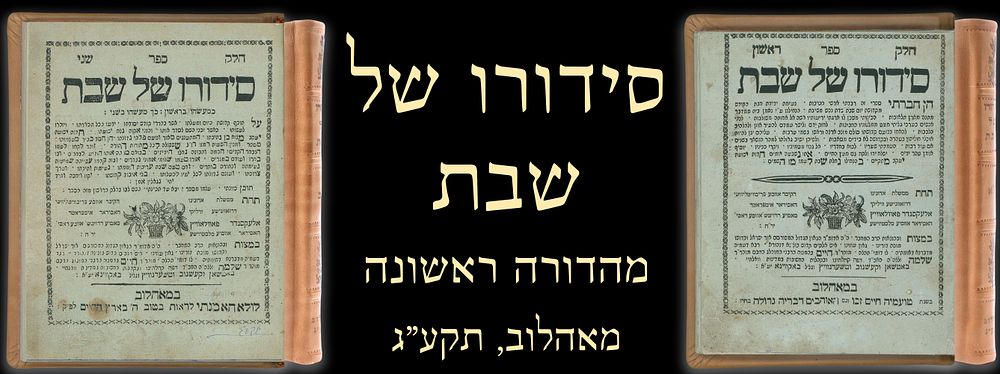
Sefer Yesod in Chassidus: Sidduro Shel Shabbos. First Edition. Mohilev 1813. Fine Copy on Greenish Paper. - Siduro Shel Shabbat, Parts I–II - on the sanctity of Shabbat according to Kabbalah and Chassidut, with halachic responsa, by the Holy Gaon Rebbi Chaim Tirer, Av Beit Din of Chernivtsi. First edition. Mohilev (Mogilev-Podolsky), 1813. The sefer Siduro Shel Shabbat was printed before the author of Be’er Mayim Chaim traveled to the Land of Israel. It was the first of his works to be published and the only one printed during his lifetime. The work was accepted as one of the foundational texts of Chassidic thought, and to this day regular study sessions are devoted to it. Chassidim and men of piety have long established fixed study of this book as preparation for Shabbat, as the author himself writes in his introduction: “Whoever studies this work should intend to learn in order to act and fulfill… each and every Shabbat they should establish a study from this work…”. Already in the early years after its publication, the sefer became widely known and highly regarded. The holy Rebbi Mordechai of Kremenets (son of the Maggid of Zlotshov) wrote in his approbation to Sha’ar HaTefillah: “He has already earned renown through his sefer Siduro Shel Shabbat, a work that shines with the awesome light of the King’s living countenance; whoever studies it, his lips drip honey and the flavors of life.” Rebbi Yehoshua of Ostrova said of the sefer: “The holy language of our master entices every Jew to the service of God” (Or Yekarot, vol. II, p. 175). The author, the Holy Gaon Rabbi Chaim Tirer of Chernivtsi (early 18th century – 1814/1815), was among the great figures of early Chassidut and a foremost disciple of the Maggid of Zlotshov. He served as rabbi in Kripets, Chernivtsi, Mohyliv-Podilskyi, Botoșani, and Kishinev. His influence in strengthening religious life throughout the Bukovina region was very great. He was known as a holy man of God, and many wondrous stories are told about him. In the Chassidic tradition, he is especially renowned for his intense attachment to the sanctity of Shabbat, during which he would ascend to exceedingly lofty spiritual levels. His teacher, the Maggid of Zlotshov, testified about him: “He draws his vitality from the holiness of Shabbat.” It is also traditionally related that after immersing in the mikveh on Friday afternoon, his appearance would change and his stature would increase by a handbreadth. Rabbi Meshullam Natan Margaliot, Av Beit Din of Berdichev, testified: “I say to you with clear testimony that I saw him every Shabbos Eve going to the bathhouse and returning, and it was truly not the same man who had gone, he appeared entirely like another person in form and stature; his entire holy body was different from before” (Kevutzat Yaakov). Toward the end of 1813, he immigrated to the Land of Israel and settled in Safed, where he authored his works Sha’ar HaTefillah (Sudylkiv, 1825) and Eretz HaChaim (Chernivtsi, 1861), and where he is buried. His foundational works, Siduro Shel Shabbat (Mohyliv, 1813) and Be’er Mayim Chaim (Sudylkiv, 1820), are distinguished both by their clear exposition and by the fervent Chassidic spirit that flows through them. His seforim were widely disseminated, reprinted in numerous editions, and became cornerstones of Chassidic teaching. They also include responsa and analytical discussions on complex halachic topics. Particularly well known is his responsum concerning the recitation of “Leshem Yichud” before performing a mitzvah, in which he sharply responds to the objections of the author of Noda BiYehuda. Stefansky, Chassidut, no. 422. Volume 1: [6], 70, 70-108, [1] Leaves. 18.5 cm. Volume 2: 12, 64 Leaves. 19.4 cm.