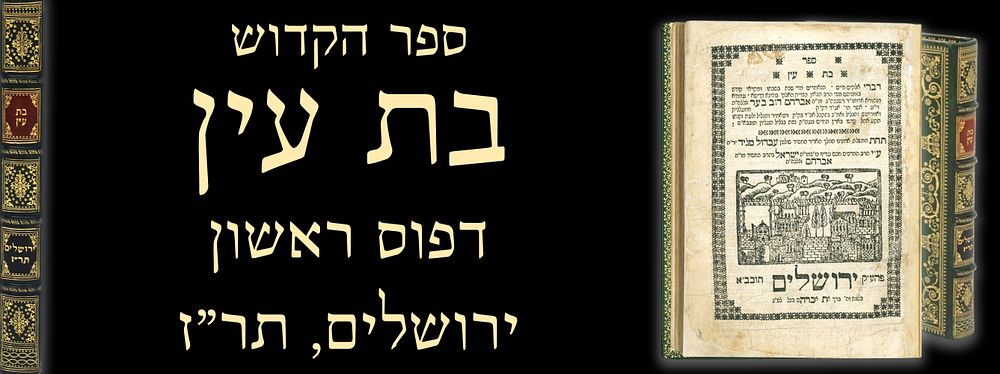
Bidspirit auction | Bas Ayin. First Edition Jerusalem,
Bas Ayin. First Edition Jerusalem, 1847. - Chiddushei Torah and drashos on the weekly Torah portions in the spirit of Chassidus and Kabbalah, delivered each Shabbos “with the ruach hakodesh that rested upon him from above” by Rebbi Avraham Dov of Ovritch, whose resting place is in Tzfas. His holy sefer Bas Ayin is a foundational sefer of Chassidus, and learning from it is known to bring salvation, as hinted by the acronym ”Bas Ayin” – Yisrael Nosha B’Hashem Tishuas Olamim (in Hashem lies eternal salvation for Yisrael). First Edition. Jerusalem, 1847. At the beginning of the sefer are two pages containing the “Apology of the Publisher”, written by the grandson of the author’s brother. This is a very interesting introduction describing the work and its printing. Among other things, the writer relates that, in accordance with the instruction of Rebbi Yisrael of Ruzhin, the sefer was first printed in Jerusalem rather than abroad. Three years after the initial printing, in 1850, the sefer was reprinted in Zhitomir, and there are significant differences between the two editions, both in the body of the text and in the arrangement of the material (see: N. Ben-Menachem, Kiryat Sefer, vol. 37, 1962, pp. 401–402; BeSha’arei Sefer, Jerusalem 1967, pp. 49–53). Rebbi Avraham Dov of Ovritch (1765 – 1841) was a towering figure among the tzaddikim of the Chassidic world in the generation of the disciples of the disciples of the Maggid of Mezeritch. He was a prime talmid of Rebbi Menachem Nachum of Chernobyl, and the son-in-law of Rabbi Nosson Neta of Ovritch, a disciple of the Baal Shem Tov and succeeded him in the rabbinate. In 1830, he moved to Tzfas, where he led the Chassidic community with unwavering devotion during in its difficult times. During the great earthquake in Tzfas, all who were present with him in the shul were miraculously spared—a story preserved by Rabbi Moshe Podhortzer of Tzfas in the name of the elders of the city (brought in Toldos Adam at the end of Bas Ayin, Jerusalem 1959 ed.), and likewise cited by Rabbi Yeshaya HaLevi Horowitz of Tzfas in Eden Tziyon, p. 5. In the plague that struck Tzfas in 1840, he proclaimed that the epidemic would cease upon his passing, and indeed, it did (Eden Tziyon, p. 6). [2], 125 leaves. Without the list of subscribors, which is not present in all copies. 20 cm. Stefansky, Chassidus, no. 103.