Bidspirit auction | Leket HaKemach (Two Parts). First
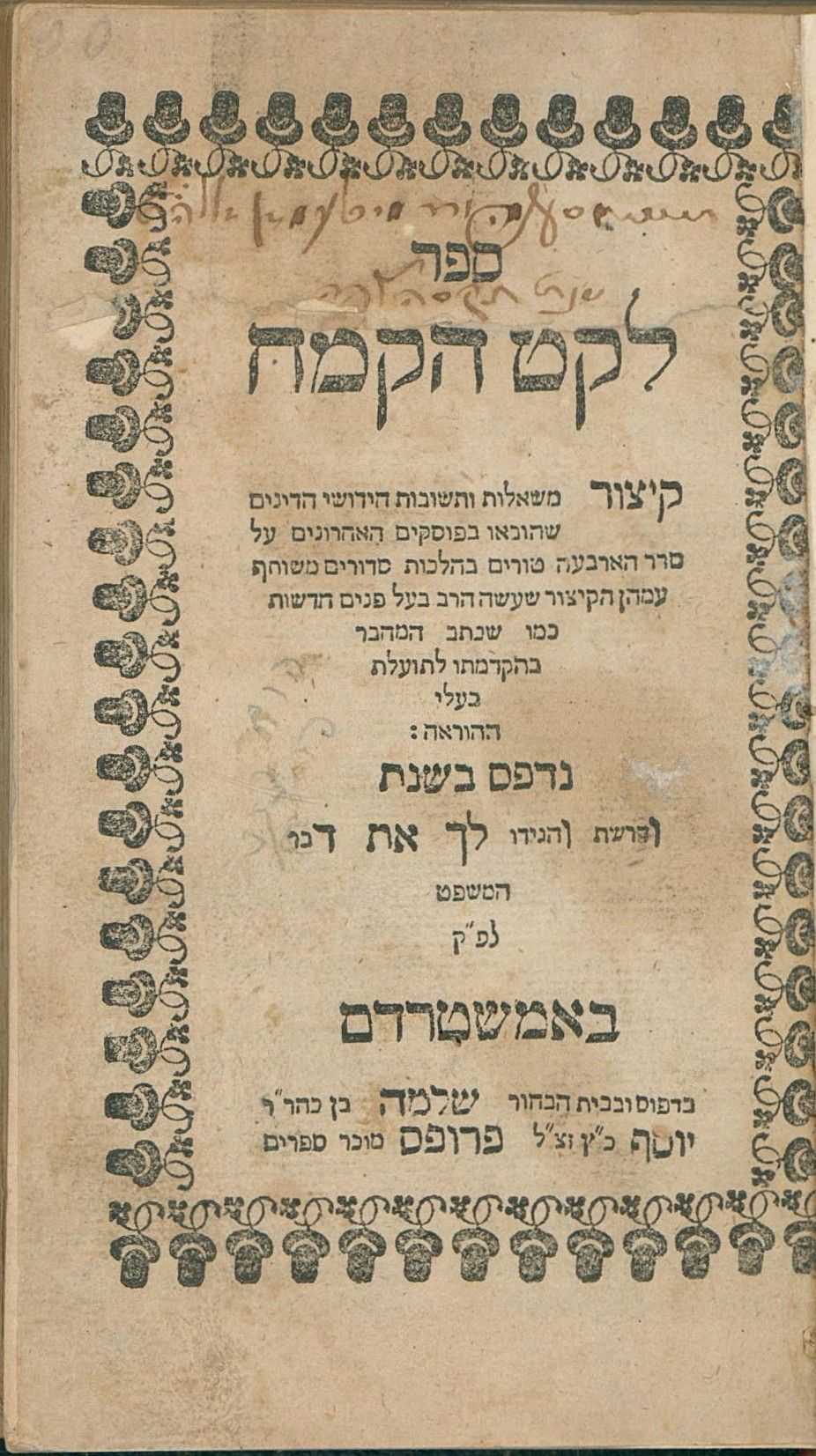
Leket HaKemach (Two Parts). First Edition. Amsterdam, 1707. - Sefer Leket HaKemach, a fundamental halachic compendium containing concise summaries of responsa and legal rulings drawn from the writings of the later halachic authorities, arranged according to the order of the Arba'ah Turim. Compiled from both printed works and manuscripts of the leading Torah scholars of earlier generations by the Gaon Rabbi Moshe ben Israel Yaakov Chagiz, known as HaMani'aḥ. The title HaKemach is an acronym for HaKatan Moshe Chagiz (”the humble Moshe Hagiz”). First Edition. Amsterdam, 1707. Printed by Shlomo Proops. With approbations by Rabbi Shlomo de Oliveira of Amsterdam, Rabbi Shlomo Ayllon of Amsterdam, Rabbi David Oppenheim, Av Beit Din of Prague, Rabbi Avraham Broda and the rabbinical court of Prague, Rabbi Yaakov Reischer, author of Shevut Yaakov, and other leading sages of the generation. About the work and its author: Leket HaKemach became one of the foundational works of practical halachah. It was reprinted in dozens of subsequent editions and incorporated into many editions of the Shulchan Aruch, accompanied over the generations by enthusiastic approbations from the foremost Torah authorities. The author, Rabbi Moshe Chagiz (1672–c.1750), was one of the leading sages of eighteenth-century Jerusalem and among the foremost opponents of the Sabbatean movement. He was the son of Rabbi Israel Yaakov Hagiz, author of Halachot Ketanot. His life was one of the most eventful among the great Torah scholars of his era, marked by extensive travels, public activity, prolific scholarship, and uncompromising leadership. In the introduction to his work Shtei HaLechem, he writes of his prolonged exile: ”After all the hardships beyond measure, my exile has been lengthened unlike that of other exiles.” Many of his responsa were written while traveling through numerous countries, and they include extensive correspondence with the leading rabbis of his generation. Among those who endorsed or corresponded with him were the Chacham Tzvi, his son the Ya'avetz, the author of Be'er Heitev, the author of Ateret Zekenim, and distinguished rabbis of Italy and Amsterdam. The renowned Rabbi Yaakov Yehoshua Falk, author of Pnei Yehoshua, wrote in his approbation to Shtei HaLechem: ”I wonder whether there is anyone in this generation capable of offering rebuke as he does... He requested an approbation from me, yet how can one so insignificant testify regarding one so great?” In 1738, he returned to the Land of Israel. According to the Chida, he settled in Safed, where he lived to an advanced age of over ninety years. Another tradition relates that he traveled to Beirut for medical treatment, passed away there, and was buried in Sidon. Ownership signature of R. Chaim Yosef ben R. Michel Emden, dated 1805. Part I: Orach Chaim. [4], 66 leaves. Part II: Yoreh De'ah. 133, [1] leaves. Each part with its own title page. 13.8 cm.