Bidspirit auction | Collection of Rare and Early
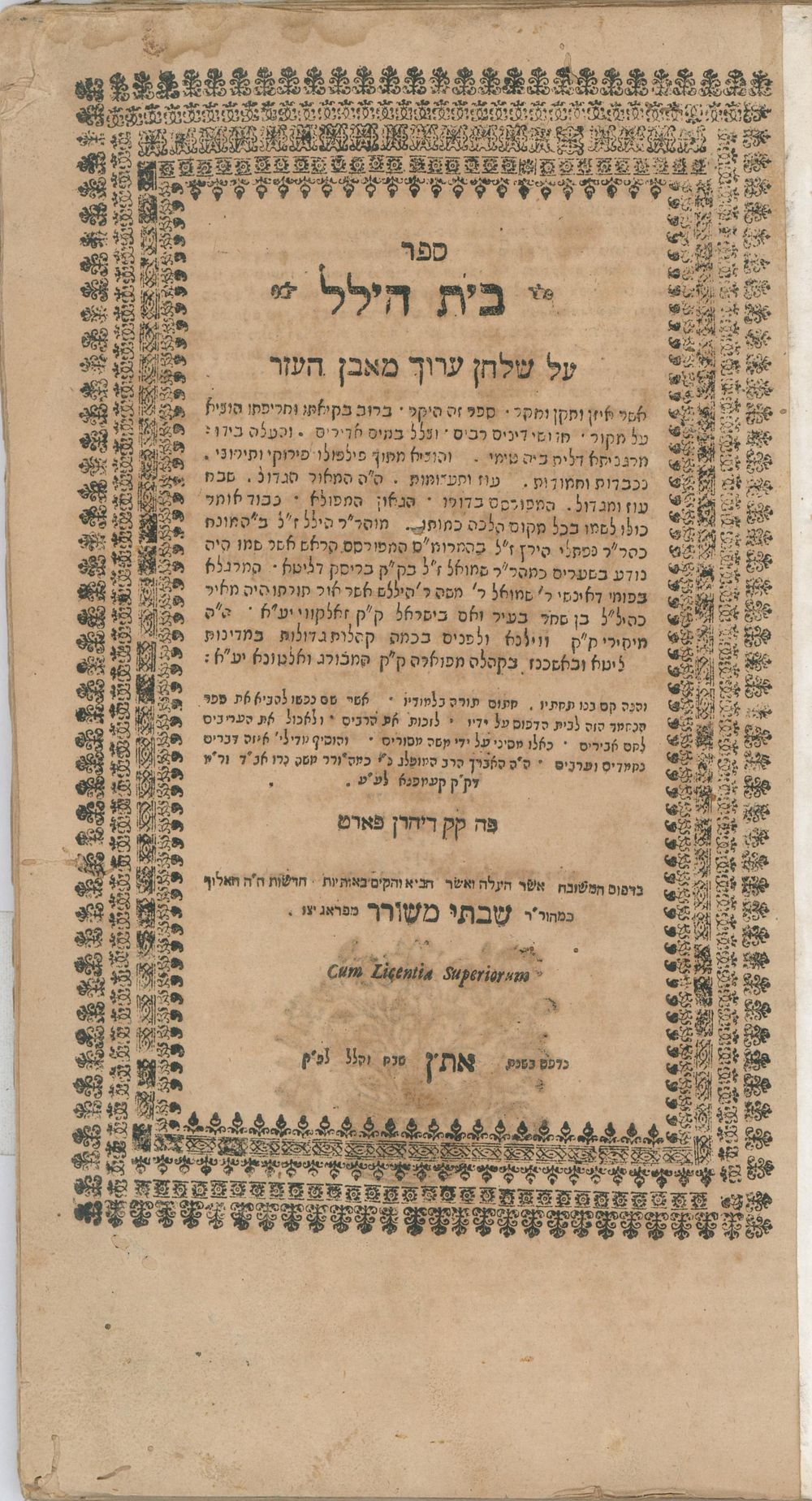
Collection of Rare and Early Seforim (1686–1794) – First Editions. - 1. Derushim al HaTorah on the books of Genesis and Exodus, by Rabbi Moshe ben Eliezer of Arptshik, Av Beit Din and Rosh Yeshiva of communities in the Poznań region, and one of the leading rabbis and judges of Leszno. Only Edition. Amsterdam, 1686. With approbations from: Rabbi Isaac Aboab of Amsterdam, Rabbi Jacob Sasportas of Amsterdam, Rabbi Moshe Yehuda ben Kalonymus HaKohen of Amsterdam, Rabbi Isaac ben Abraham of Poznań, Rabbi Isaac ben Moshe Gershon of Leszno, Rabbi Israel ben Nathan Shapira of Kalisz, Rabbi Menachem Mendel ben Zalman Auerbach of Kratshin, Rabbi Shimon ben Israel Ashkenazi of Grodzisk [2], 34 leaves. Extremely Rare! Condition: Fair to good. Title page and following leaf have tears with loss. Margins trimmed, affecting the running headers. General wear. A few wormholes. Old water stains. 2 . Sefer Beit Hillel, Parts I and II, on the Shulchan Aruch, Yoreh De'ah and Even HaEzer, by Rabbi Hillel Hirsch. First Edition. Dyhernfurth, 1691. Printed by Rabbi Shabbetai Bass, author of Siftei Chachamim on Rashi's commentary to the Torah. 3 . Sefer Toledot Yaakov on the Torah, by the eminent Rabbi Yaakov Eilenburg of Kraków, author of Minchah Belulah, preacher of the Kraków community and Av Beit Din of Rechniew and other communities, disciple of Rabbi Aryeh Leib Broda and other leading sages of Kraków. With approbations from many of the foremost rabbis of the generation, including some whose names are known to us only from their approbations to this work. First Edition. Fürth, 1726. An extraordinary work on the Five Books of the Torah in the dialectical (pilpul) style prevalent at the time, presenting intricate homiletical discourses upon discourses on the weekly Torah portions, interwoven with material from throughout the Talmud and halakhic literature. It was later cited by many of the great Torah scholars. In 1730, four years after this sefer appeared, the work Apryon Shelomo was published in Wilhermsdorf, containing the teachings of Rabbi Solomon of Zolkiew, author of Tiferet HaKodesh. The sefer was brought to press by his son, who wrote in the introduction: ”Only a portion and not the entirety... because another came, who had not labored, and stole several of my father's manuscripts, publishing them under his own name in the book Toledot Yaakov, wrapping himself in a garment that was not his. But it has already become known... that a deceiver gains nothing from his deception.” In his own introduction to Toledot Yaakov, Rabbi Yaakov Eilenburg appears to anticipate such accusations with an unusually forceful and eloquent preface, in which he complains of: ”...baseless enemies whose mouths speak falsehood... against authors... claiming... 'These teachings were already spoken long ago by a great scholar, and the author merely stole them.'' 4 . Sefer Hishta'arut Melech HaNegev im Melech HaTzafon (”The Struggle of the King of the South with the King of the North”), concerning the battle between the Good Inclination and the Evil Inclination (”the Northerner”), by Rabbi Yaakov London of Leszno. Only Edition. Amsterdam, 1737. Printed by Abraham Athias. The sefer opens with important approbations, foremost among them that of Rabbi Elazar Rokeach, author of Ma'aseh Rokeach on the Mishnah. 5. Abudarham, by Rabbeinu David Abudarham. Prague, 1784 Printed with the approbation of the Noda BiYehudah. Antique ownership inscription: ”Gamliel son of Gamliel.” 6 . Sefer Rimon Gadish, an elegant work on several Talmudic topics by Rabbi Alexander ben Abraham HaLevi. Only Edition. Brünn (Brno), 1788. With approbations from the rabbis of Trebitsch (Třebíč) and Rabbi Gershon Chajes of Nikolsburg. 7 . Sefer Torat Chaim, ”A liturgical order (Tikkun) for Thursday night during the four weeks of the month, according to the custom practiced in the cities of the Maghreb...” First Edition. London, 1792. A Thursday-night devotional service, including selections from the Zohar and prayers to be recited before and after the study. This was the first published work of Rabbi Moshe ben Yitzchak Adre'i (d. 1829; Otzar HaRabbanim no. 14388), a rabbi and kabbalist, one of the sages of Mogador (Essaouira), Morocco, who settled in Jerusalem toward the end of his life.