Bidspirit auction | Signature of the Gaon Rabbi
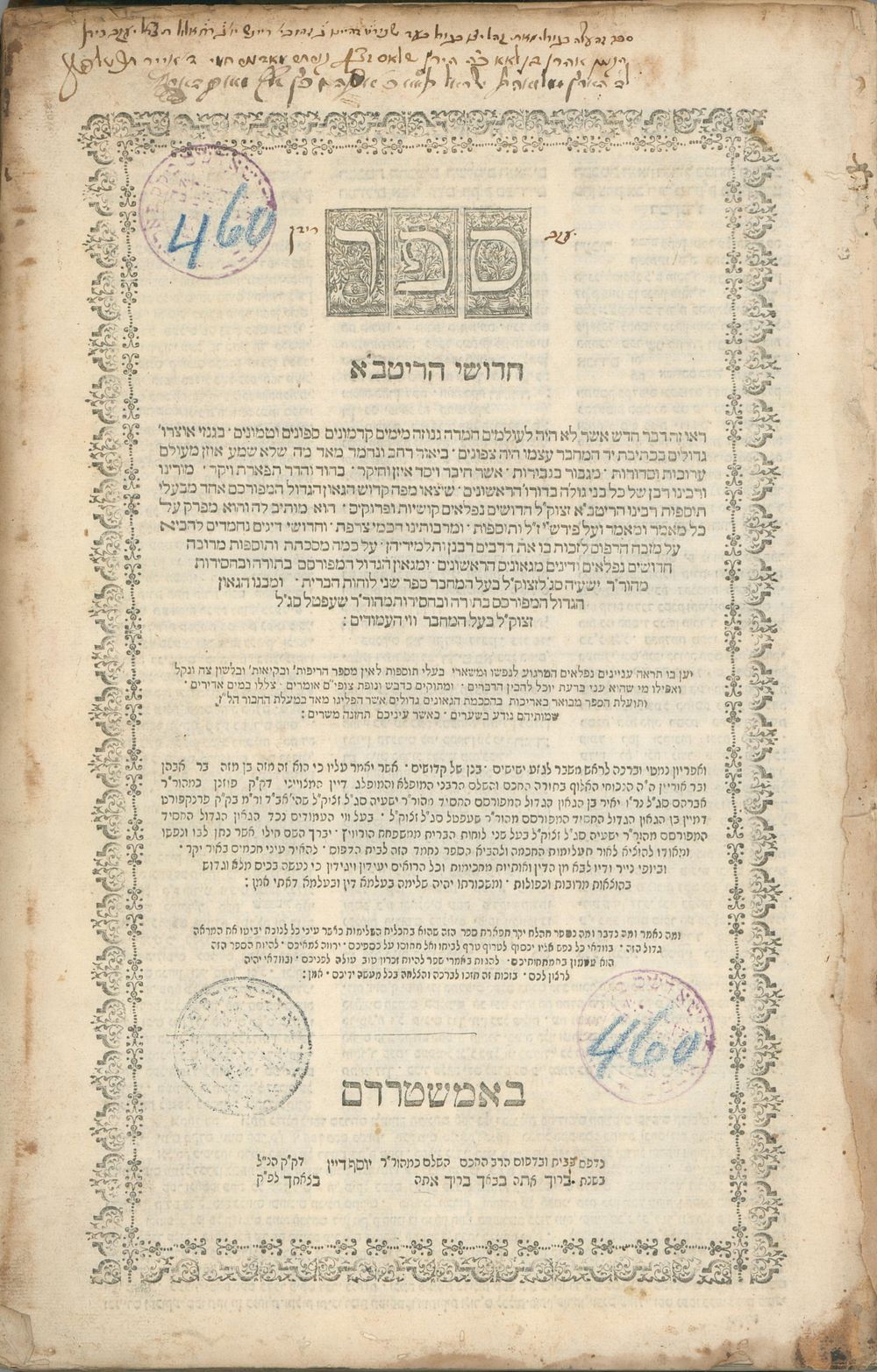
Signature of the Gaon Rabbi Aharon Schloss ABD Offenbach. Chiddushei HaRitva. First Edition, Amsterdam 1729- Additions by Rabbi Isaiah Horowitz (the Shelah) and His Son Rabbi Sheftel. - Sefer Chiddushei HaRitva on the tractates Eruvin, Ta'anit, Moed Katan, Ketubot, and Bava Metzia, together with additional novellae by Rabbi Isaiah Segal Horowitz (the Shelah) and his son Rabbi Sheftel Horowitz. First Edition. Amsterdam, 1729. On the title page appears the signature of Rabbi Aharon ben Hirsch Schloss, Rabbi of Offenbach. Born in Frankfurt am Main, he served as Rabbi of Offenbach beginning in 1782, and in 1786 returned to Frankfurt. He was a lifelong friend of the eminent Rabbi Nathan Maass, Chief Rabbinical Judge of Frankfurt, and wrote an approbation for his work Binyan Shlomo. An ownership inscription indicates that Rabbi Aharon acquired this volume from his father-in-law in 1739. Also bearing two additional early signatures dating from the eighteenth century. The volume was printed with approbations from many of the leading rabbis of the generation, who praised the important discovery and publication of the Ritva’s novellae. Included are letters from Rabbi Naphtali Katz, author of Semichat Chachamim; Rabbi Jacob ha-Kohen of Prague, author of Shev Yaakov; Rabbi Abraham Broda of Prague; Rabbi Samuel ha-Kohen Schotten (the Maharshach); and others. The sefer was published by Rabbi Abraham Segal Horowitz, grandson of the Shelah. The dates of the approbations reveal that the publisher devoted approximately fifteen years to bringing the work to print—from obtaining Rabbi Abraham Broda’s approbation in late 1715 until the final printing and the approval of the Amsterdam rabbis in 1729. It emerges that the editor of the present Chiddushei HaRitva was also the editor of the famous Shelah prayer book, Sha'ar HaShamayim. Rabbi Abraham Horowitz was responsible for the siddur’s editorial work from beginning to end. He incorporated dozens, perhaps hundreds, of prayers, supplications, commentaries, and halachic notes, and established the text of the liturgy. (See the introduction to Part I of the 1998 Ahavat Shalom edition of Siddur HaShelah.) The introductions and approbations printed in the present volume shed additional light on the publication history of the first edition of Sha'ar HaShamayim. After completing the siddur’s publication in Amsterdam in 1717, Rabbi Abraham Horowitz resolved to continue fulfilling the wishes of his father, Rabbi Isaiah Horowitz, and his grandfather, Rabbi Sheftel Horowitz, by publishing the Ritva’s novellae together with writings of the Horowitz family. He explains his reasons at length in his introduction. Among the approvers is Rabbi Naphtali Katz of Frankfurt, who had also endorsed the printing of Sha'ar HaShamayim in 1717. In his lengthy approbation to Chiddushei HaRitva, he explicitly links the two publications, praising the works of the Shelah and noting that the publication of these writings would benefit future generations through their clear and accessible style. Stefansky, Sifrei Yesod, no. 54. [4], 75, 2–29, 3–64, 2–55 leaves. 35 cm.