Bidspirit auction | Rare Sefer: Te'udat Shlomo. First
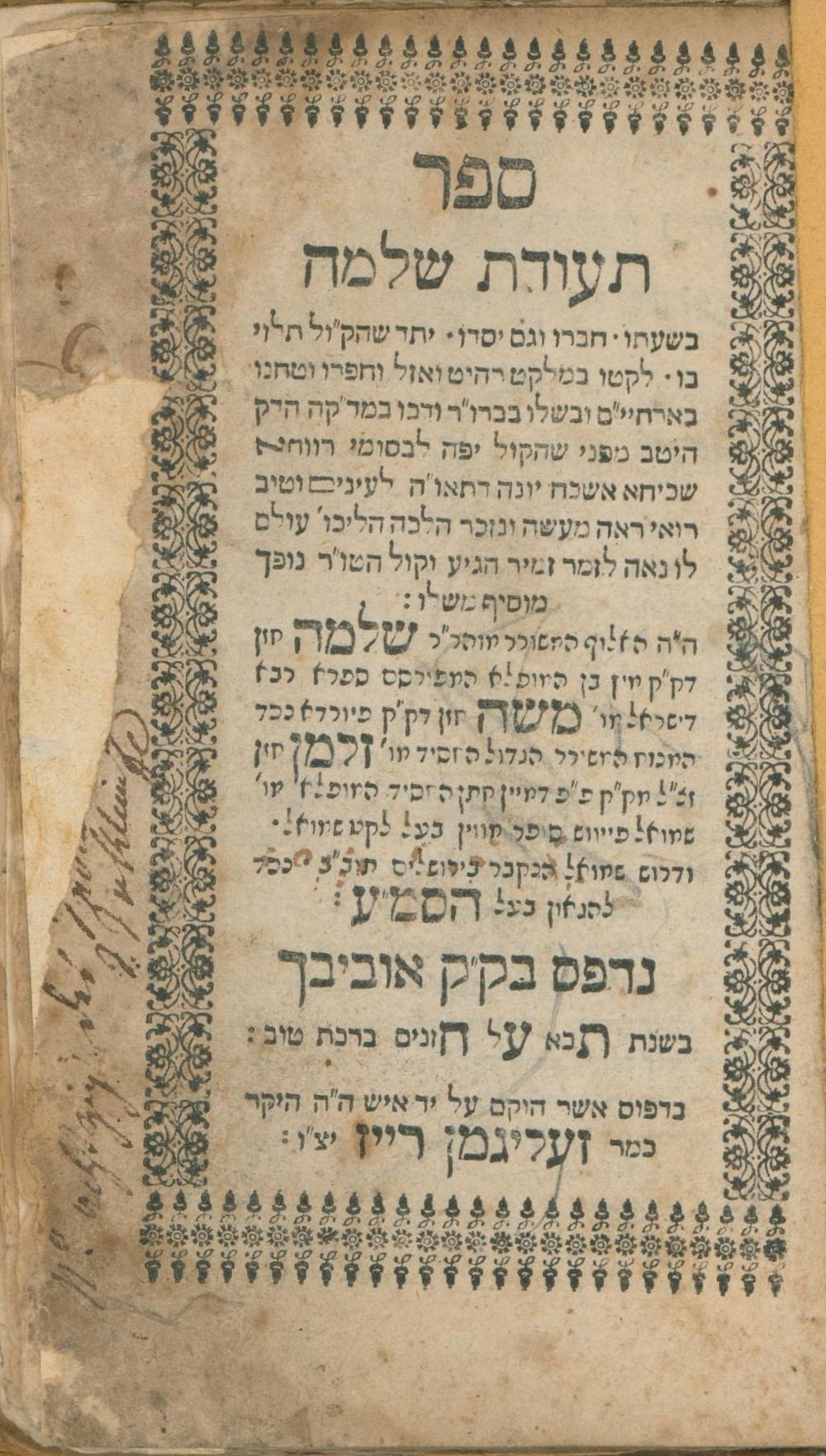
Rare Sefer: Te'udat Shlomo. First Edition, Offenbach, 1718 – A Rare and Important Treatise, an Invaluable Source for the History of Cantorial Music and Liturgy. - Sefer Te'udat Shlomo, an important and distinctive work on the laws and practices of the Jewish cantor (chazzan), by the eminent scholar and saintly Rabbi Shlomo Lipschitz, cantor of the Prague Jewish community and great-uncle of the illustrious Chatam Sofer. First Edition. Offenbach, 1718. Printed by Reis. This rare and significant work is an invaluable document for the history of Jewish cantorial practice. It survived only in this single edition, of which very few copies remain worldwide, and was not reissued until a 1992 facsimile edition. The book discusses the halakhic obligations of cantors and serves as an indispensable source for Ashkenazic liturgical customs. Among its notable rulings, the author states that a cantor must immerse in a mikveh before leading the prayers, and that a cantor who sings without knowledge of musical theory is comparable to one who prays without proper devotion. The work also reproduces the celebrated responsum of Rabbi Judah Aryeh Modena concerning the study of music. As the author explains in his introduction, the primary purpose of the book is to establish the laws and proper conduct for prayer leaders. Alongside discussions of cantorial practice and music, however, approximately half of the volume is devoted to halakhah and Kabbalah, demonstrating the author's broad mastery of every field of Torah scholarship. The work is prefaced by approbations from leading rabbinic authorities of the generation, including Rabbi Jacob Reischer, author of Shev Yaakov; Rabbi Isaac Aharon Worms, Av Beit Din of Mannheim and one of the approvers of Chavot Yair; and Rabbi Benjamin Ze'ev Wolf, author of Ir Binyamin. The second half of the work contains original Torah novellae and Talmudic analyses. Rabbi Shlomo also incorporates Torah insights from his distinguished father, Rabbi Moshe Chazzan of Fürth. Speaking of his own contributions, Rabbi Shlomo writes: ”A son follows in his father's footsteps... I have walked in the path of my ancestors and have also offered some thoughts of my own, according to the limited understanding with which God has graciously endowed me, and 'I will speak of Your testimonies before kings and will not be ashamed.'” These Torah discussions comprise approximately half of the volume. The Author Rabbi Shlomo Lipschitz (1675–1758) was a disciple of the renowned Rabbi David Oppenheim, Av Beit Din of Nikolsburg and Prague. He served as cantor of the Jewish communities of Metz and Prague and was regarded as one of the outstanding cantorial figures of his era. He belonged to the third generation of a distinguished family of cantors. In Ashkenazic communities, cantors were viewed not merely as singers but as sacred emissaries of the congregation, individuals held in exceptional esteem. Rabbi Shlomo's father was the celebrated Rabbi Moshe Chazzan of Fürth, described on the title page as ”the illustrious and renowned great scribe of Israel.” His grandfather, the pious Rabbi Zalman, son-in-law of the author of Leket Shmuel and great-grandson through the maternal line of the Sema (Rabbi Joshua Falk), served as cantor of Frankfurt. Rabbi Shlomo's brother, Rabbi Yaakov Raphael Chazzan, was the father of Rabbi Elchanan Chazzan, whose daughter became the mother of Maran the Chatam Sofer. [6], 46 leaves. 15.8 cm. Antique ownership inscription on the binding ”This sefer belongs to Yehudah Aryeh, son of R. Naftali, may he live a good and long life.”