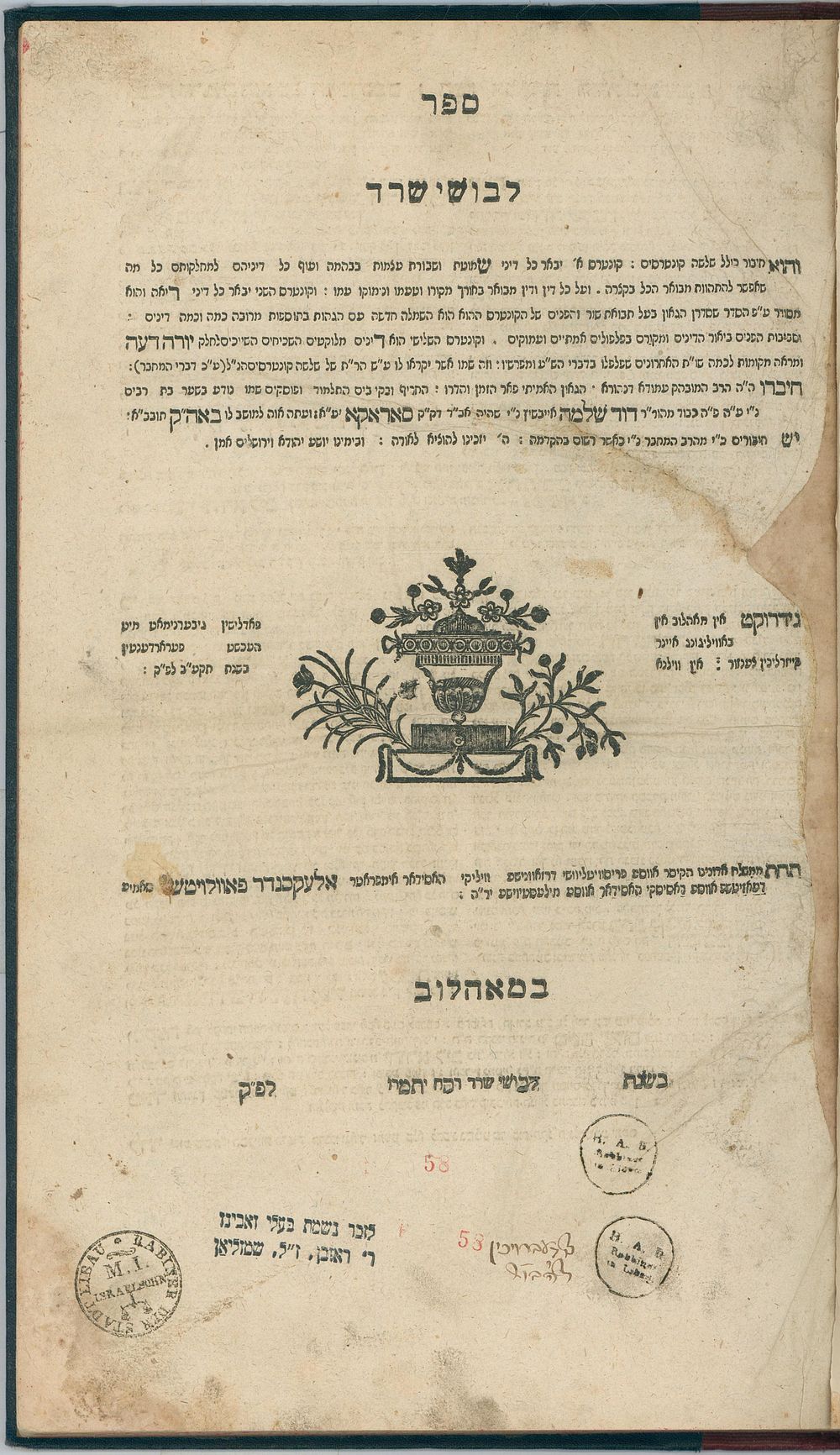
Bidspirit auction | Levushei Serad. [Sudylkiv], [ca. 1828].
Levushei Serad. [Sudylkiv], [ca. 1828]. Rare Edition. - Sefer Levushei Serad, a commentary on the Shulchan Aruch, Yoreh De'ah. [Sudylkiv], [ca. 1828]. The title page states Mohyliv and gives the chronogram corresponding to the year 1812. However, this is not a Mohyliv edition. The title page was copied from the Mohyliv printing with minor alterations (including the omission of the printer Rabin Stein's name). Based on the typography and decorative title-page border, the sefer appears to have been printed in Sudylkiv. Following the approbations, the printer notes: ”Be it known that we possess new approbations from the rabbis and leading sages of our time, prohibiting infringement upon our printing rights until the year 1838.” Since the original approbations prohibited any reprinting of the work for ten years ”from the completion of the printing, ” it follows that this edition was printed around 1828. See: A. Yaari, Hebrew Printing in Mohyliv on the Dniester, Kiryat Sefer, vol. 23 (1946–1947), p. 317; Y. D. Waller, Editions of Levushei Serad and Arvei Nachal, Zachor LeAvraham, 1991, pp. 98–100. This is a rare Russian edition that has appeared only once at public auction. The author, the holy Rebbi David Shlomo Eibeschütz (1755–1814), was one of the leading figures of the Hasidic movement and among the foremost halachic authorities of his generation. He served as Av Beit Din of Khorostkiv and Soroca and, in 1809, immigrated to the Holy Land, settling in the holy city of Safed. His relative, the renowned Rebbi Levi Yitzchak of Berditchev, wrote of him in his approbation: ”Sharp and expert in the chambers of Torah like one of the early sages, and all his deeds are for the sake of Heaven.” His works became foundational texts in both Halachah and Chasidic literature. [1], 102 leaves. 37.5 cm.