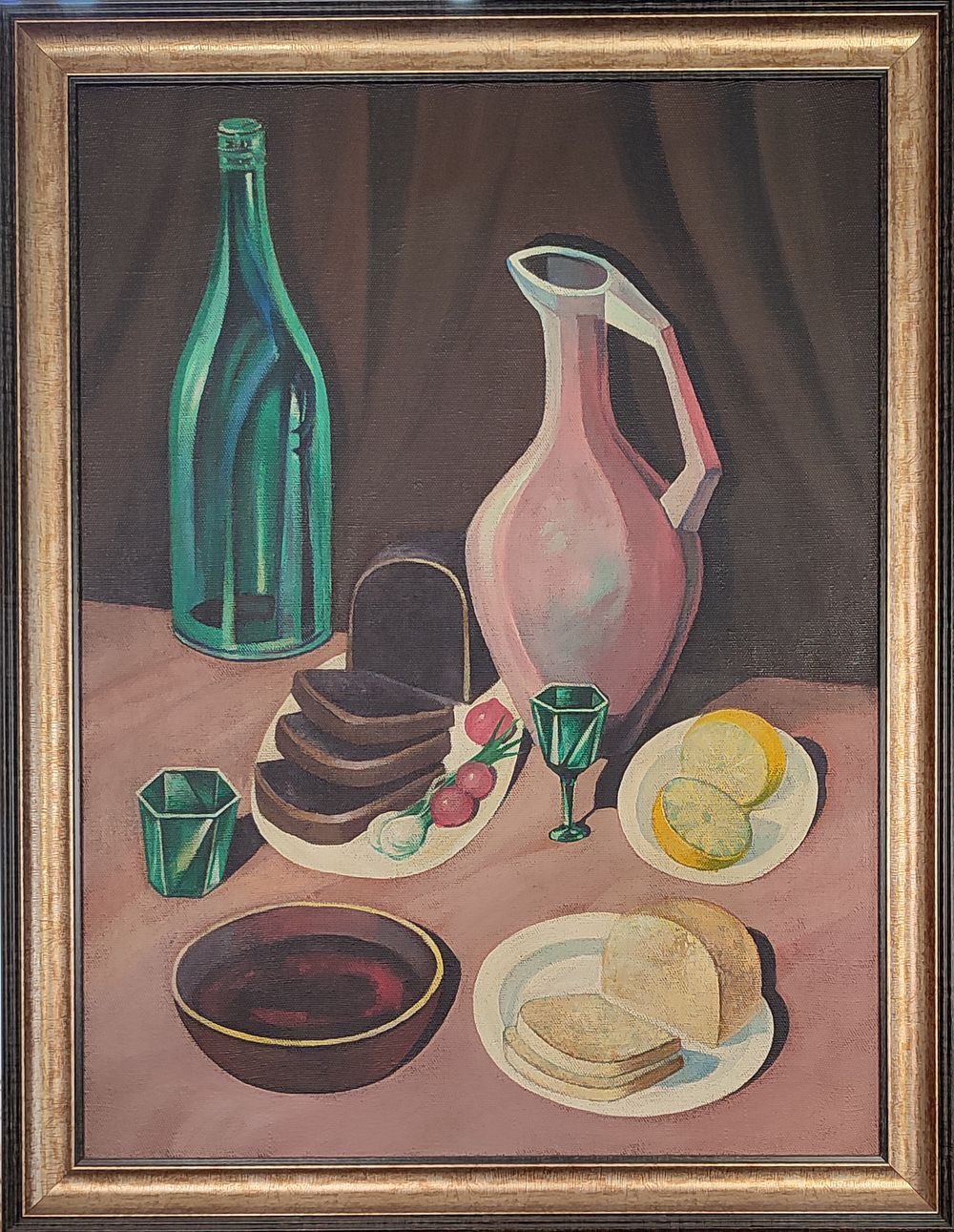
Bidspirit auction | Gevorg Grigorian (Giotto) (Armenian, 1897–1976)
Gevorg Grigorian (Giotto) (Armenian, 1897–1976) - Gevorg Grigorian (Giotto) (Armenian, 1897–1976), oil on cardboard, signed and dated 1963 on verso, 80 x 60 cm. Notes Gevorg Grigorian, widely known by the artistic pseudonym Giotto, was one of the most distinctive figures of twentieth-century Armenian art. Born in Tiflis (now Tbilisi) in 1897, he developed an early fascination with the masters of the Renaissance, particularly Giotto di Bondone, Leonardo da Vinci, Raphael, El Greco, and Luis de Morales, influences that would later inform his unique artistic vision. From 1916 to 1920, Grigorian studied at the School of Painting and Sculpture of the Caucasus Society for the Encouragement of Fine Arts in Tiflis under the renowned Armenian painter Yeghishe Tadevosyan. In 1921, he moved to Moscow, where he continued his studies at the Higher Artistic Workshops (VKhUTEMAS), one of the most progressive art institutions of the period, and became associated with the Armenian artists’ union Hayartun. After returning to Tbilisi, Grigorian devoted himself to both artistic practice and teaching. Despite his growing reputation, the late 1940s marked a tragic period in his life. Subjected to political persecution and professional isolation, he was expelled from the Union of Artists of Georgia and, in a moment of profound despair, destroyed approximately 300 of his own paintings. These difficult years contributed to the rarity and significance of surviving works from his early and middle periods. In 1962, Grigorian settled in Yerevan, where his artistic legacy gradually received wider recognition. He was awarded the title of Honored Artist of the Armenian SSR in 1967. Following his death in 1976, the Gevorg Grigorian Museum-Studio was established in Yerevan to preserve and promote his oeuvre. Grigorian’s work encompasses portraits, still lifes, and landscapes distinguished by a restrained palette, expressive linearity, and remarkable emotional depth. Drawing inspiration from the multicultural environment of Tbilisi, Armenian history, and the cultural achievements of Armenian, Georgian, and Russian intellectual life, he created compositions of exceptional poetic sensitivity. His paintings are celebrated for their quiet elegance, psychological intensity, and distinctive place within the tradition of the Armenian school of Tbilisi. Today, works by Giotto are held in major museum collections, including the Gevorg Grigorian Museum-Studio, the Modern Art Museum of Yerevan, the National Gallery of Armenia, the State Museum of Oriental Art in Moscow, the Zimmerli Art Museum, and numerous private collections worldwide.