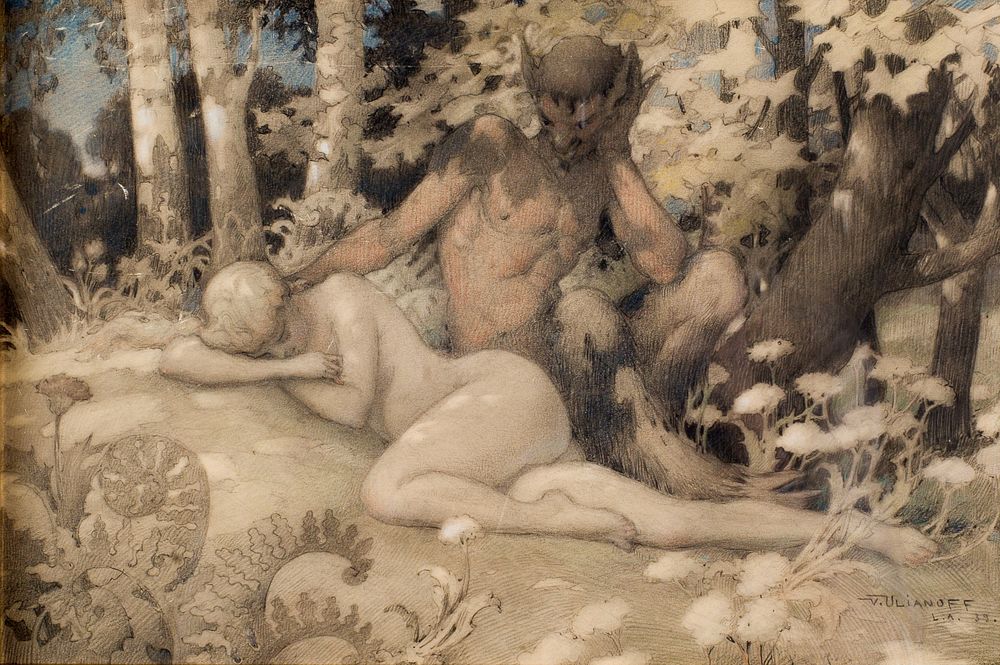
Bidspirit auction | Vsevolod Ulianoff (Russian, 1880-1940)
Vsevolod Ulianoff (Russian, 1880-1940) - Vsevolod Ulianoff (Russian, 1880-1940), pencil and watercolor on paper, signed in Latin and dated '39' l.r, 23 x 34 cm. Notes Vsevolod Fyodorovich Ulyanov was not an avant-garde artist in the strict sense, yet his painting Red Horses (1917) has been included in the exhibition The Great Transition at the Hermitage–Ural Center, dedicated to the Russian avant-garde. The work’s symbolism and its stylistic affinity with the “Blue Rose” circle reflect an artistic current that directly preceded the avant-garde and significantly influenced its development. Painted in 1917, Red Horses (oil on canvas, 137 × 183.5 cm; Yekaterinburg Museum of Fine Arts) presents a dramatic image of galloping horses—an image that, in retrospect, seems almost prophetic of the artist’s own fate. The swastika motif on one of the horse blankets, at the time a symbol of movement, fire, and transformation, echoes the profound upheavals brought by the October Revolution. Ulyanov did not accept the Revolution; in 1918, he left Russia via Siberia, first settling in Harbin before emigrating to the United States. Ulyanov was born in Orenburg, with sources citing either 1878 or 1880 as his year of birth. He received his early education at the Neplyuev Cadet Corps before moving to St. Petersburg to study at the Central School of Technical Drawing of Baron Stieglitz, specializing in decorative and theatrical painting. Upon graduating with a gold medal in 1902, he traveled extensively—visiting Egypt, Greece, and France—and produced numerous sketches during his journeys. After returning to Russia, he worked as a teacher in the Orenburg educational district and later in Zlatoust (1903–1907). He subsequently taught drawing, drafting, and design at the Yekaterinburg School of Art and Industry, contributing significantly to the development of professional art education in the Ural region. Although personally reserved and somewhat distant, he introduced his students to the refined aesthetics associated with the Mir Iskusstva circle. From 1920 onward, under the name Vsevolod Ulianoff, he lived in Los Angeles, where he maintained a successful artistic career. He executed interior decorations for public buildings, including a cycle of 17 large murals on American history for the Bricker’s Hotel, and painted extensive decorative schemes for the Chinese Theatre, comprising hundreds of human and animal figures. He also designed theatrical scenery and created costume designs for film productions. In 1932, he collaborated with artists such as Hugo Ballin on a monumental ceiling fresco for the University of Southern California hospital in Los Angeles. According to the writer Georgy Grebenshchikov, Ulyanov exhibited in his studio a series of works on the theme of the “Tsarevich, ” likely the cycle later known as Last of Knights (1924), which inspired Grebenshchikov’s epic tale Zlatoglav. Ulyanov died in 1940. Despite his wide-ranging career and international activity, he remains relatively little known in Russia today.