Bidspirit auction | Sergei Parajanov (Armenian, 1924 -
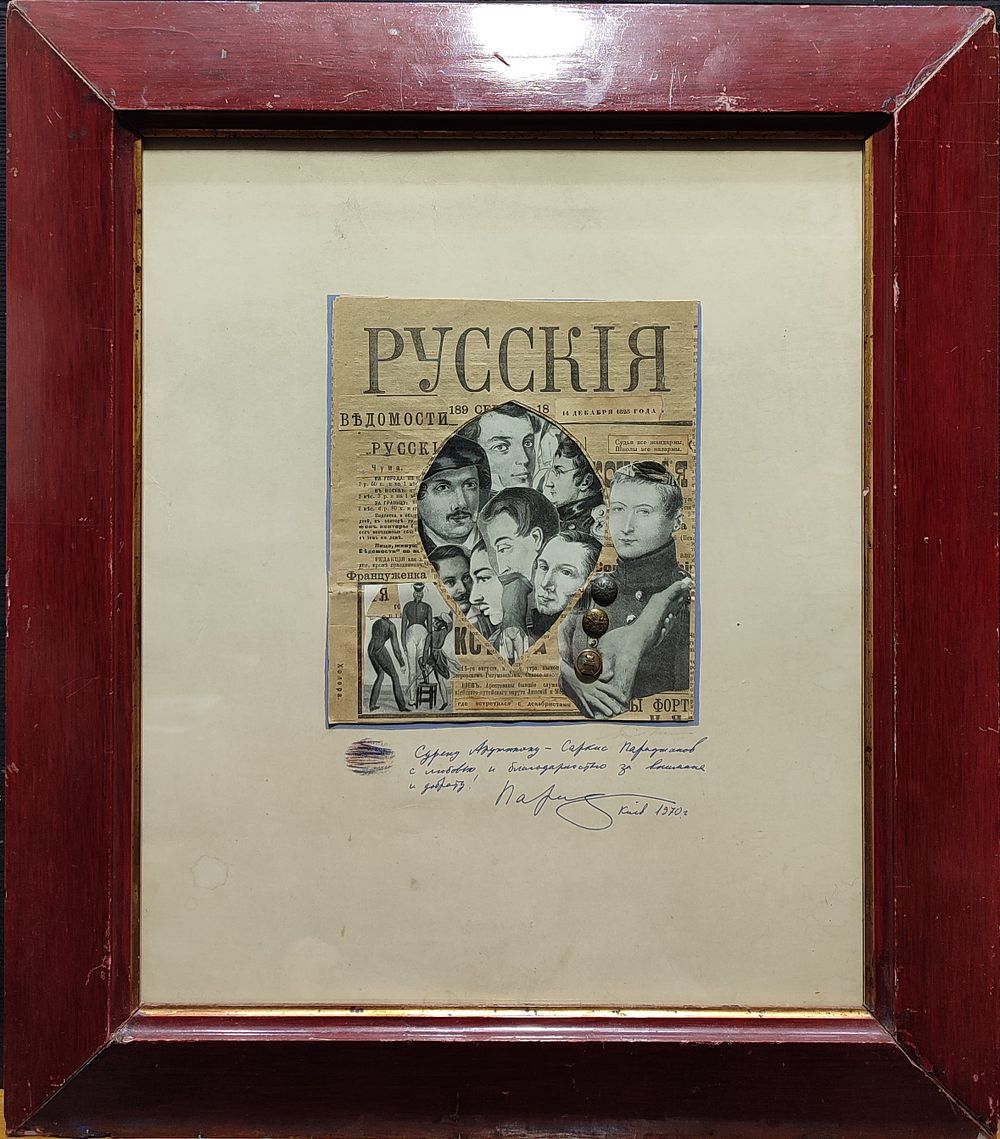
Sergei Parajanov (Armenian, 1924 - 1990) - Sergei Parajanov (Armenian, 1924 - 1990), collage, 23 x 20 cm, passe-partout with the dedication to Suren Harutyunyan and signed 40 x 49 cm. Notes Sergei Iosifovich Parajanov was one of the most innovative and influential artists of the twentieth century, internationally celebrated for his groundbreaking contributions to cinema as a director, screenwriter, visual artist, and collagist. Born in Tbilisi to an Armenian family, Parajanov occupies a unique position at the crossroads of Armenian, Georgian, and Ukrainian cultural traditions, all of which profoundly shaped his artistic vision. After studying directing at the All-Union State Institute of Cinematography (VGIK) in Moscow under the renowned filmmakers Igor Savchenko and Alexander Dovzhenko, Parajanov began his career within the Soviet film industry. His artistic breakthrough came with Shadows of Forgotten Ancestors (1965), a visually revolutionary film that departed dramatically from the conventions of Socialist Realism and established his international reputation. This was followed by his masterpiece The Color of Pomegranates (1969), a poetic and highly symbolic interpretation of the life of the Armenian troubadour Sayat-Nova, now widely regarded as one of the greatest achievements in the history of world cinema. Parajanov's distinctive artistic language was characterized by rich symbolism, striking color, folkloric imagery, and a highly personal visual vocabulary inspired by Armenian miniature painting, religious iconography, folk traditions, and Eastern decorative arts. His work challenged both artistic and political conventions, leading to repeated conflicts with Soviet authorities. Throughout the 1970s he faced censorship, imprisonment, and prolonged restrictions on his creative activity. During periods when filmmaking was prohibited, Parajanov turned increasingly toward visual art, producing an extraordinary body of collages, assemblages, drawings, dolls, and mixed-media works. These creations, often assembled from found objects and everyday materials, reveal the same imaginative richness and poetic symbolism that distinguish his films. Today they are recognized as an integral part of his artistic legacy and are held in museum and private collections worldwide. In the final years of his life, Parajanov returned to filmmaking with The Legend of Suram Fortress (1985) and Ashik Kerib (1988), reaffirming his status as one of the great visionaries of international cinema. Widely admired by fellow artists including Andrei Tarkovsky, Federico Fellini, Jean-Luc Godard, Pier Paolo Pasolini, and Martin Scorsese, Parajanov remains a towering cultural figure whose influence extends far beyond film. His works—whether cinematic, graphic, or assemblage-based—are celebrated for their originality, poetic imagination, and enduring contribution to modern art. Today, the Sergei Parajanov Museum in Yerevan preserves and exhibits his artistic legacy, ensuring the continued appreciation of one of the most remarkable creative minds of the twentieth century.