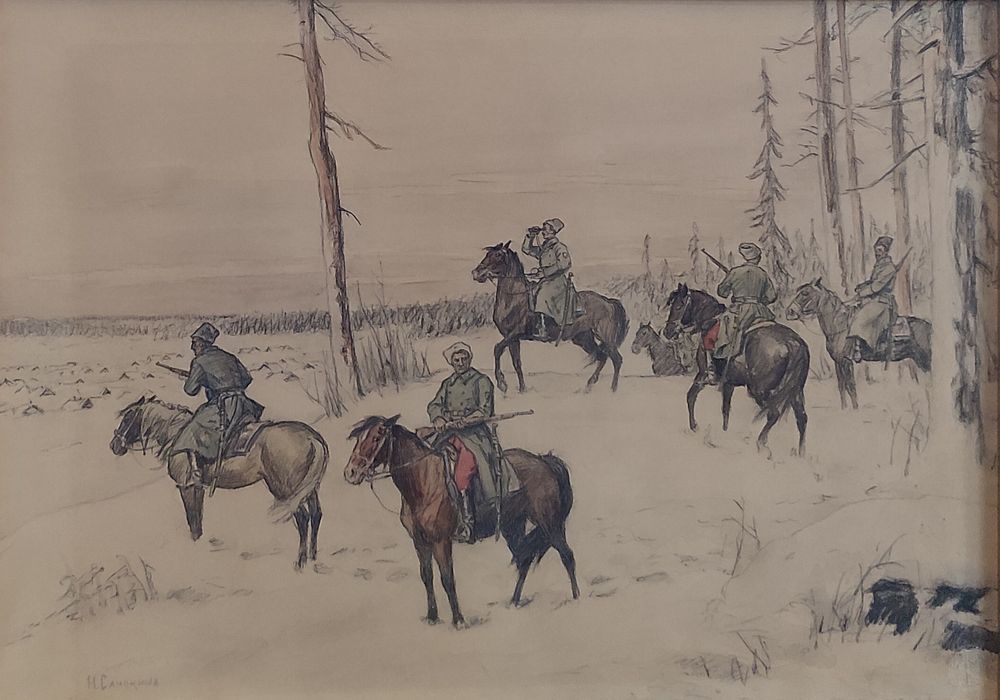
Bidspirit auction | Nikolai Samokish (Russian/Ukrainian, 1860–1944)
Nikolai Samokish (Russian/Ukrainian, 1860–1944) - Nikolai Samokish (Russian/Ukrainian, 1860–1944), charcoal pencil and watercolor on paper, signed l.l., 31,3 x 44 cm. Notes Nikolai Semyonovich Samokish was one of the most accomplished military painters and animal artists of the late Russian Imperial and Soviet periods. Renowned for his dynamic battle scenes, equestrian subjects, and illustrations, he combined academic precision with exceptional observational skill, earning a distinguished place within the tradition of historical and military painting. Born in Nezhin, in the Chernigov Governorate of the Russian Empire (present-day Nizhyn, Ukraine), in 1860, Samokish received his artistic education at the Imperial Academy of Arts in St. Petersburg, where he studied under prominent masters including Bogdan Willewalde, Mikhail Clodt, and Valery Jacobi. His exceptional talent was recognized early in his career, and several of his student works attracted the attention of leading collectors, including Pavel Tretyakov. Between 1885 and 1888, Samokish continued his studies in Paris under the celebrated French military painter Édouard Detaille, whose influence strengthened his command of historical narrative and battlefield composition. Upon returning to the Russian Empire, he collaborated with Franz Roubaud on monumental military panoramas and quickly established himself as a leading specialist in battle painting. In 1890, Samokish was elected an Academician of the Imperial Academy of Arts, and later became a professor at the institution. Throughout his career, he served as an official artistic correspondent during major military conflicts, including the Russo-Japanese War and the First World War, producing extensive visual records of military campaigns. His firsthand observations endowed his battle scenes with remarkable authenticity and dramatic energy. Alongside military subjects, Samokish achieved particular distinction as an animal painter, especially for his depictions of horses. His equestrian compositions are celebrated for their anatomical accuracy, movement, and vitality, qualities that remain among the defining characteristics of his oeuvre. Works such as Herd of Mares at the Watering Hole, which earned him the title of Academician, exemplify his mastery of animal painting. A prolific illustrator, Samokish produced thousands of drawings for literary and historical publications. Among his most notable commissions were illustrations for Taras Bulba by Nikolai Gogol, works by Marko Vovchok and Ivan Nechuy-Levytsky, as well as the monumental publication Imperial Hunting in Russia. His illustrations are highly regarded for their technical excellence and vivid narrative quality. During the Soviet period, Samokish continued to work actively as a painter, educator, and consultant on large-scale historical projects, including the celebrated panorama depicting the Siege of Perekop. In recognition of his artistic achievements, he was awarded the Stalin Prize in 1941. Today, Samokish is regarded as one of the foremost military and equestrian painters of his era. His works are represented in major museum collections across Eastern Europe and remain highly sought after for their historical significance, technical virtuosity, and powerful depiction of movement and action.