Bidspirit auction | Tamara Starzhenetskaya (Russian, 1912–2002)
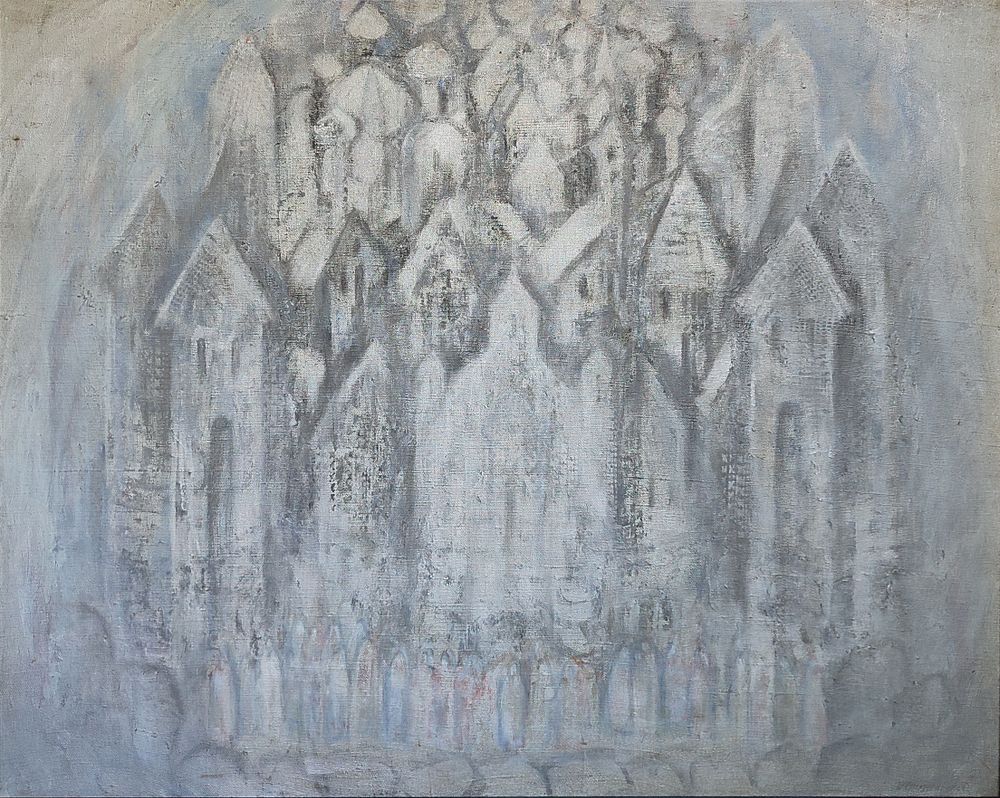
Tamara Starzhenetskaya (Russian, 1912–2002) - Tamara Starzhenetskaya (Russian, 1912–2002), Design for the Nikolai Rimsky-Korsakov's monumental opera”The Legend of the Invisible City of Kitezh and the Maiden Fevroniya”, Act II: Little Kitezh, tempera on canvas, signed l.r., export and price lables on reverse, 80 x 100 cm Notes Tamara Georgievna Starzhenetskaya was a prominent Soviet theatre artist, stage designer, and painter whose career spanned more than five decades and encompassed some of the most important theatrical institutions of the USSR. Renowned for her sophisticated scenic designs, she combined a painter's sensitivity to color and composition with a deep understanding of music, drama, and theatrical space. Born in Moscow in 1912, Starzhenetskaya received an early education with an architectural focus and worked in the pre-war years at the architectural studio of the celebrated Vesnin brothers while simultaneously pursuing studies in painting. In 1940, she entered the Institute of Painting, Sculpture and Architecture in Leningrad (now St. Petersburg). Her studies were interrupted by the Second World War, during which she endured the siege of Leningrad before being evacuated with the institute to Samarkand in 1942. Returning to Leningrad after the war, she graduated with distinction in 1948 from the prestigious Ilya Repin Institute, specializing in theatrical design under Mikhail Bobyshev. That same year, Starzhenetskaya joined the Union of Artists of the USSR and began exhibiting her work. Her talent was quickly recognized on a national level when she received second prize in the All-Union competition for the design of The Sleeping Beauty at the Bolshoi Theatre. From the early 1950s, she worked as a stage designer for the Bolshoi Theatre, where she contributed to several major productions and established herself as one of the leading theatrical artists of her generation. Among her most notable achievements was her work on Giuseppe Verdi's Aida, directed by Boris Pokrovsky, for which she designed both sets and costumes. Throughout her career, she created stage designs inspired by the music of Edvard Grieg, Pyotr Tchaikovsky, Nikolai Rimsky-Korsakov, Wolfgang Amadeus Mozart, Richard Wagner, and Dmitri Shostakovich. Reflecting on her artistic process, she remarked: ”I perceive music through color, and color through music.” This synesthetic approach became a defining characteristic of her work. In 1957, Starzhenetskaya served as Chief Designer of the Sixth World Festival of Youth and Students in Moscow. Over the following decades, she designed productions for opera, drama, and musical theatres across the Soviet Union, including major theatres in Yerevan, Tbilisi, Tashkent, Odessa, Saratov, Voronezh, Donetsk, Yaroslavl, Volgograd, Syktyvkar, and other cultural centers. Alongside her theatrical career, Starzhenetskaya maintained an active practice as an easel painter. Extensive travels throughout the Soviet Union and abroad provided inspiration for numerous landscapes, architectural studies, and observational sketches executed directly from nature. These works reveal the same mastery of atmosphere, color, and spatial construction that distinguished her stage designs. Today, Tamara Starzhenetskaya is remembered as an important figure in Soviet theatrical art whose legacy bridges the worlds of painting, architecture, music, and stage design. Her works are appreciated for their decorative sophistication, painterly richness, and their contribution to the visual culture of twentieth-century theatre.