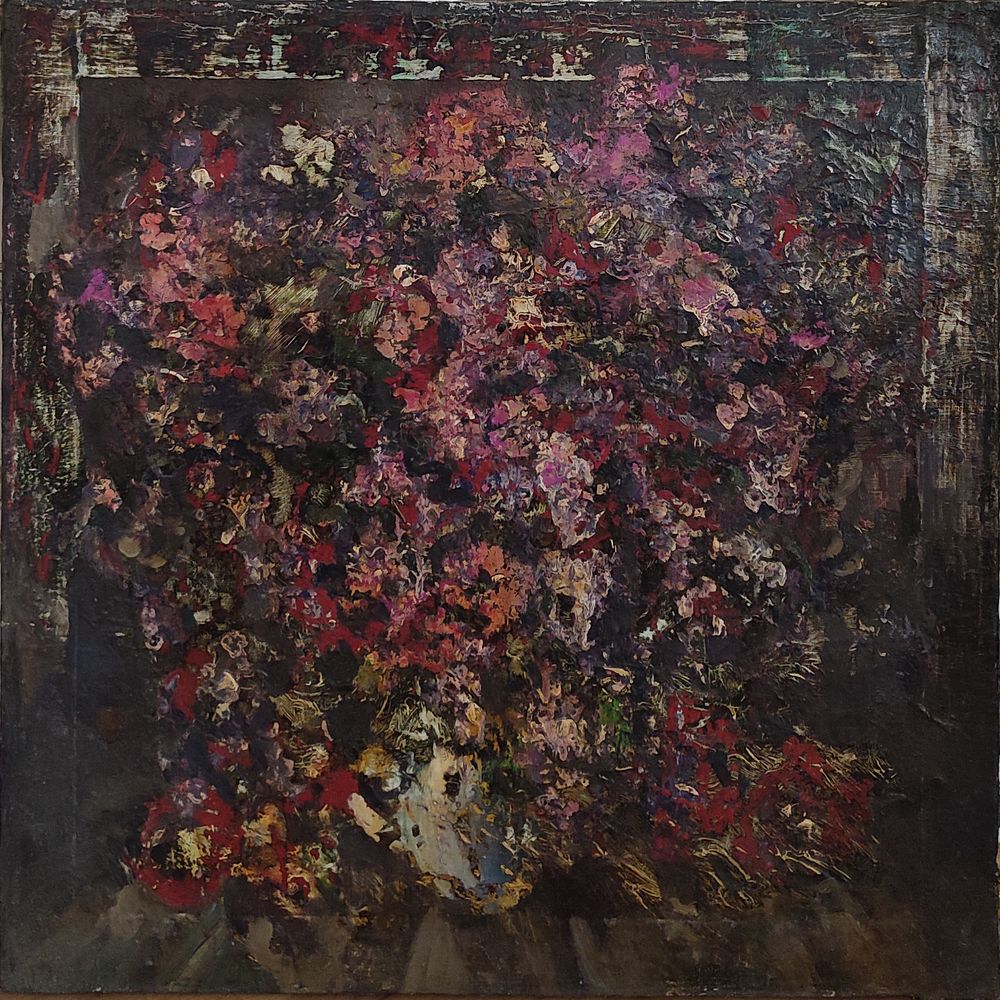
Bidspirit auction | Zulum Grigoryan (Armenian, 1932–2018)
Zulum Grigoryan (Armenian, 1932–2018) - Zulum Grigoryan (Armenian, 1932–2018), oil on canvas, signed on reverse, 75 x 75 cm. Notes Zulum Nikoghosi Grigoryan was one of Armenia’s most distinguished painters and a recipient of the title of People's Artist of the Republic of Armenia (2010). Born in Krasnodar in 1932, he graduated from the Yerevan State Institute of Fine Arts and Theatre in 1957 and became a member of the Union of Artists of Armenia the same year. He was also the father of the noted painter Mushegh Grigoryan. Working primarily in the genres of figurative composition and landscape, Grigoryan developed a highly expressive style distinguished by psychological depth and emotional intensity. His rich palette, dominated by silvery and grey tones, is complemented by energetic, impassioned brushwork, often softened by delicately rendered passages. His paintings are represented in the collection of the National Gallery of Armenia. A central theme throughout Grigoryan’s oeuvre was the Armenian Genocide. His early works were deeply imbued with patriotic sentiment, and the series Nightmare Days (1955–57) marked the beginning of his extensive reflections on historical memory. Other significant works inspired by national themes include The Zeytuntsis, Longing, Vision, Justice, Three Generations, and It Was Spring. Alongside these historical compositions, his landscapes and still lifes convey a profound affection for Armenian culture and everyday objects, which appear as silent witnesses to a vibrant and enduring past. Grigoryan's art was widely exhibited internationally, with solo exhibitions held in Hungary and Czechoslovakia (1972), Germany (1977), the United States (1977), Denmark (1978), France (1977, 1978), Moscow (1987), Yerevan (1994, 1998), and Vienna (2002). Among his most notable works are Nightmare Days (1955–57), The Zeytuntsis (1960, National Gallery of Armenia), It Was Spring (1965, National Gallery of Armenia), Three Generations (1966, National Gallery of Armenia), Longing (1971), Daily Bread (1973), Vision (1979–80), Justice (1980), Evening Bells (1985), Meditation (1989), Autumn Still Life (1994–2004), Astvatsenkal Church (2002), Mount Ara (2010), and Saghmosavank (2010). Admired for both his artistic vision and personal integrity, Zulum Grigoryan occupies a unique place in Armenian art. Critics have noted the extraordinary emotional power of his paintings, which simultaneously unsettle and inspire, awakening a deep sense of warmth and humanity. Guided by intuition and sincerity, Grigoryan believed that the artist's mission was to elevate public taste and lead viewers toward the highest ideals of art—a conviction reflected throughout his remarkable body of work.