Bidspirit auction | Giovanni Battista Della Porta (Vico
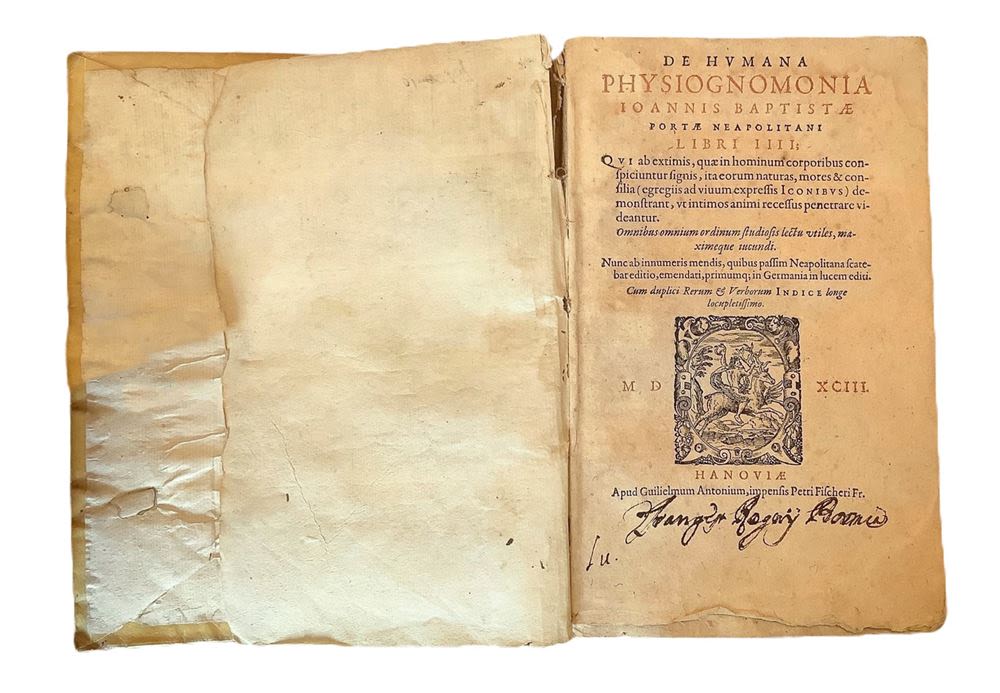
Giovanni Battista Della Porta (Vico Equense, 1535 - Napoli, 1615) - De Humana Physiognomonia. 1593 Technique: Scienza - Fisiognomonia Dimensions: 13x20 cm Qui ab extimis, quae in hominum corporibus conspiciuntur signis, ita eorum naturas, mores et consilia (egregiis ad vivum expressis Iconibus) demonstrant, ut intimos animi recessus penetrare videantur. Omnibus omnium ordinum studiosis lectu utiles, maximeque iucundi. Nunc ab innumeris mendis, quibus passim Neapolitana scatebar editio, emendari, primumquae in Germania in lucem editi. Cum duplici Rerum et Verborum Indice longe locupletissimo. Libri IIII; Hanoviae, apud Guilielmum Antonium, impensis Petri Fischeri Fr., 1593. Pag. 586 Other: Giovanni Battista della Porta (or sometimes, Giovanni Battista Porta) (Vico Equense, 1535 - Naples, 1615) was a philosopher, alchemist, playwright, scientist and polyhedric man and eruded that, with its greatness dominated the scene of Italian scientific thought Even before the statement of Galileo Galilei of which he was a friend (and even before him wrote a treaty, the ”de telescope”). He wrote a huge number of works, including Magiae Naturalis (1558), on the art of remembering (1566). He founded the Naturae Secretorum Academy (Secret Academy) in the field of natural sciences, pharmacopedia, medicine, chemistry, etc. to which Galilei and other large contemporary scientists participated. Suspected that dealt with themes of magic and occultism, it was investigated by the Inquisition and the Academy was closed. In 1586 he published in Latin the Treaty ”De Humana Physiognomonia” in 4 books obtained great success (this work will constitute the base of the studies of the great Johann Lavater and then of the Lombroso). It is in fact a parascientific discipline that, studying the correlation between the character and physical aspect of the person, aims to deduce the psychological characteristics of individuals. However, in 1592 the Holy Uffizio forbid him to publish the Italian version, (but he will publish it equally, with a pseudonym, in 6 books, in 1598). The present work, enriched by numerous tables in which figures of human profiles and morphologically similar profiles are placed compared to animals has a binding in parchment coevia and calligraphic title on the back. However, the particular and extreme rarity of the volume consists in the fact that according to all biographies, after the strict prohibition of publication by the Holy Office of 1592, the door would proceed to publish the work in 6 volumes (with a pseudonym) , only in 1598, while our specimen, on the other hand, shows irrefutably as he had hastened to publish it the following year (1593), but for prudence in an unknown resort (Hanoviae). No news appears in this edition in any biography.