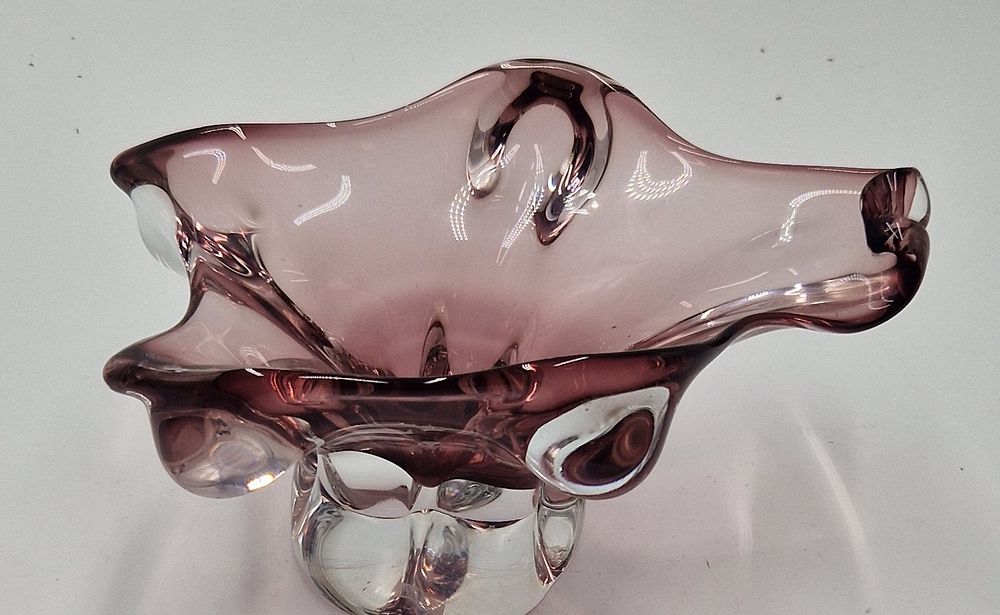
Bidspirit auction | CHRIBSKA (Czechoslovakian) (Mid 20th Century)
CHRIBSKA (Czechoslovakian) (Mid 20th Century) COLOURED GLASS BOWL By Mr Josef Hospodka. (Few pieces of mid-century glass capture attention quite like Chribska Glass. Known for its bold colours, fluid shapes, and sculptural forms, this glassware combines craftsmanship and imagination in equal measure. It holds an important place in Czech design history and remains one of the most recognisable examples of 20th-century art glass. Collectors around the world value Chribska Glass for its quality, individuality, and character. Each piece carries the fingerprint of the glassmaker who shaped it. No two examples are ever the same, and that uniqueness keeps it popular with collectors, decorators, and enthusiasts. The story begins in Chřibská, a small town in northern Bohemia, near the German border. Glassmaking there dates back to the early 15th century, which makes it one of the oldest continuous glassmaking regions in Europe. For hundreds of years, local families produced window glass, bottles, and simple tableware. By the 19th century, the factory had grown into a respected workshop supplying decorative glass to Austria and Germany. Then, after World War II, the Czechoslovak government nationalised most of the country’s glassworks. The Chřibská factory became part of a network of state-owned enterprises that aimed to rebuild and modernise Czech design. Although the company’s name changed several times, the glassmakers of Chřibská kept their focus on quality. In the mid-20th century, that focus led to a new and exciting direction. The transformation of Chribska Glass began with one man — Josef Hospodka. Born in 1923, he studied sculpture and design at the Academy of Arts, Architecture and Design in Prague. After graduating, he joined the Chribska glassworks, where his creativity and technical knowledge soon made an impact. Hospodka believed that glass should move beyond utility. He wanted each object to feel alive, with curves that reflected light and colour in unpredictable ways. His designs broke away from traditional symmetry and introduced free-flowing, organic forms.) Because he worked directly with the glassmakers, Hospodka developed new techniques that allowed molten glass to stretch, twist, and fold without losing control. The result was a distinctive style filled with movement, contrast, and emotion. Under his influence, Chribska Glass entered a new golden age during the 1950s and 1960s. The workshop produced decorative pieces that stood alongside international names such as Murano and Whitefriars. Yet, it kept its own unmistakable identity.)