Bidspirit auction | Landscape painting by the artist
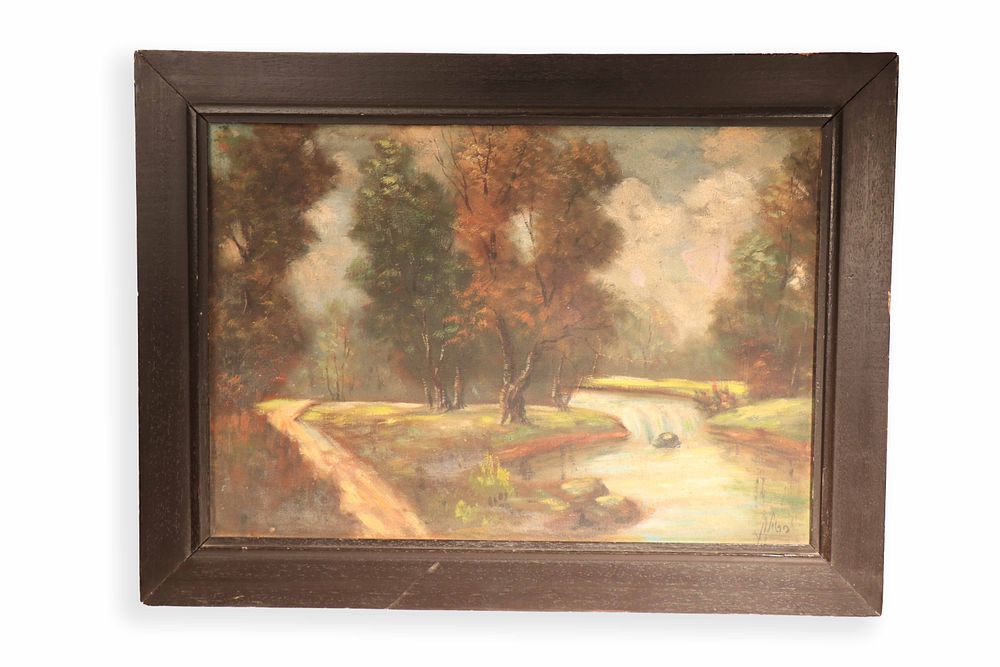
Landscape painting by the artist Yehuda Leon Patilon - Yehuda Leon Patilon was born in Salonika, Greece, to a family descended from the exiles of Spain, and grew up alongside his grandfather, the Kabbalist, and thus from a young age engaged in Kabbalah and Tikkun Chatzot. His exact year of birth is not known, among other reasons, because no documents were preserved, and he himself sometimes changed his age to avoid army conscription. After the Second World War, he immigrated to Israel and settled in the Shabazi neighborhood of Tel Aviv, where he lived a modest life and worked in painting as a source of livelihood until he earned the title “The Holy Painter.” He lived in poverty and was known as a G-d-fearing man with spiritual influence. Patilon integrated into his work a spiritual–Kabbalistic approach. He passed away in the month of Cheshvan in 1974. The style of Yehuda Leon Patilon is characterized by simple and direct realism, based mainly on oil paintings on canvas or on cardboard. He often depicted landscapes, quiet urban surroundings, and at times Jewish figures, though he avoided painting women. In his works, one senses the presence of soft natural light and compositions with depth, which highlight modesty and simplicity — values that were a central part of his personality. Alongside this, Patilon’s Kabbalistic and spiritual background is subtly present in his paintings, at times through a sense of contemplation, loneliness, or an inward gaze into a spiritual world, which made his works a unique combination of figurative craftsmanship and spiritual depth. In the work, there is a pastoral landscape with a winding path beside a small stream, among tall trees and slight mist softening the background. Patilon’s use of soft oil colors and gentle light–shadow transitions creates a quiet and contemplative atmosphere. The path and the stream lead the viewer inward and give the work a sense of depth and a calm journey within nature. The composition is balanced, based on quiet and non-dramatic nature, and expresses Patilon’s tendency to create landscapes that contain innocence, modesty, and a sense of inner contemplation. There are slight defects in the canvas of the work, tears in the lower part.