Bidspirit auction | Meikitz Nirdamim, by the Gaon
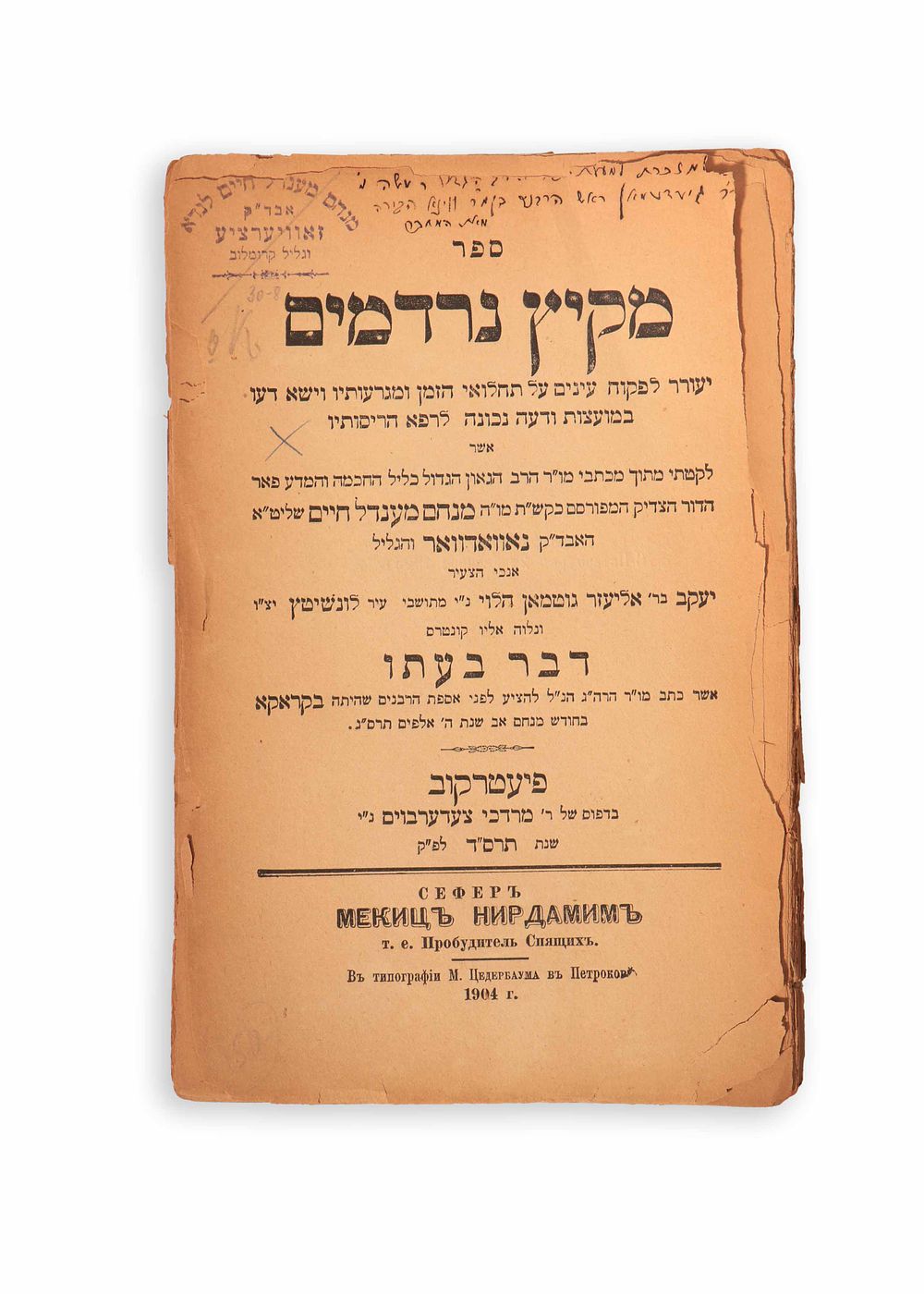
Meikitz Nirdamim, by the Gaon Rabbi Menachem Mendel Chaim [Landa], Av Beis Din of Novodvor. Piotrków, 1904. First edition, with the author’s inscription. Sefer Mekitz Nirdamim, on the ailments of the time and its deficiencies, with the booklet Davar B’Ito, by Rabbi Menachem Mendel Chaim, Av Beis Din of Novodvor, edited by Rabbi Yaakov Gutman HaLevi. Mordechai Zederbaum Press, Piotrków, 1904. [2], 140 pp., with a separate title page for the booklet Davar B’Ito, containing a proposal by Rabbi Menachem Mendel Chaim Landa before the Rabbinic Conference of Krakow, 1903, primarily on matters of Torah study, observance of the Mitzvos, and the splendor of the rabbinate. With an inscription in the author’s handwriting: 'למעלת [...] הרב הגדול ר' משה נ”י ד”ר גיעדעמאן ראש הרבנים בן מ”ר ווינא הבירה' With the author’s stamp: 'מנחם מענדל חיים לנדא, אבד”ק זאוויערציע וגליל קרומלוב' Rabbi Dr. Moshe ben Rabbi Yosef Giedemann (Mahar”m Giedemann, 1835–1918) — of Hildesheim, disciple of Rabbi Samson Raphael Hirsch. From 1890 he served as chief rabbi of the capital city Vienna. Author of HaTorah VeHaChaim B’Artzos HaMa’arav Bimei HaBeinayim (vols. I–II, 1897–1899), and wrote notes on Pesikta Rabbasi (Vienna edition, 1880). Harav HaKadosh Rabbi Menachem Mendel Chaim Landa (1861–1935) — son of Harav HaKadosh Rabbi Yaakov of Yezov and grandson of Harav HaKadosh Rabbi Avraham of Tashkenov. Rabbi Menachem Mendel Chaim received Semichah from the Gaon Rabbi Chaim Elazar Wax, Av Beis Din of Kalish, and served as Rav in many towns from 1885. From 1894 he filled his father’s place in the Admor’s leadership. From 1899 he served as Av Beis Din of Novodvor, and from 1904 as Av Beis Din of Zawiercie and the district of Kromelow. From 1922 he served as Rav in Chassidic communities in New York, and later returned to Poland, where he passed away on his way to Eretz Yisrael. He was renowned as a Gaon in all disciplines of Torah, a rapid writer, educator, and outstanding Darshan, keenly aware of worldly affairs and a remarkable critic, with great expertise in the study of the Hebrew language and in the history of Am Yisrael. See Zchuta D’Avraham (1949), pp. 160–210, for a comprehensive article about him, about the reactions to the present Sefer, and about the controversy that arose in its wake. Without binding (aside from a damaged and detached back cover). Damaged spine dividing the Sefer into several leaves and gatherings. Defects along the edges of some pages. Fair condition.