Bidspirit auction | משניות עם הגהות בכתב יד
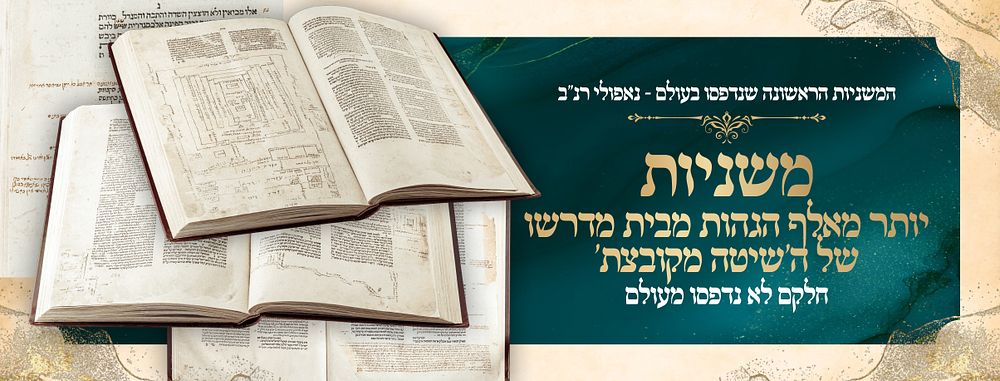
משניות עם הגהות בכתב יד - The First Mishnayos Ever Printed! – Naples, 1492 – Approximately One Thousand Glosses from the Beis Medrash of the Shitah Mekubetzes – Numerous Handwritten Diagrams from the Sixteenth Century – A Menorah Drawing Contrary to the Chabad Tradition! Mishnayos on Seder Kodashim and Taharos , with the Rambam's commentary. Naples, 1492. Incunable! The first edition of the Mishnah ever printed , and among the earliest Hebrew books to emerge from the printing press! The present volume is profusely annotated with approximately one thousand handwritten glosses , many lengthy, entered by an early talmid chacham from the Beis Medrash of Rav Betzalel Ashkenazi, author of the Shitah Mekubetzes, together with additional glosses by another early gaon. Numerous halachic diagrams, apparently dating from the sixteenth century, appear throughout the volume. According to the note printed in every Vilna Mishnayos, based on the research of Rav Raphael Natan Nata Rabinovicz, author of Dikdukei Sofrim , only ten copies of this Naples Kodashim-Taharos volume are known to exist. Approximately One Thousand Glosses from the Beis Medrash of the Shitah Mekubetzes Rav Betzalel Ashkenazi had a particular affection for Kodashim and Taharos . As Rav David Conforte , author of Korei HaDoros , relates: ”...While I was in Yerushalayim, I came upon his Venice Talmud, entirely corrected in his handwriting, especially throughout Kodashim and Taharos, every margin filled from end to end with his handwritten glosses...” Today, a Venice 1546 edition of Mishnayos Taharos bearing many glosses in the handwriting of Rav Betzalel Ashkenazi , or that of a close Talmid, is well known and has served as the basis for later printed editions of his corrections. The present volume appears to preserve another witness to that remarkable scholarly tradition. A comparison with the published glosses reveals that many correspond to those attributed to Rav Betzalel Ashkenazi, while numerous others appear never to have been printed. The evidence strongly suggests that these glosses were penned by one of the gedolim of the Beis Medrash of Rav Betzalel Ashkenazi in Egypt, where the authoritative corrections to the Rambam's commentary on the Mishnah were produced. This volume may preserve an entirely new body of textual corrections to the Rambam's commentary on the Mishnah—an extraordinary discovery whose significance for the study of the Rambam has yet to be fully explored. Contemporary Halachic Diagrams Throughout the Naples edition, the printer intentionally left blank spaces where illustrations were evidently intended but never printed, likely because of the technical limitations and expense of producing woodcuts. These spaces have been filled by an accomplished early hand with numerous halachic illustrations, especially for Maseches Middos , including a large plan of the Beis HaMikdash and many other explanatory diagrams, apparently executed during the sixteenth century. An Early Drawing in the Menorah Debate! Among the most remarkable illustrations is a carefully executed drawing of the Menorah , depicting rounded branches . For generations, great authorities debated whether the branches of the Menorah were straight or rounded . Rashi describes them as extending diagonally, and a famous sketch attributed to the Rambam likewise depicts straight branches—a view championed in recent generations by Lubavitch . By contrast, the majority of ancient representations of the Menorah—including coins, mosaics, stone carvings, and the famous Arch of Titus —show rounded branches. The present volume preserves a remarkable early witness , apparently drawn during the sixteenth century alongside the Rambam's commentary to Maseches Menachos, depicting the Menorah with rounded branches. An extraordinary manuscript treasury of early glosses and illustrations, preserved within the very first edition of the Mishnah ever printed—a volume whose importance can scarcely be overstated!