Bidspirit auction | Nikolai Ivanovich Golikov (1924–2011)
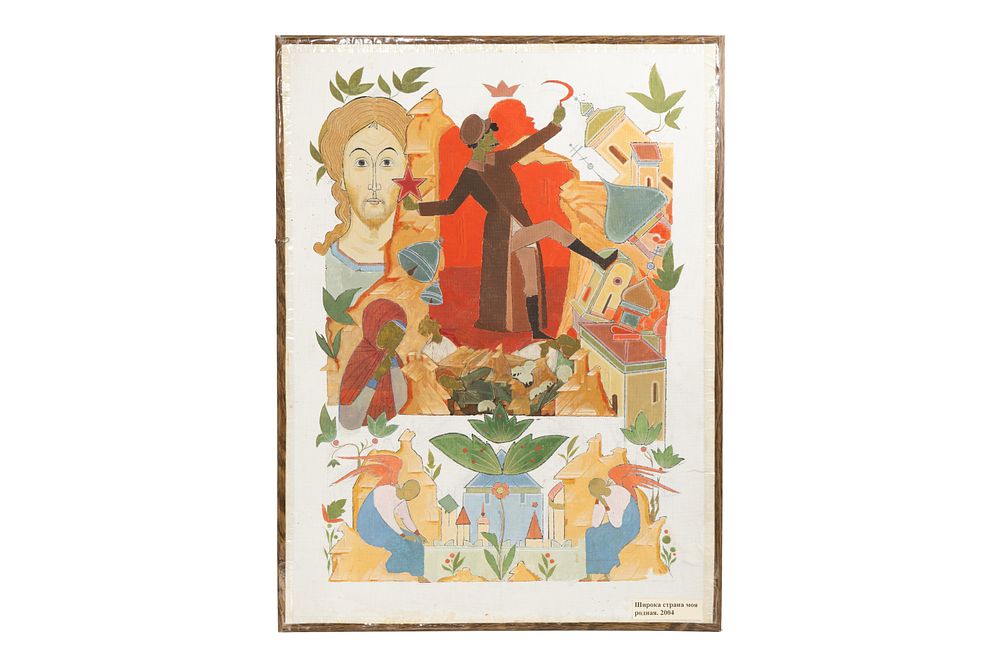
Nikolai Ivanovich Golikov (1924–2011) - Programmatic Painting “Wide Is My Motherland” (“Bolshevik”). Palekh, Russia, 2004. Tempera and gold on canvas laid on board. 60 by 40 cm Condition report: Surface wear; stains and traces of moisture; deformation of support; adhesive traces along edges and verso; edges reinforced. Provenance: From the family collection of the Golikov dynasty. Created during the artist’s late period and preserved in the personal collection of Nikolai Ivanovich Golikov as part of his philosophical cycle. A programmatic late work addressing historical and philosophical themes of the 20th century. The composition is structured through strong contrasts and symbolic oppositions. The central figure - “the Bolshevik” - is presented as a monumental emblem rather than an individual character, defined by expressive form and dominant color. The surrounding space is filled with dramatic imagery: architectural elements suggesting destruction and transformation. Opposing zones introduce iconographic motifs - Christ and the Virgin - rendered with references to traditional Russian icon painting. The lower register features a procession of angels, creating an allegorical narrative structure. The landscape and architecture function as symbolic rather than literal space. The painting combines bold color fields (red, black, ochre) with refined linear detail. The use of gold enhances the visual and symbolic intensity of selected elements. This work represents a rare shift from narrative tradition toward philosophical expression within the Palekh school. ”Wide Is My Motherland”, also known as the ”Song of the Motherland”, is a Soviet patriotic song from 1936. The music was composed by Isaac Dunaevsky and the lyrics were written by Vasily Lebedev-Kumach. The song was first featured in the classic Soviet film Circus. Collecting & Investment Potential: Late philosophical works by Nikolai Ivanovich Golikov are exceptionally rare. Such pieces were typically created outside commercial circulation and remained in the artist’s personal archive. This lot is significant both as a work of the Palekh tradition and as an independent conceptual statement bridging decorative and intellectual painting. A key late work reflecting the artist’s transition to symbolic and philosophical language.