Bidspirit auction | Patek Philippe
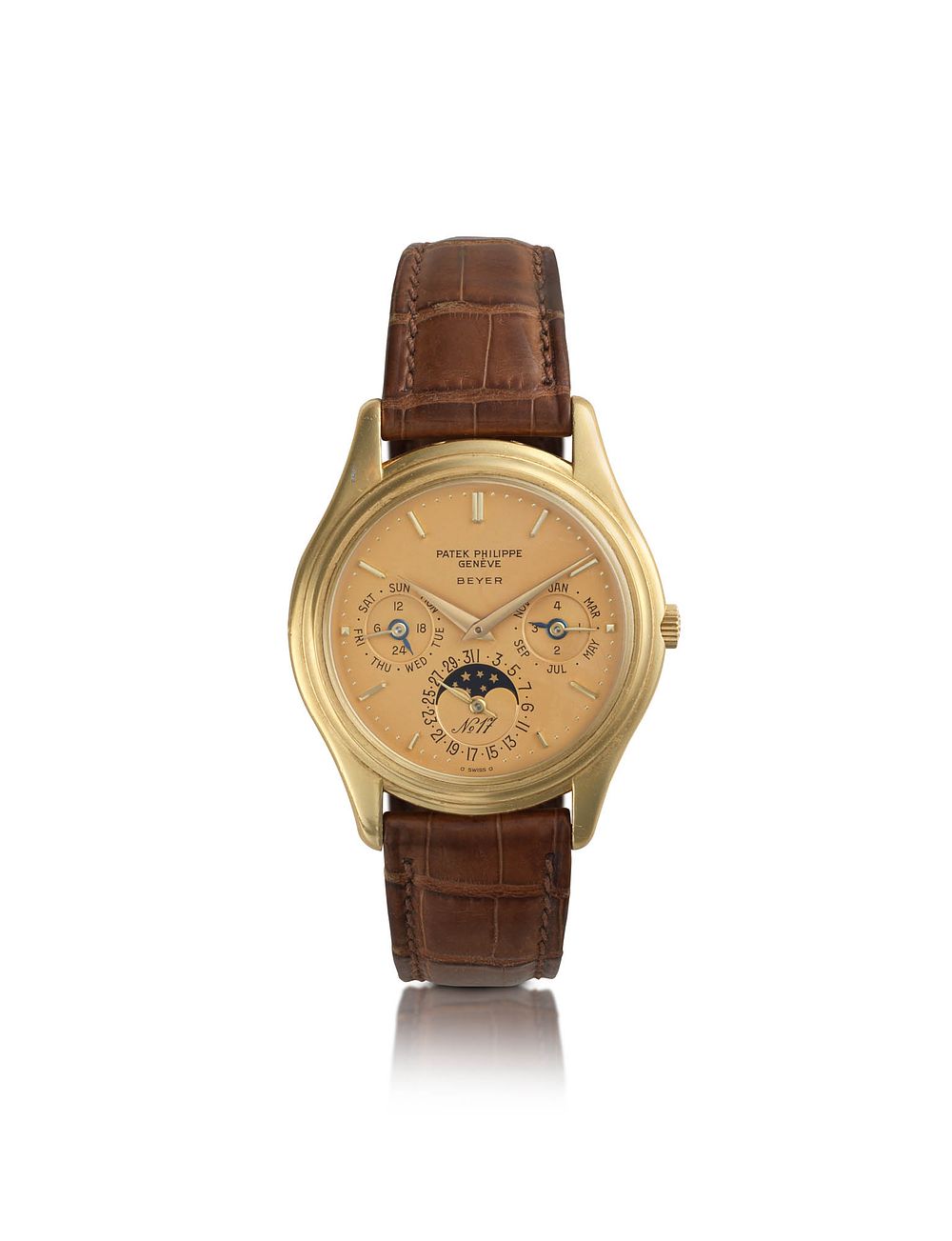
Patek Philippe - Patek Philippe “Beyer No. 17” Ref. 3940, No. 770 017, circa 1985 A 18k yellow gold automatic perpetual calendar wristwatch with moon phases made for the 225th anniversary of Beyer in Zurich Case: tonneau shape, snap-on case back, engraved on the back Patek Philippe No. 770 017 Fabriquée pour le 225ème anniversaire de Beyer à Zürich 1760–1985, signed Dial: champagne with applied baton indexes, 3 subsidiary dials for the indication of months and leap year, aperture for the moon phases with date and days of the week with 24h display, numbered No. 17 and double signed Patek Philippe and Beyer Movement: automatic with micro-rotor, nickel finished, caliber 240Q, 27 jewels, signed Buckle/Clasp: 18k yellow gold buckle, signed Dimensions: 36 mm Weight: 62,9 g Accessories: a presentation service box and a certificate for lot 228 from the Patek Philippe 150th Anniversary thematic auction, The Art of Patek Philippe, organized by Habsburg Feldman & Antiquorum, April 9th, 1989, signed by Osvaldo Patrizzi Beyer Certificate: stating that it was entered in the register on August 6, 1985 and sold the same year a few days later on August 13, 1985 Provenance: acquired by the current owner from the thematic auction The Art of Patek Philippe celebrating the 150th anniversary of Patek Philippe in 1989 (The Art of Patek Philippe, Habsburg Feldman, April 9, 1989) The Patek Philippe Reference 3940 stands as one of the most revered perpetual calendar wristwatches in horological history, representing a pinnacle of classical complications in an elegantly proportioned case. Technical Specifications: Movement: Caliber 240 Q, ultra-thin self-winding perpetual calendar movement Case: 36 mm in yellow gold, white gold, rose gold, or platinum Thickness: remarkably slim at approximately 8,2 mm total case thickness Complications: perpetual calendar with day, date, month, moon phases, leap year indicator Power Reserve: approximately 48 hours Production Period: 1985–2006 (21 years of continuous production) Movement Excellence: The Caliber 240 Q represents extraordinary miniaturization, measuring only 3,88 mm thick while incorporating the perpetual calendar mechanism. This ultra-thin construction required innovative engineering solutions, with the micro-rotor positioned off-center to minimize thickness while maintaining winding efficiency. Design Philosophy: The 3940 exemplifies Patek Philippe’s philosophy of understated elegance. The clean, symmetrical dial layout presents all calendar indications with perfect clarity, avoiding visual complexity despite the movement’s sophisticated mechanics. The applied gold hour markers and dauphine hands maintain classical proportions. Historical Significance: This reference succeeded the legendary 3450 and established the template for modern perpetual calendar wristwatches. Its 21-year production run demonstrates exceptional design longevity, with only subtle dial variations throughout its history. Collector Perspective: The 3940 model marks the final generation of Patek Philippe perpetual calendars preceding the release of the current 5140 series. Beyer-signed examples from the initial production batch, especially those featuring English calendar displays like our present example, are among the rarest variants and consistently command substantial premiums within the collector community. The reference 3940 is considered today by many collectors as a key development in the history of complicated wristwatches at Patek Philippe and largely contributed to the revival of the Swiss Watch Industry. In 1985, the first 25 watches from that reference were produced to celebrate the 225th anniversary of Chronometrie Beyer in Zürich. Our present example is from the second, and rarer batch with only 10 examples made with the English calendar. It bears on the dial No. 17 and was featured in the selection of watches presented at the historic thematic auction organized in 1989 to celebrate the 150th anniversary of Patek Philippe in Geneva. Philippe Stern released the reference 3940 to coincide with the 225th anniversary of the eponymous retailer and show support for his close friend Theodore Beyer. The first 25 models were made with customized and numbered dials for Beyer. Numbers 1 to 15 had a German calendar display, while numbers 16 to 25 were in English, like our example. All watches were delivered to Beyer in May 1985. Appropriately, the first model with 770.001 movement was given to Theodore Beyer, the No. 2 to the famous collector from Basel Eugen Gschwindt on July 9 1985, and is now on display at the Patek Philippe Museum. The Patek Philippe Reference 3940, particularly the limited edition retailed by Beyer in 1985, holds a distinguished place in horological history due to its technical innovation, rarity, and the significant collaboration between Patek Philippe and Chronometrie Beyer. Beyer Limited Series - Unique Features Limited Production: Only 25 pieces were produced,