Bidspirit auction | Rolex
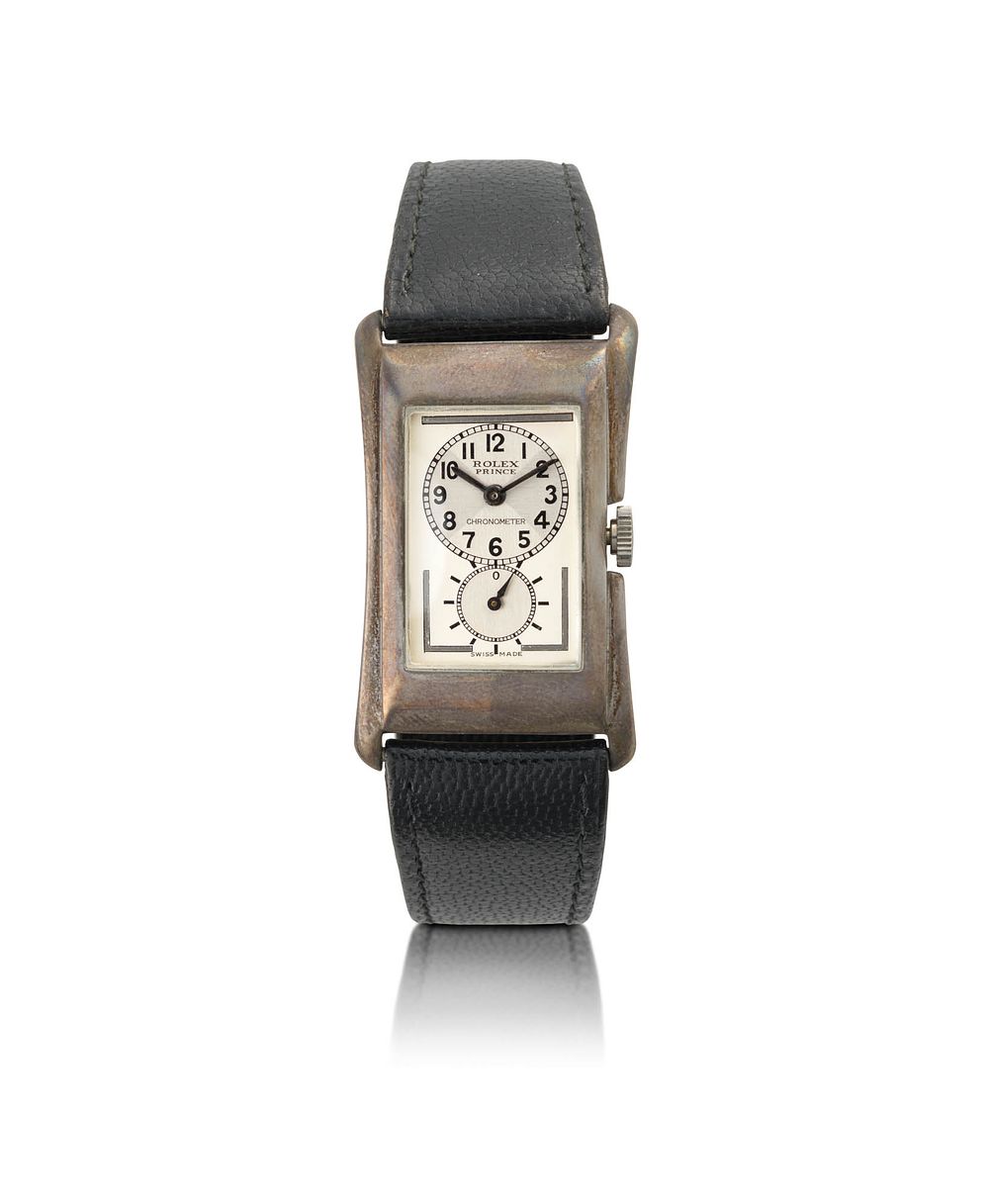
Rolex - Rolex No. 02899, circa 1932 A silver manual winding Art Deco wristwatch with subsidiary seconds Case: rectangular curved, snap-on case back, numbered and signed Dial: silvered, two-tone, Arabic numerals for the hour and minutes subsidiary dial, outer minute track, subsidiary seconds, signed Movement: manual winding, chronometer certified, signed Buckle/Clasp: steel buckle signed with the Rolex logo Dimensions: 22 × 42 mm Weight: 37,6 g Accessories: original Rolex presentation box, Beyer certificate signed by René Beyer, official bulletin for the rating of watches movement at the Contrôle Officiel de la Marche des Montres, Bienne, Suisse dated 12.11.1930. The Rolex Prince represents one of the most distinctive and historically significant chapters in Rolex’s early heritage, embodying the Art Deco movement’s geometric elegance and technical precision. Introduced in 1928, the Prince was revolutionary for its time with its distinctive rectangular case and unique dual-dial configuration. The watch featured two separate subdials – one for hours and minutes, another for running seconds – creating a striking asymmetrical composition that perfectly captured the Art Deco aesthetic of the era. What makes the Prince particularly remarkable is its technical achievement. These timepieces were equipped with chronometer-certified movements, a significant accomplishment for wristwatch movements in the 1920s and 1930s. The chronometer certification represented exceptional precision and reliability, establishing Rolex’s reputation for technical excellence that continues today. The Prince’s design philosophy reflected the era’s fascination with geometric forms and functional beauty. The elongated rectangular case, often crafted in precious metals, created an elegant silhouette that was both modern and sophisticated. The dual-dial layout wasn’t merely aesthetic – it enhanced legibility and represented a thoughtful approach to horological design. This model demonstrates how certain timepieces become cultural artifacts, capturing the spirit of their era while advancing horological technique. The Prince influenced rectangular watch design for decades and remains highly sought after by collectors who appreciate both its historical significance and its distinctive aesthetic.