Bidspirit auction | Astrological sign of Aquarius. Padua
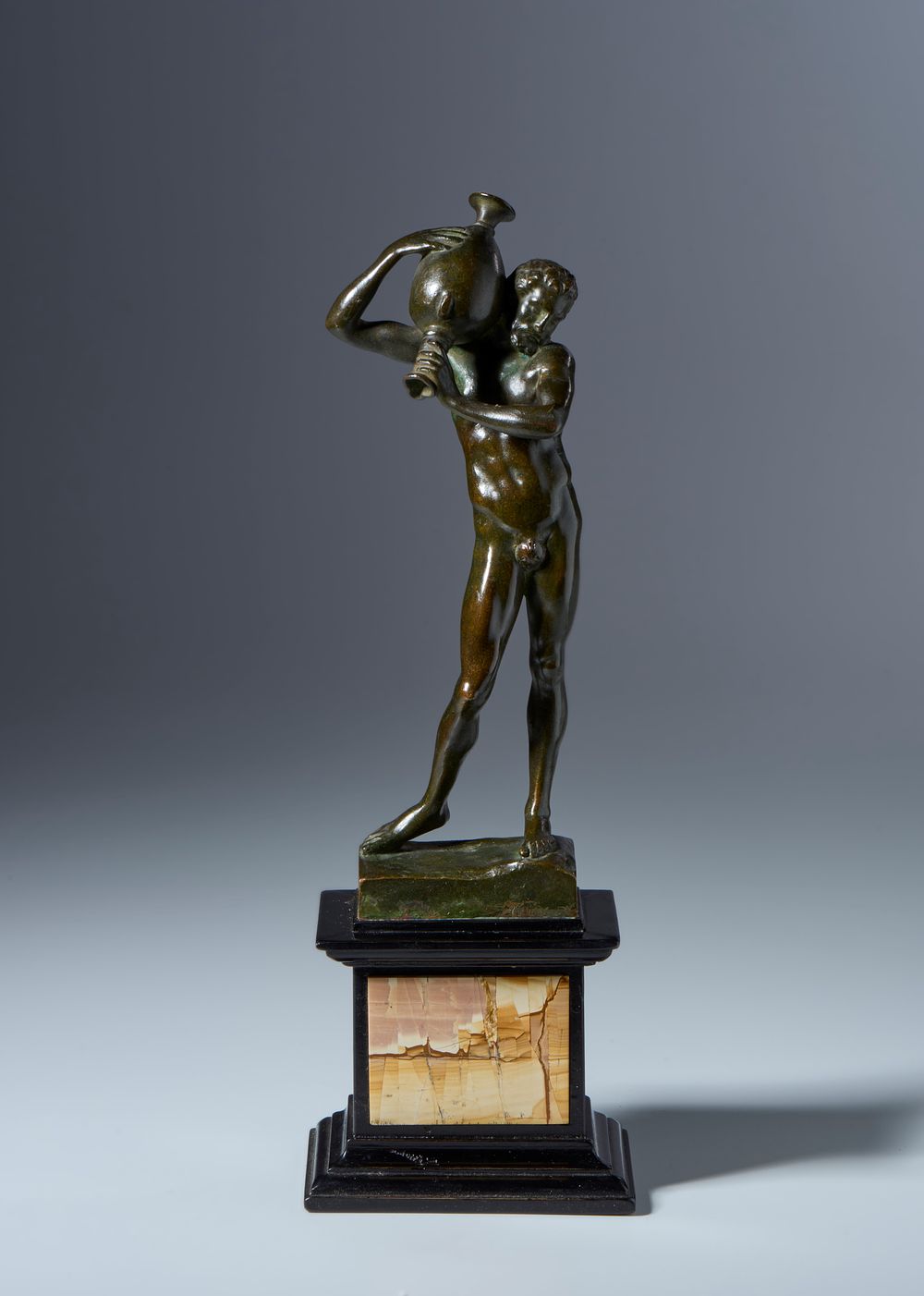
Astrological sign of Aquarius. Padua or Venice, 16th-17th century. Traces of dark artificial patina, large areas of transparent natural patina. - 28 x 12 x 6.5 cm The model of the bronze statuette under examination is based on a similar one held at the Bode Museum in Berlin. Its dimensions are 27.7 cm (including a low cast bronze pedestal), while ours are approximately 26 cm (the figure alone) and 28.5 cm (with the parallelepiped pedestal, also cast). This mysterious subject depicts a standing bearded man: balanced on his left leg, he brings his right leg slightly back, giving a subtle sense of movement to the composition. On his right shoulder he holds a jar with both hands, its mouth curiously turned downwards. If we compare the two bronzes stylistically, we note a greater materiality in the Berlin bronze, with little cold finishing of the details, characterized by a hammered finish present across the entire surface. This method of working gives the metal a vibrant vibrancy and is typical of many works of the early Renaissance. It is particularly typical of the bronzes attributed to Andrea Briosco, known as Riccio (Trento 1470-Padua 1532), the absolute genius of Paduan Renaissance bronze, to whom many works were initially attributed, later passed to other foundries, particularly that of Severo da Ravenna (Ravenna 1465-Ravenna 1543). The Berlin bronze was also initially attributed to Riccio, but later changed to other attributions that were never definitively confirmed. Our ”Amphora Bearer” has slightly more worked and therefore more reflective surfaces, while maintaining the same materiality of the metal and little cold finishing of the details, such as the workmanship of the hair and face. Another rather evident difference is represented by the flat base in the German model and the parallelepiped one in ours. Comparing the details of the two bearded men, we find a series of small differences, such as in the composition of the locks of hair or the definition of the genitals. These findings highlight the fact that the two bronzes do not come from the same mold, but are, to some extent, original works. While it is clear that the Berlin bronze is the original, we can assume that ours came from the same foundry that replicated its invention or from another workshop that drew inspiration from it, perhaps some time later, possibly even in the following century. It remains a commonly accepted practice, and found in museum catalogs, that the production of Renaissance subjects continued into the 17th century and was therefore inherent to the foundries' practices, which often repeated the models for generations. That said, for intellectual honesty and a thorough understanding of these artifacts, anyone who has handled many of these objects and seen just as many in museum displays can hardly guarantee that the casting dates back to the 16th or 17th century. It remains certain that these are extremely rare objects with an extraordinary evocative power that must maintain certain standards of workmanship and patina to be considered ancient and not from other centuries. The last detail to highlight between our two castings is the preservation of the patina, which is very similar in both. That is, both retain traces of an original dark artificial patination replaced by a natural transparent one in the areas of worn bronze. In the Berlin bronze, it appears more reddish, while in ours, it appears more golden. In the bronze base we notice a hole that was once used to fix the sculpture to the marble with a pin. The bronze is currently placed on a beautiful ”monumental” marble base of recent production, perhaps from the early 1900s. Early 20th-century art critics attributed a number of small bronzes to the great masters of Renaissance bronze, which were then prudently passed on to the school or other foundries inspired by them. The vast majority of the works attributed by Bode or Planischig to Riccio were revealed to be workshop castings, primarily by Severo, another extraordinary figure active in Padua during the same period. This consideration must always be kept in mind in order to discard any attribution taken for granted to great authors, unless it is supported by studies by historians of established fame or by certain historical documentation. The production of bronze statuettes during the Renaissance was fueled by the ever-increasing demand of humanists, who saw in this art form the rebirth of classical antiquity. These same intellectual princes loved to surround themselves with these statuettes, which filled the shelves of their studies. Foundries meet these demands by reproducing the designs invented by the most successful masters, often copying them with variations or serially, even for generations. However, this is an elite and limited production inherent to the foundry's working practices, where the master craftsman invented and other professionals created the finished product.