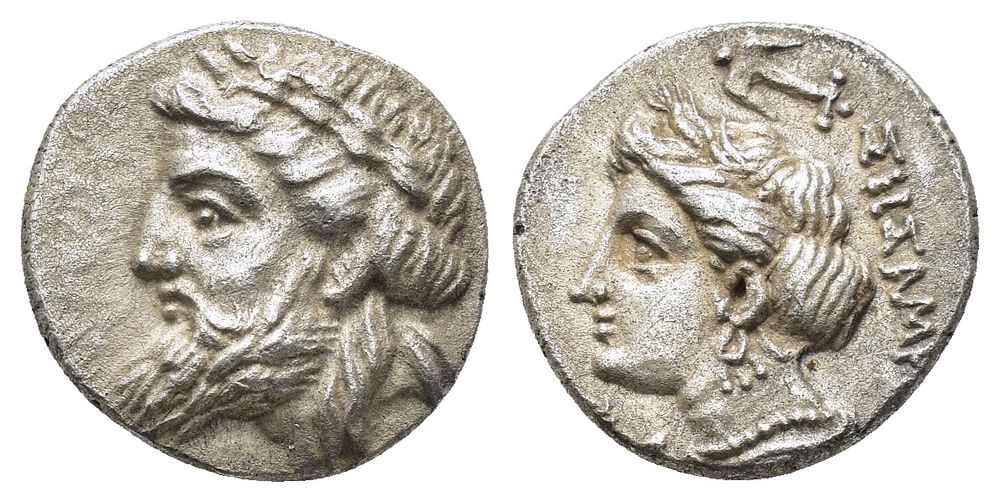
Bidspirit auction | PAPHLAGONIA.Sesamus.(circa. 330-300 BC).Drachm. Obv :
PAPHLAGONIA.Sesamus.(circa. 330-300 BC).Drachm. Obv : Laureate head of Zeus facing to left. Rev : ΣΗΣΑΜΙΩΝ. Draped bust of Demeter facing to left, wearing wheat ears in hair, earring, and necklace. Above, anchor. All within circular incuse. Sear 3683. Condition : Good very fine. Material : Silver. Axis : 11h. Weight : 3.42 gr Diameter : 15 mm Sesamus (Greek: Σήσαμος), an ancient city located in the historical region of Paphlagonia on the northern coast of Asia Minor (modern-day Turkey), was a notable center of commerce and culture in antiquity. Overlooking the Euxine Sea (Black Sea), Sesamus occupied a strategic position on the rugged coastline of Paphlagonia and played a meaningful role in regional trade and maritime activity. The site is often identified with the later city of Amastris, which eventually absorbed its territory and identity under the Hellenistic period. Paphlagonia, bordered by Bithynia to the west, Galatia to the south, and Pontus to the east, was a mountainous and forested region rich in natural resources, especially timber and minerals. Sesamus itself was located near a natural harbor, facilitating trade with other cities along the Black Sea and with inland settlements. Homer makes mention of Sesamus in the Iliad as the city of the Eneti, allies of the Trojans (Iliad, 2.852), which suggests that the settlement already had legendary status even in early Greek literature. This makes it one of the earliest named cities in Paphlagonia. During the Hellenistic period, Sesamus, along with neighboring cities like Cytorus and Cromna, was unified under the rule of Amastris, a Persian princess of royal lineage and widow of Dionysius of Heraclea. She founded the city of Amastris (modern Amasra) in the late 4th century BC by synoecizing these towns. Sesamus, which had been a well-established settlement, became one of the constituent communities of the new polis. Strabo, the geographer of the 1st century BC–AD, records that Amastris was beautifully situated on a peninsula with two harbors and notes that Sesamus formed its acropolis—suggesting that the site of Sesamus occupied the upper and more defensible part of Amastris. While specific architectural remains from Sesamus itself are limited due to its later incorporation into Amastris, its cultural legacy lived on through literary and historical references. Its mention in Homer, its strategic role in the regional economy, and its later absorption into a major Hellenistic city all point to its local importance. Coins from Amastris occasionally reflect earlier Paphlagonian imagery and may indirectly preserve the cultural identity of places like Sesamus. The city was likely a blend of Greek, Persian, and local Anatolian elements—typical of urban centers in northern Asia Minor during the Classical and Hellenistic eras. Though largely overshadowed by the more prominent city of Amastris, Sesamus was a foundational urban center in Paphlagonia with roots stretching back into myth and early Greek epic. Its coastal location, historical mentions, and eventual role as the acropolis of Amastris attest to its early importance. Today, traces of its legacy can still be glimpsed in the landscape of Amasra, where the ancient past merges with the present beauty of the Black Sea coast.