Bidspirit auction | IONIA.Ephesos. (Circa 390-325 BC).Tetradrachm. Obv
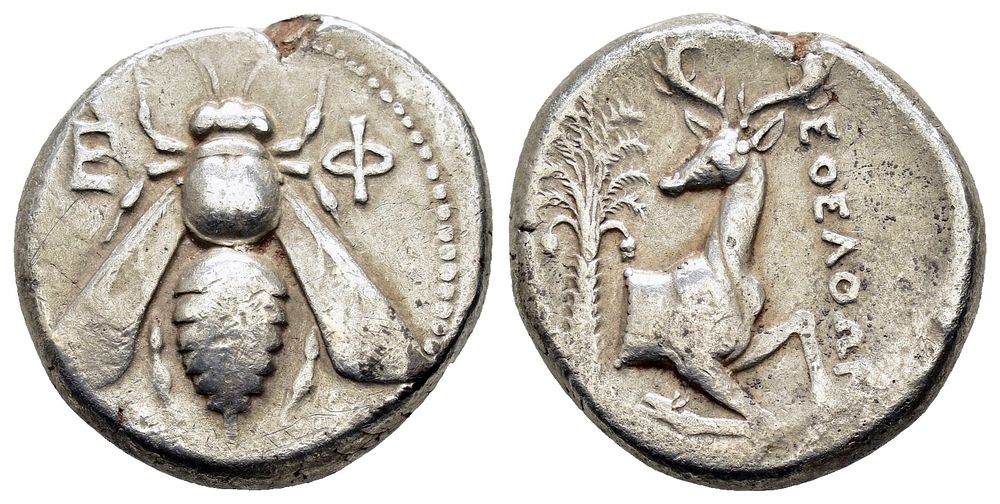
IONIA.Ephesos. (Circa 390-325 BC).Tetradrachm. Obv : Bee with straight wings. Rev : EOEΛΘΩN. Forepart of stag right, head left; palm tree to left. Pixodarus Class F, obv. die 92; SNG Aulock 1829. Condition : Good very fine. Material : Silver. Axis : 12h. Weight : 15.20 gr. Diameter : 24 mm. This striking silver tetradrachm from Ephesos in Ionia, struck circa 390–325 BC, exemplifies the rich visual symbolism and civic pride of one of the most influential cities in the Greek world. The coin combines two of Ephesos’ most important religious and cultural symbols—the bee and the stag—closely associated with the goddess Artemis, whose great temple stood at the city’s heart. The obverse displays a large, finely rendered bee with straight wings, flanked by Greek letters (likely abbreviations of magistrate names or civic identifiers). The bee was not a random choice: it was a sacred creature in Ephesos, intimately linked to the cult of Artemis Ephesia. The priestesses of Artemis were known as melissae (”bees”), and the bee served as both a literal and symbolic representation of purity, industriousness, and divine order. Stylistically, this rendering of the bee—with detailed segmentation, large wings, and a symmetrical form—follows the Pixodarus Class F tradition (as catalogued in ”Pixodarus: Class F, obv. die 92”). The reverse portrays the forepart of a stag, kneeling right with its head turned left, next to a palm tree, a motif that often appears in Ephesian coinage. The stag is another sacred animal of Artemis, signifying the goddess's dominion over wild nature and her role as a huntress. The dynamic pose of the animal, captured mid-turn, enhances the coin’s sense of motion and alertness. The palm tree beside it alludes to the original founding myth of Ephesos, in which the city was said to be established where a sacred palm tree grew. Together, these elements reinforce Ephesos’ religious identity and the centrality of the cult of Artemis to the city’s civic life. The legend ΕΟΕΛΘΩΝ likely refers to the name of a magistrate or mint official responsible for the coin’s issue. Magistrate names varied across Ephesian coinage and help us assign specific issues within broader chronological ranges. This coin was struck during a period of significant political transition. In the wake of the Peloponnesian War, Ionia came under the influence of the Persian satraps, including Pixodarus, under whose authority this issue has been categorized. Despite foreign oversight, Ephesos retained a degree of cultural autonomy, as shown in its consistent and rich numismatic iconography. The city's famous Temple of Artemis, one of the Seven Wonders of the Ancient World, was a magnet for pilgrims and a source of immense civic pride—reflected in the religious motifs on this coin. Coins of this type were not just local currency—they also circulated widely in trade and helped spread Ephesian iconography throughout the eastern Mediterranean.