Bidspirit auction | Manuscript - Eitz Chaim by
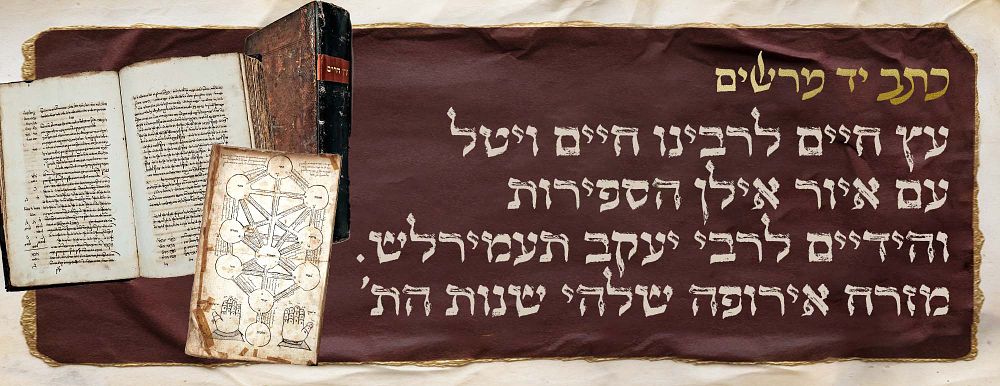
Manuscript - Eitz Chaim by Harav Chaim Vital with a maamar by the Ari and diagrams of the ilan hasefiros and the hands by Harav Yaakov Temerelish. Glosses. Eastern Europe, early 1700s. Thick, impressive volume in a leather-covered wooden binding. Impressive manuscript, Eitz Chaim Toras HaAri by Harav Chaim Vital, redacted by Harav Meir Poppers based on the Mahadura Kama and Mahadura Basra manuscripts. With ” Maamar MeHakadosh Harav Reb Yitzchak Luria Ashkenazi and a diagram of the ilan hasefiros and the hands by Harav Yaakov Temerelish. The Kabbalistic diagrams are on one page. A different version of the maamar was printed for the first time under the title ” Maamar Kadishin meHarav Hakadosh HaAri z”l, kolel kol shorshei Sefer Yetzirah , ” at the end of Sefer Yitzirah with a commentary by the Vilna Gaon (Warsaw 1884), from a manuscript owned by the Gr”a. Harav Yaakov Temerelish's commentary was printed there as well, but without the diagrams. Harav Yaakov Temerlish was a genius in both the hidden and revealed Torah and the teacher of a number of giants of his generation. He fasted frequently and composed a commentary on Torah entitled Safra Ditzniusa d'Yaakov . He passed away in 1666. Glosses by several different writers. Our experts' findings show that some were never printed. Eastern Europe, early 1700s. 302 pgs, 50 of which are blank. Total 252 written pages. 34 cm. Condition: Thick, impressive volume in a leather-covered wooden binding with the remnants of buckles. The binding is slightly worn and the spine was replaced. Thick, quality paper. Wide margins. On some pages, the ink has spread and on a small number of pages the acid in the ink has corroded a small part of the paper. Tapings on a number of the first pages, mostly in the margins. A few worming holes. A few tears, mainly in the margins of a number of pages. Two pages in the center of the book are cut so that only the margins and very little of the text remain. Stains, mostly light. Condition: Very Good. Specifications: The manuscript was written by an expert scribe, with handsome Ashkenazi penmanship. Part of the manuscript has more ornamental writing. It is possible that the same scribe used a more ornamental script on some pages (a phenomenon observed in other manuscripts) or these pages might have been written by a different scribe. There are a number of glosses in the margins - some later. At the beginning of the volume are two pages with writing that appears earlier. On the first page is what appears to be a signature, possibly ” Hak' .... Hakohen .” On the top of Pg 1: ” Neu' Moshe behaRabbani Mahor”r Dovid Katz z”l .” On the first pg: In the margins of the page - the order of the months and their inyanim (according to Sefer Hayetzirah) Pg 2 has the ilan hasefiros . At the top of the page the scribe wrote: ”I have drawn this... it is simple to understand the maamar from the Ari z”l [in other words, the maamar from the previous page] and may Hashem illuminate our eyes in His Torah to understand it properly, so says he who is called Shmuel” The aforementioned scribe took the three commentaries elucidated in the maamar of the Ari and combined them within the tree. ספר אמ”ש- in the width of the tree; ספר בג”ד כפר”ת - along the length of the tree; the twelve elemental letters - 12 diagonal shapes. There are three types of glosses: 1) Glosses written by the scribe who penned the manuscript. For the most part, he corrects himself in only one place. He appears to be commenting to himself; see Note A below. 2) From a later period. These constitute the majority of glosses. Most are textual corrections. See below. 3) Recent comments, apparently by someone who reviewed the manuscript closely and made notations. Possibly Harav Yechiel Fishel ben Reb A.M. HaKohen, whose name is signed a number of times in the book, and possibly someone else. If one reviews the essay meticulously, comparing it line by line to the print version, it is possible that he will find changes. A. Gloss 1 in the book appears to have been written by the scribe himself. So far, I have not found this comment in print: ubefrat ki Rabbi Akiva samach al mah she'avru al Ben Azai uBen Zoma B. At the very beginning of the third page is a note by the author. See glosses and elucidations in the printed version, os gimmel , for his answer to this. However, this edition cites the question only without identifying the writer. These are his words: ” Tuva kashye li b'bilti bal tachlis ach yesh nekudah emtza'is d'kol makom sheyesh emtza yesh sof verosh k'mevuar etzleinu b'mekomosr abim bchol baalei hachochmah vetzarich le'ayen od. ” C. An original diagram of the matter of yeridas hakav el toch hachalal. D . Ibid a uthor's note printed in sefer Kinus Chachamim by Harav Eliyahu Meni of Chevron and he elucidates his words. E.