Bidspirit auction | WW2 Four BOB pilots ace
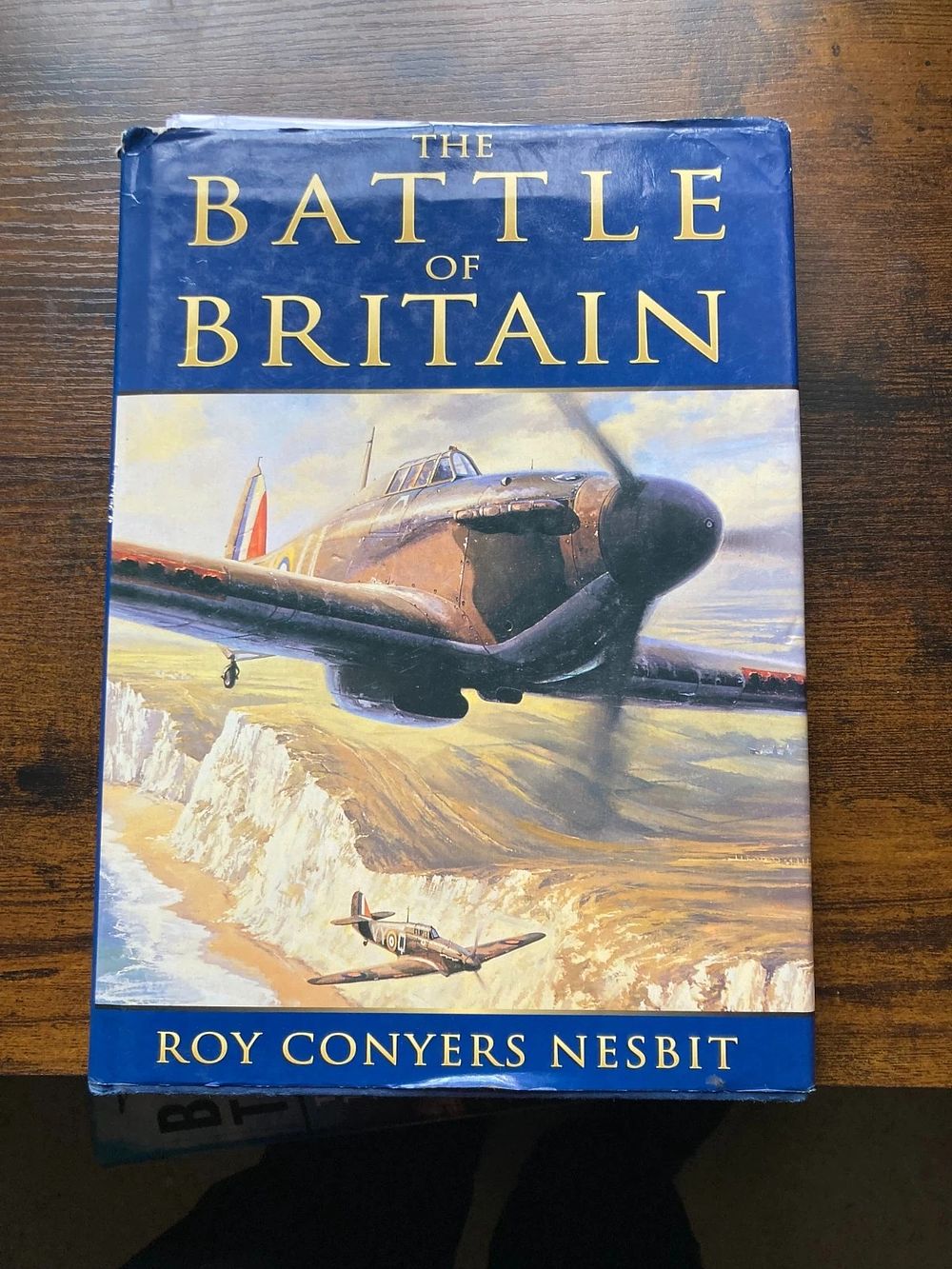
WW2 Four BOB pilots ace signed book Battle of Britain by Roy Conyers Nesbit. 5 limited edition loose bookplates signed by Flt Lt W Clarke DFM, Air Cdre John Ellacombe DFC, Wg Cdr J Tim Elkington, Flt Lt Richard Jones, Flt Lt W Bill Green. William Terence Montague Clark, DFM, AE (11 April 1919 – 7 May 2020) was a British nightfighter navigator/radar operator in the Royal Air Force (RAF) from 1938 to 1945. He, along with John Hemingway, was one of the last two verified surviving aircrew of the Battle of Britain. Clark enlisted in the Auxiliary Air Force in 1938 joining No. 615 Squadron at Kenley in March 1938 as an aircrafthand, then trained to be an aircraft gunner in Hawker Hectors on Army cooperation duties. He joined No. 219 Squadron, then flying Bristol Blenheims, at Catterick on 12 July 1940, later training on radar as a radio observer, flying in Bristol Beaufighters.On the night of 16/17 April 1941 Clark flew with the commanding officer of 219 Squadron, Wing Commander T.G. Pike, when Pike's own navigator was taken ill. They intercepted and destroyed a Junkers Ju 88 and a Heinkel He 111 in the Guildford area. During the night of 27/28 April 1941, flying with Flying Officer D.O. Hobbis, his regular pilot, Clark assisted in the destruction of an unidentified enemy aircraft, on each of 1/2 June and 13/14 June 1941 they shot down a Heinkel He 111. Clark was awarded the Distinguished Flying Medal, which was gazetted on 8 July 1941. Commissioned as a Pilot Officer in May 1942, Clark had reached the rank of Flight Lieutenant by the end of the war. Post war Clark joined the reconstituted Royal Air Force Volunteer Reserve (RAFVR) in 1949 serving in the Fighter and Aircraft Control Branches before resigning his commission in 1954. Clark died on 7 May 2020 at the age of 101, leaving John Hemingway as the last surviving member of The Few. John Ellacombe joined the RAF in 1939 and was posted to 151 Squadron in July 1940, immediately converting to Hurricanes. On 24th August he shot down a He111, but a week later his Hurricane was blown up in combat and he bailed out, with burns. Rejoining his squadron a few months later, in February 1941 was posted to 253 Squadron where he took part in the Dieppe operations. On 28th July, flying a Turbinlite Havoc, he probably destroyed a Do217. Converting to Mosquitos, John was posted to 487 Squadron RNZAF, and during the build up to the Normandy Invasion and after, was involved in many ground attacks on enemy held airfields, railways, and other targets of opportunity. He completed a total of 37 sorties on Mosquitos. Flying a de Havilland Mosquito XIII with a devastating set of four 20mm cannon in the nose, John Ellacombe flew deep into occupied France on the night before D-Day searching out and destroying German convoys and railway targets. As the Normandy campaign raged on, 151 Squadron intensified its interdiction sorties - including night attacks on Falaise and the Seine bridges. On August 1st Ellacombe took part in the famous attack by 23 Mosquitoes on the German barracks in Poitiers, led by Group Captain Wykeham Barnes. Ellacombe had first joined 151 Squadron during the Battle of Britain, direct from Flying Training School. Within weeks he had scored his first victory but also force landed in a field, having shot down a He 111, and bailed out of a blazing Hurricane. He bailed out a second time during the Dieppe Raid in 1942 but was picked up safely. Postwar he had a long and successful career in the RAE. Wing Commander John Francis Durham ”Tim” Elkington (23 December 1920 – 1 February 2019) was a British Royal Air Force (RAF) fighter pilot who flew during the Battle of Britain and was one of the last surviving aircrews known as ”The Few”. Elkington joined the Royal Air Force in September 1939 as a Flight Cadet at the Royal Air Force College Cranwell. Between October 1939 and April 1940, he trained at No. 9 Elementary Flying Training School at RAF Ansty. Elkington then undertook further training with No. 17 Service Flight Training School at RAF Cranwell. He was commissioned on 14 July 1940[3] and joined No. 1 Squadron RAF at RAF Northolt a day later and flew Hawker Hurricanes during the Battle of Britain. His first confirmed ”kill” came on 15 August 1940, downing a Messerschmitt Bf 109. A day later he was shot down and wounded on 16 August 1940 (research shows that he was shot down by Helmut Wick). After recuperating at the Royal West Sussex Hospital at Chichester he rejoined No. 1 Squadron on 1 October 1940 at RAF Wittering. After a spell with No. 55 Operational Training Unit as an instructor, in late May 1941 he joined No. 601 Squadron RAF at RAF Manston. He was promoted to Flying Officer on 14 July 1941. From there he joined No. 134 Squadron RAF at RAF Leconfield in July 1941. On 12 August 1941 the squadron embarked on HMS Argus and took off from the carrier on 7 September for an airfield near Murmansk.