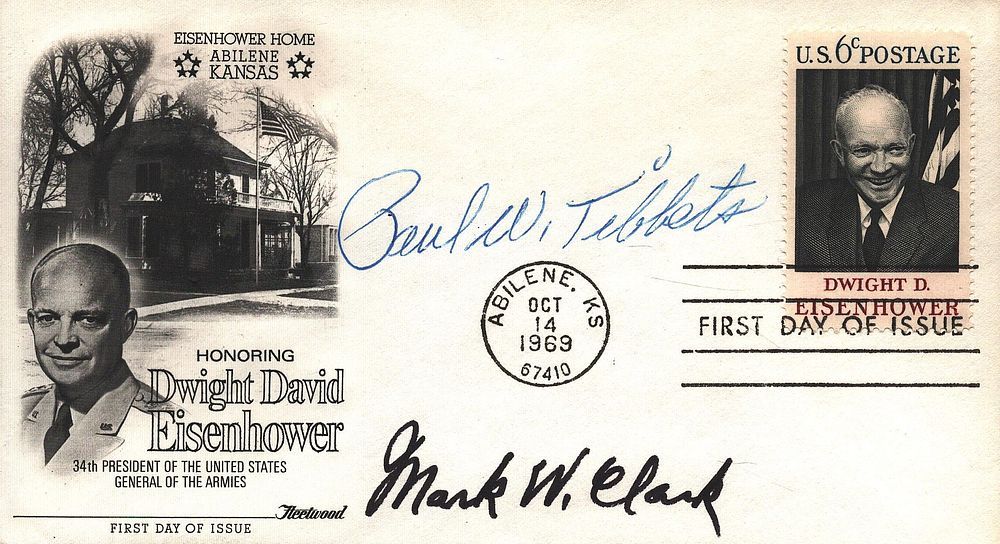
Bidspirit auction | Brigadier General Paul Tibbets and
Brigadier General Paul Tibbets and General Mark Clark signed Honouring Dwight David Eisenhower First Day of Issue cover PM ABILENE. KS Oct 14, 1969, 67410. Paul Warfield Tibbets Jr. (23 February 1915 - 1 November 2007) was a brigadier general in the United States Air Force. He is best known as the aircraft captain who flew the B-29 Superfortress known as the Enola Gay (named after his mother) when it dropped a Little Boy, the first of two atomic bombs used in warfare, on the Japanese city of Hiroshima. Mark Wayne Clark (1 May 1896 - 17 April 1984) was a United States Army officer who fought in World War I, World War II, and the Korean War. He was the youngest four-star general in the U. S. Army during World War II. Mark Wayne Clark (1 May 1896 - 17 April 1984) was a United States Army officer who fought in World War I, World War II, and the Korean War. He was the youngest four-star general in the U. S. Army during World War II. During World War I, he was a company commander and served in France in 1918, as a 22-year-old captain, where he was seriously wounded by shrapnel. After the war, the future US Army Chief of Staff, General George C. Marshall, noticed Clark's abilities. During World War II, he commanded the United States Fifth Army, and later the 15th Army Group, in the Italian campaign. He is known for leading the Fifth Army when it captured Rome in June 1944, around the same time as the Normandy landings. He was also the head of planning for Operation Torch, the largest seaborne invasion at the time. On 10 March 1945, at the age of 48, Clark became one of the youngest American officers promoted to the rank of four-star general. Dwight D. Eisenhower, a close friend, considered Clark to be a brilliant staff officer and trainer of men. Throughout his thirty-six years of military service, Clark was awarded many medals, the Distinguished Service Cross (DSC), the US Army's second-highest decoration, being the most notable.