Bidspirit auction | Battle of the Ruhr Signed
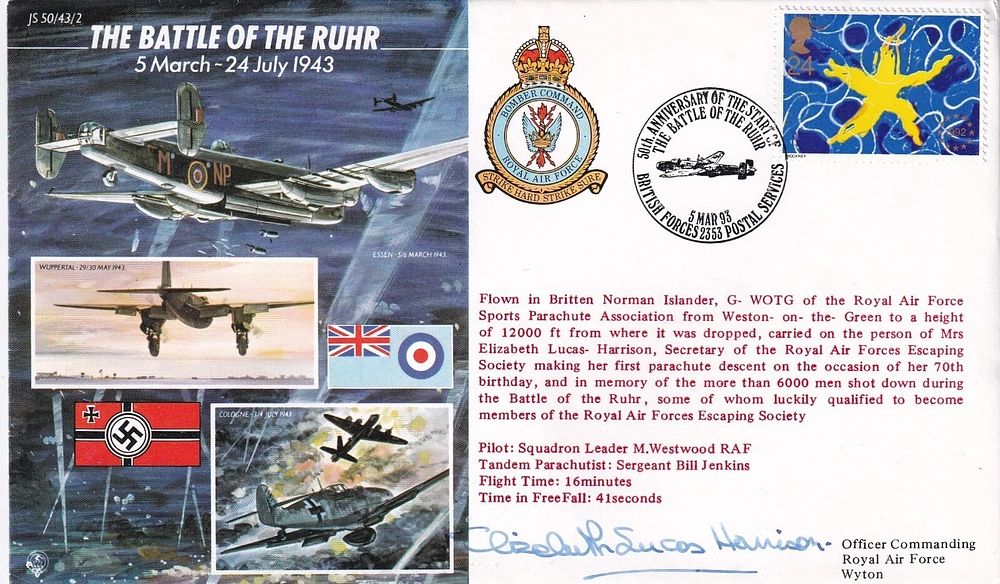
Battle of the Ruhr Signed Elizabeth Harrison WW11 1942 Resistance, a courier. 5 Mar 93 BFPS 2353 The Battle of the Ruhr, Red Flown Cachet Flown in Britten Norman Islander Carried and Parachute by Mrs Elizabeth Lucas Harrison Secretary of the RAF Escaping Society making her 1st Parachute descent on the occasion of her 70th Birthday, and in memory of the more than 6000 men shot down during the Battle of the Ruhr, some of whom luckily qualified to become members of the RAF Escaping Society. Personally Signed by Elizabeth Lucas Harrison Elizabeth Harrison, who has died aged 93, escaped from Germany as Hitler rose to power, fled Belgium and worked for the French Resistance before becoming the long-serving secretary of the RAF Escaping Society and devoting her later life to the ”helpers” who had come to the aid of Allied airmen shot down over occupied Europe. The daughter of a Jewish banker who had served in the Imperial German Army and was wounded at Verdun in 1916, Liesel Ethel Marie Lucas - always known as Elizabeth - was born on March 8 1923 in Dusseldorf. She was educated at the city's Goethe Lyzeum where, in 1933, every class began with teachers and pupils making the Nazi salute. Her father immediately started to make plans to leave Germany. At the end of October 1933 the family moved to Brussels, where Elizabeth continued her education at the Lycée de Saint Gilles, where she became a keen girl guide, an activity that would stand her in great stead in the coming years. In 1938 she travelled to Teddington on a school exchange programme and ”immediately fell in love with England”. On the outbreak of war on September 3 1939, Elizabeth left school and started a one-year secretarial course. On May 10 1940 the Germans invaded the Netherlands and Belgium; the Lucas family were arrested as Jewish immigrants. Elizabeth, her brother and their mother were later released but her father was held in an internment camp in the south of France for three months. With her mother and brother, Elizabeth headed for the French frontier but they were turned back because their temporary identity cards bore their German nationality. They ended up at the Belgian coastal town of La Planne where they came across groups of the retreating British Army. Shortly afterwards, the house they were sheltering in was shelled by the Germans and on May 31 they were ”liberated” from the British by the Nazis. They were forced to return to Brussels and there she immediately offered her services to the Red Cross, starting work in the office that listed the missing and the dead. She remained in Brussels until July 1942, by which time Jews were required to wear the Star of David on their clothing. Her father decided to move the family, and they left for Paris, intending to travel south to cross the Line of Demarcation between Occupied France and the Vichy-held territory to the south. Then, after three failed attempts to leave Paris, they were smuggled on to a goods train from which they escaped at Givors in Vichy France. They were able to obtain papers indicating that they were Belgians. Soon Elizabeth Lucas became involved with the Resistance, serving as a courier carrying messages to Lyon, an occupation that she did not divulge to her parents. She also assisted in distributing air-dropped supplies. After the liberation of southern France in August 1944 she appeared proudly wearing her FFI (Forces Françaises de l'Intérieur) armband when, to her amazement, she discovered that her father had also been helping the Resistance. Elizabeth Lucas immediately began work in a hospital caring for troops, including Germans and French civilians injured in air raids and bombardments. In October she returned to Brussels, where she started working for the American Red Cross in the Civilian War Relief department, which had close links with the British Red Cross. Working for the latter, she had the harrowing experience of helping released inmates of the concentration camps as they returned to Belgium and the Netherlands. With the work of the American Red Cross coming to an end in early 1946, Elizabeth Lucas worked in Brussels for the World's Alliance of YMCAs - War Prisoners' Aid. Some of the aid provided was for 64, 000 German prisoners of war held in camps in the Low Countries. Speaking fluent German, French and English, her service as a translator was invaluable. By the summer of 1947, with the trials of the major war criminals at an end, other senior German military officers were to be tried. Before they were transported away from their special camp in Belgium, an inspection of their accommodation and facilities had to be carried out. Elizabeth Lucas was given the job of joining the inspection party as the German-speaking secretary. She was the first woman the prisoners had seen for almost two years. At one stage, two high-ranking German officers were standing guard outside a lavatory while a 24-year old German Jewish woman answered a call of nature.