Bidspirit auction | WW2 Battle of Britain fighter
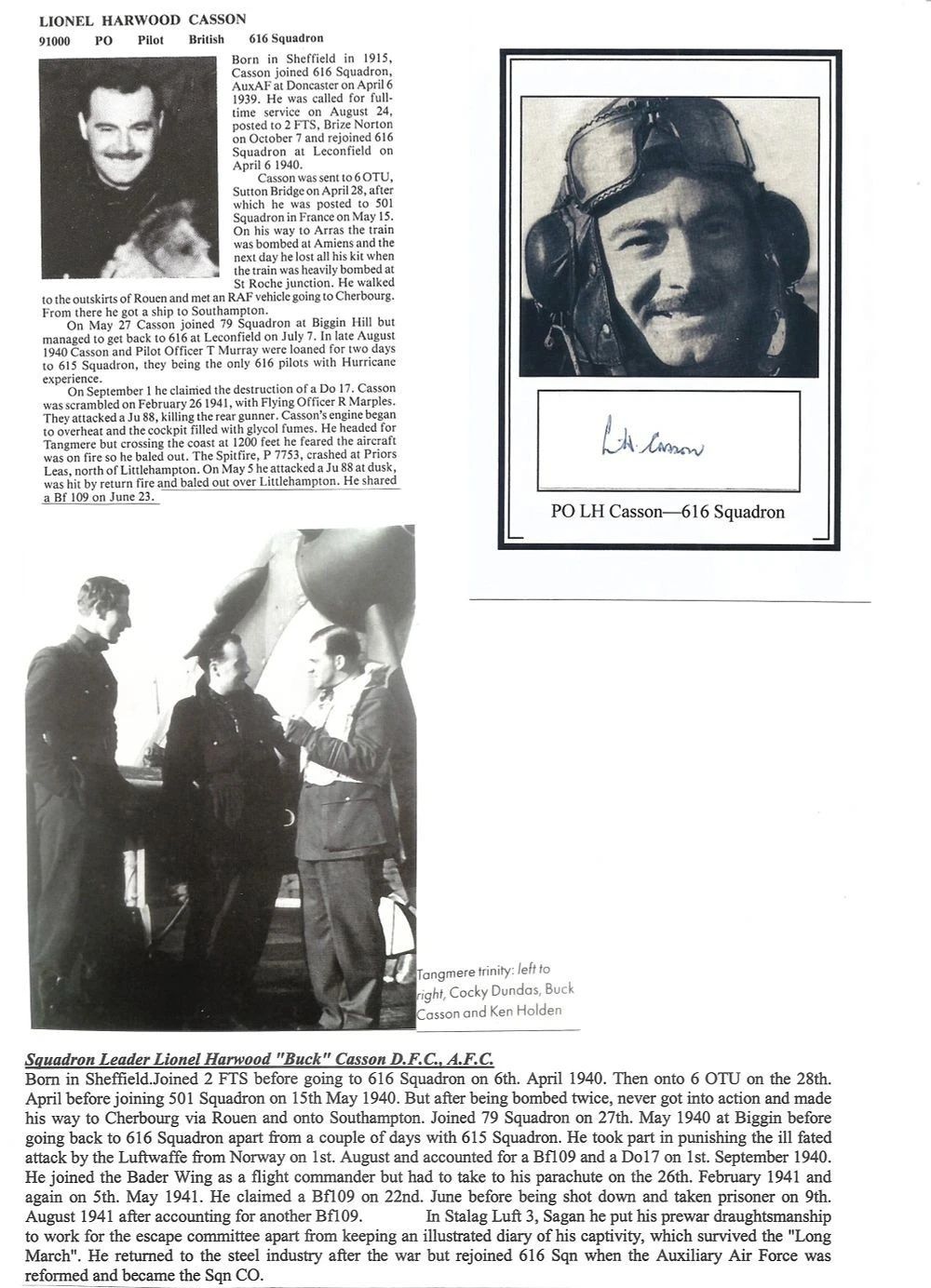
WW2 Battle of Britain fighter pilot Lionel Casson 616 sqn signature piece signature piece with biography details fixed to A4 page. Lionel Harwood Buck Casson. Name : Lionel Harwood Buck Casson. Died : 8th October 2003. Service Number : 91000. Awards : Distinguished Flying Cross. Air Force Cross. Pilot Officer Lionel H. 'Buck' Casson D. F. C. / A. F. C. of No 616 Squadron was in combat with a Do 215 over Kenley on the 1st of September 1940 at 14:20hrs. His Spitfire I (R6778) was a write off due do the damage but he escaped injury. Casson was one of the original three trainee pilots to join the newly formed 616 (South Yorkshire) Auxiliary Air Force Squadron at Doncaster in early 1939. Training at weekends and during the annual summer camps. he qualified as a pilot in early 1940 before being sent to France as a reinforcement to 501 Squadron. But. before he could join them. the train on which he was travelling was bombed outside Amiens and he lost all his belongings. Casson managed to escape by boat back to England from Cherbourg. After a brief spell flying Hurricanes with 79 Squadron at Biggin Hill. he rejoined 616 at Leconfield. Yorkshire. just as the Battle of Britain gathered momentum. At lunchtime on August 15. the fighter squadrons based in north-east England were scrambled to face the Luftwaffe's most concentrated attack against industrial targets in Scotland and the north of England. Casson flew one of the 12 Spitfires which met the enemy as they crossed the Yorkshire coast. Within minutes. 616 Squadron had accounted for six of the unescorted bombers. with similar results achieved by other northern-based squadrons. A few days later. 616 flew south to Kenley where the squadron was involved in some of the fiercest fighting of the battle as part of Air Vice-Marshal Keith Park's No 11 Group. Casson and his colleagues were scrambled three or four times each day and losses mounted; in a five-day period 10 squadron pilots were killed or wounded. On August 30 Casson was credited with a probable and a damaged Heinkel 111. Two days later he claimed an Me 109 fighter. followed by the destruction of a Dornier 17 bomber. After suffering severe losses. the squadron was withdrawn to Kirton in Lindsay on September 4 with just seven of the original 21 pilots fit to fly. With barely 300 hours flying time. Casson was now a veteran; he remained with 616 to train the new crop of young pilots. and to fly patrols over coastal convoys and during the Luftwaffe's night blitz in December. A steel buyer's son. Lionel Harwood Casson. always known as ”Buck”. was born at Sheffield on January 6 1915 and educated at Birkdale School and the King's School. Ely. before embarking on a career in the steel industry. Although working in a reserved occupation. he elected to remain with the Royal Auxiliary Air Force on the outbreak of war when he completed his pilot training. Once 616 became fully operational again in early 1941. it was transferred and came under the command of the new Wing Leader. the legless pilot Douglas Bader. at Tangmere. The squadron boasted a glittering array of outstanding pilots. including ”Johnnie” Johnson and ”Cocky” Dundas. With his steadying and mature influence. allied to the experience gained during the hectic summer days of 1940. Casson became a section leader. On May 5. he shared in the destruction of a Junkers 88. but was hit by return fire. and was forced to bale out over Chichester harbour. Throughout the summer of 1941. the Wing was heavily engaged over northern France escorting bombers and flying offensive sweeps when it made regular contact with Adolph Galland's fighters. Casson destroyed a Me 109 on June 22. claimed a ”damaged” two days later and in July claimed two Me 109s as probables. The squadron suffered heavy losses. and Casson soon found himself appointed to command B Flight. On August 9. the ”Bader” Wing took off for another sweep over France. During a hectic fight in which German fighters surprised them from above. Bader was shot down. and the Wing was forced to scatter. Casson had accounted for an Me 109 when he went to the aid of a lone Spitfire. but before he could join up he was engaged by a German fighter. Cannon shells damaged his aircraft's engine. forcing him to crash near St Omer. where he was captured. Shortly after his arrival at Stalag Luft III at Sagan. it was announced that Casson had been awarded the DFC. During his years in captivity. Casson's outstanding talents as a draughtsman were put to good use by the camp's escape committee. He maintained a detailed and beautifully illustrated diary of events throughout his imprisonment. which he was able to salvage despite the horrors and privation he and his colleagues suffered on the ”Long March”. during the severe winter of 1945 when the PoWs were driven eastwards ahead of the advancing Soviet Army. On returning home. Casson rejoined the steel industry in Sheffield.